Alfredo Leonardi
Directing
Known For

In all of his work, Bussotti makes frequent reference to the body, to sexuality. This to remind musicians — especially classically trained ones — that they are not body-less angels, that they are not just their musical thoughts, that they are still, in the last analysis, flesh and bones. Thus the erotic is not for shocking, but to stress that making music involves the body in a very direct way.
RARA

No description available.
Filmstudio, mon amour
No description available.
Après la Passion selon Sade

A (temporary) leave of many friends who are my truest world, with the attempt of getting them together in an ideal summary conceived to support me during my being far away. –A. L.
Book of Saints of Eternal Rome

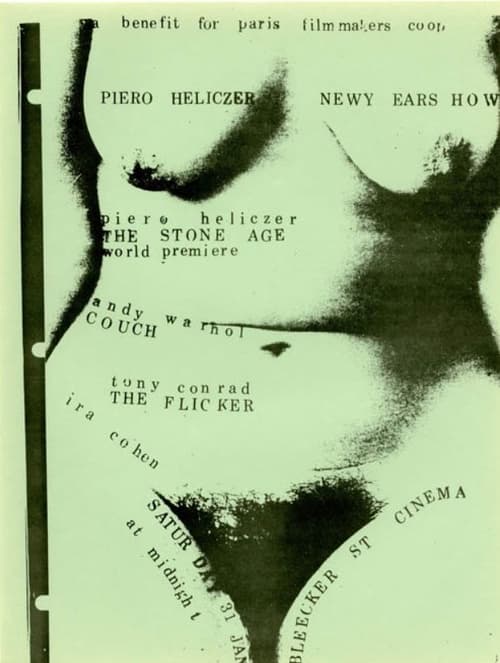
"The question is, it is either going to be a stoned age or a new Stone Age" - Louis Brigante
The Stone Age

In the distant future, a spaceship inhabited by a group of young descendants of a "subversive" minority who escaped the destruction of the Earth, recovers a capsule in which the hibernating body of a reactionary warmonger has been preserved, who after having caused war and death, it has abandoned the now unlivable Earth. The visual experimentation aimed at the liberation of the gaze is intertwined with psychedelic visions on the one hand and with the orgone theory of Reichian memory on the other.
Long Live The Orgonauts!
The title Amore amore ( Love Love) defines the primary emotive motor of the film and constitutes the filter through which are selected the materials used - people, things, signs - and determines a good portion of the associations though which the sequences unwind.
Amore, amore

Collective manifesto by the members of C.C.I. It is a collective film, the result of an operation devoid of any aesthetic purpose: to verify the existence of any harmony between a fairly large group (twelve people) of members of the independent Cooperative. Someone, who had the idea, turned 60 meters of Ektachrome according to the moods –or discontent – of the moment and gave them to others to see. The others reacted, each with their own piece. It was then thought to call the film “circular letter”. It was not so simple and so quick: the operation, which started in June of ’68, ended in March of ’69.
Tutto, tutto nello stesso istante
Experimental and anarchist young generation before May of 68'.
Sigma 1967

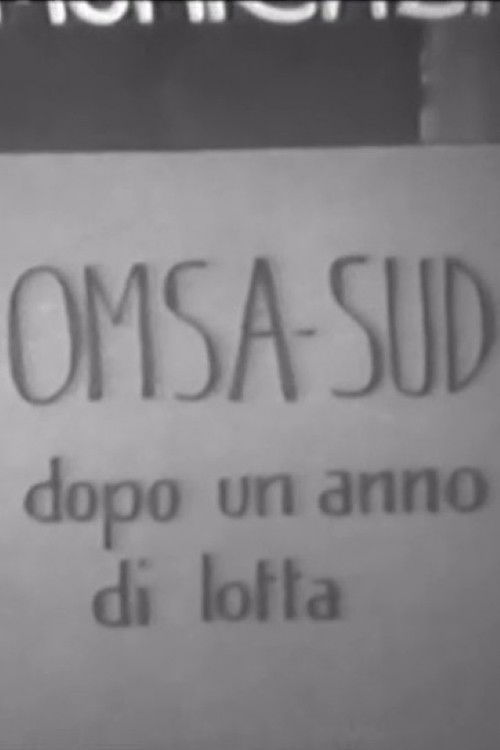
Omsa Sud workers’ struggle to keep the factory occupied. The documentary was partially realized within a project financed by the city of Fermo, which initially included the idea of teaching video shooting techniques as part of a laboratory. Omsa Sud was shot only in one week, an unusual occurence for the Videobase group, and features as part of their methodology the "video within the video" approach.
Omsa Sud. Dopo un anno di lotta
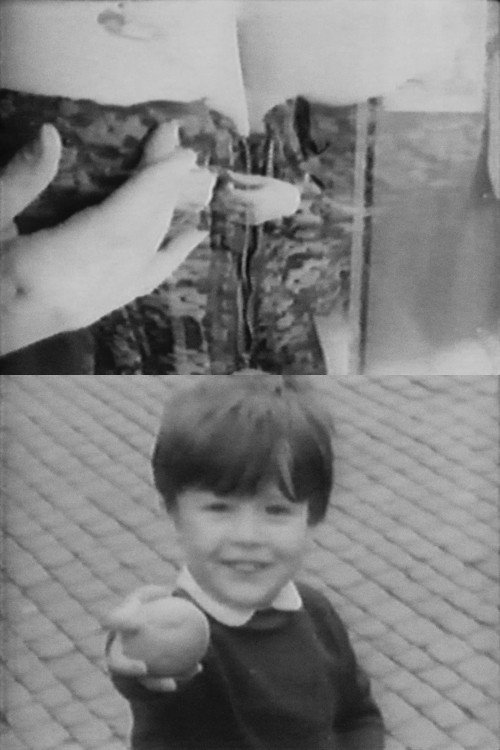
In this film, as in all my previous ones, there is a direct connection between inner urges and cinematic rendering. I tried to visualize my present aspiration to recover, through the various ways taught by one’s experience, the easiness, directness and ripeness proper to children’s relationships and affective life. This film is maybe a track of this path backwards. – A. L.
If the Unconscious Revolts
On the occasion of the regional elections of 1970, the Italian Communist Party seizes a new model of propaganda and counter-information developed in France during May 68: the cine-tract.
Cine-Volantini

Leonardi's film about the Living Theatre is less concerned with a straight documentary presentation of the exile theatre group from New York, but rather is concerned with the specific atmospheric factor which is indicated by their name, and which constitutes the highly suggestive effect of their playing. Cutting, for Leonardi, is the most decisive aesthetic device. The result is a wonderfully composed furioso of pictures. The hand-held camera catches rehearsals, conversations without sound, bits of theatre and daily life actions (which, for Living Theatre people, is very often intermixed).
Living & Glorious

The struggles of the workers at Montedison in Porto Marghera, following an accident that resulted in the deaths of three people.
Porto Marghera, il lavoro contro la vita

In a construction site near Rome, a Calabrian construction worker dies. The emigrant's hard life is reconstructed through the words of his fellow workers and family, interviewd between Rome and Calabria. One of the first experiments of collective directing that will later turn into the group Videobase.
E nua ca simu a forza du mundu

Dedicated to Dieter Meier. voice-over by Gregory Markopoulos, reading an excerpt in English translation of Paul Valéry’s L’Homme et la nuit (Man and the Night).
Political Portraits

The faces of beauty are infinite, if you only want to look at them, and the ones of infancy are the most divine. –A. L.
The N Most Beautiful Girls of Navona Square

A piece of reality, a roman square, observed in a way to achieve a more intense self-perception. –A. L.
Exercise in Meditation

Motion Vision was originally screened in alternation with slides as part of the rotating installation Rotor Vision, in Rome in 1967 for the seminal group show at L’Attico entitled Fuoco, Immagine, Acqua, Terra with the participation of Mario Bignardi, Mario Ceroli, Piero Gilardi, Jannis Kounellis, Pino Pascali and Michelangelo Pistoletto. In Motion Vision Bignardi constructs a curious repertoire of animal profiles drawn in colour on paper, alternated with pop icons and a sequence of everyday gestures: from the tying of neckties the film passes to walking nude figures in slow motion, alluding to Muybridge and his chronophotography. —Tate Modern
Motion Vision

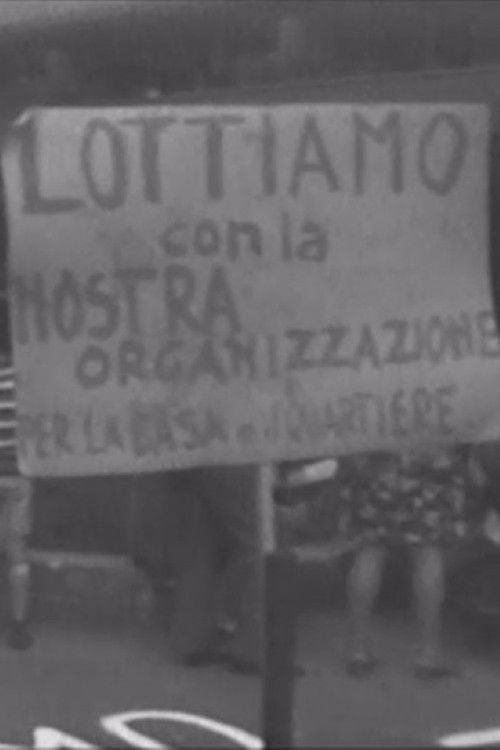
The struggle for housing in Rome, in the area of Magliana. Self-organization is opposed to the mediation of political parties, especially the Communist Party, and emerges as the only way for the emancipation and re-appropriation by the exploited.