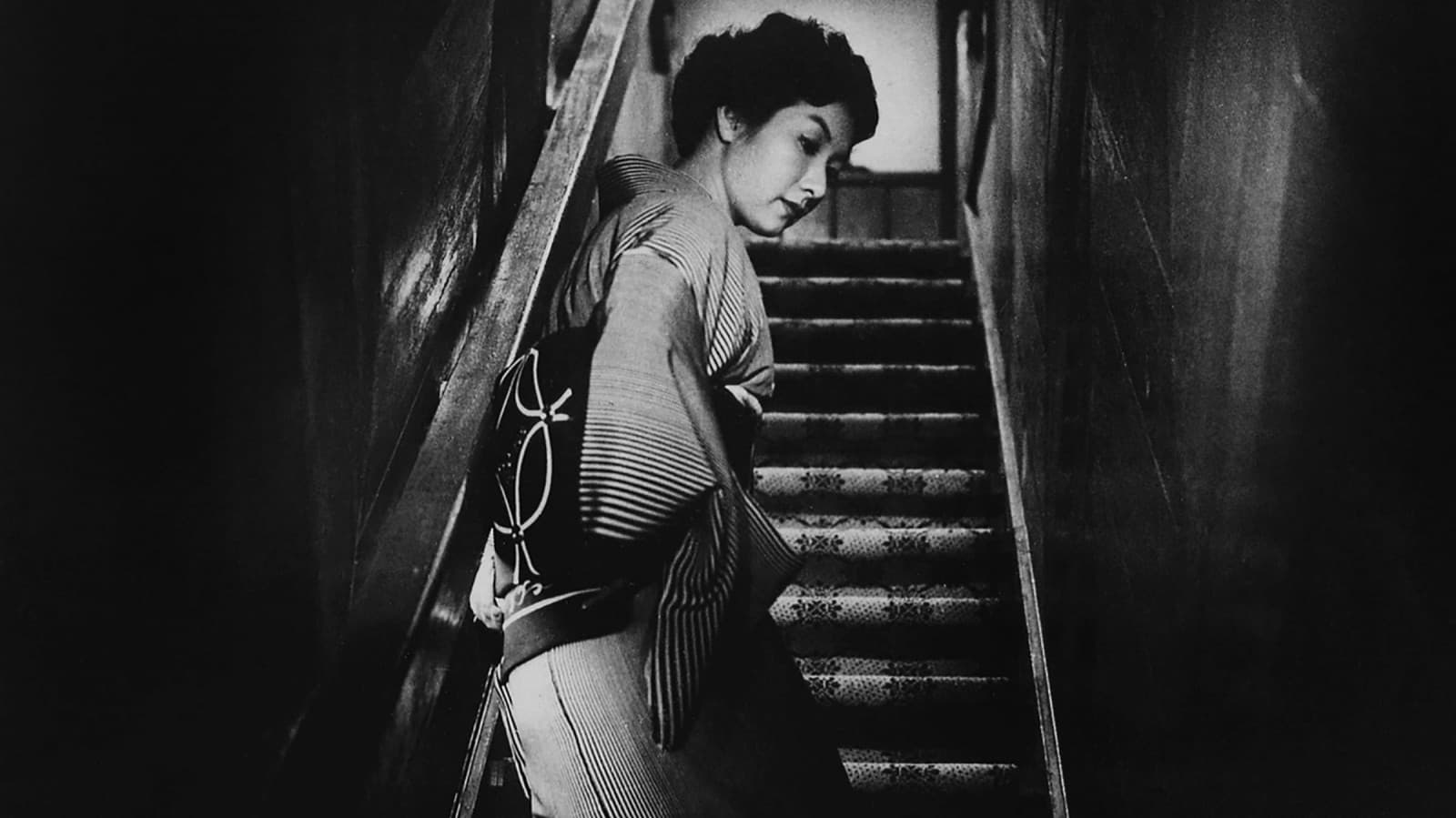
When a Woman Ascends the Stairs
"The tree sprouts no matter how strong the wind blows."

"The tree sprouts no matter how strong the wind blows."
Keiko, whom everyone calls Mama, narrates her story: she's a hostess on the Ginza, 30, a widow. She describes life's vicious cycle: acting cheerful around drunks, dressing and living well to convey confidence, needing money for these expenses and for her demanding mother and brother, and knowing she's growing older.

Kiyoha rises from the lowly courtesan ranks to the high class position of Oiran in the steamy red-light district of Yoshiwara. She is determined to stand on her own two feet and live life as she pleased.

Widower Shuhei Hirayama's caretaker is his 24-year-old daughter, Michiko. Gradually, he comes to realize that Michiko should not be obliged to look after him for the rest of his life, so he arranges a marriage for her.

A Yokohama shoe executive faces a wrenching choice when kidnappers mistakenly seize his chauffeur’s son but demand the ransom anyway.

The family of an older man who runs a small sake brewery become concerned with his finances and his health after they discover him visiting an old mistress from his youth.

Ayako becomes the mistress of her boss in order to pay her father's debt and prevent him from going to prison for embezzlement.

Fleeing a distressing family situation, Eiko, a very young girl, becomes an apprentice to Miyoharu, a veteran geisha. Both, determined to preserve their professional integrity, must face the selfishness and ambition of several petty people.

Follows five sex workers employed at a Japanese brothel while the nation debates the passage of an anti-prostitution law.

After living a traumatic experience in Tokyo, Yukiko returns to Kyoto, where Hatsuko, her mother, runs a brothel, which upsets Yukiko very much.

In the city of Yokosuka, Kinta and his lover Haruko, both involved with yakuza, brave the post-occupation period with a goal to be together.

In the shady black markets and bombed-out hovels of post–World War II Tokyo, a tough band of prostitutes eke out a dog-eat-dog existence, maintaining tenuous friendships and a semblance of order in a world of chaos. But when a renegade ex-soldier stumbles into their midst, lusts and loyalties clash, with tragic results. With Gate of Flesh, visionary director Seijun Suzuki delivers a whirlwind of social critique and pulp drama, shot through with brilliant colors and raw emotions.

The arranged marriage between a capricious woman from Tokyo high society and a quiet rustic man is tested by a marital crisis.

Prostitutes in burnt out Tokyo ghetto of post-WWII Japan peddle their flesh and save one-third of their money for a proposed dancehall to be named Paradise. The hookers live in a bombed-out building, but they accept the precarious situation with typical resolve.

A young woman uses her body and her sexuality to help her climb the social ladder, but soon begins to wonder if her new status will ever bring her happiness.

A woman, Tome, is born to a lower class family in Japan in 1918. The title refers to an insect, repeating its mistakes, as in an infinite circle. Imamura, with this metaphor, introduces the life of Tome, who keeps trying to change her poor life.

In a touring Shakespearean theater group, a backstage hand - the dresser - is devoted to the brilliant but tyrannical head of the company. He struggles to support the deteriorating star as the company struggles to carry on during the London Blitz. The pathos of his backstage efforts rival the pathos in the story of Lear and the Fool that is being presented on-stage, as the situation comes to a crisis.

In 1930s England, a group of pretentious rich and famous gather together for a weekend of relaxation at a hunting resort. But when a murder occurs, each one of these interesting characters becomes a suspect.

A headstrong young woman returns to New Orleans after the death of her estranged mother.

In 11th-century feudal Japan, following the exile of an idealistic governor, his wife and children are separated by slave traders; the children, Zushio and Anju, are sold into brutal servitude under the cruel bailiff Sansho.

In Tokyo, Japan, several grotesque murders take place on rainy days. Detective Sawamura, who is in charge of the case, soon discovers that his own family is connected to the crimes.

In postwar Tokyo, a blunt, alcohol-soaked doctor diagnoses a swaggering young yakuza with tuberculosis, forging an uneasy bond that’s tested when the gangster’s ruthless former boss returns and drags him back toward the swampy underworld he can’t escape.