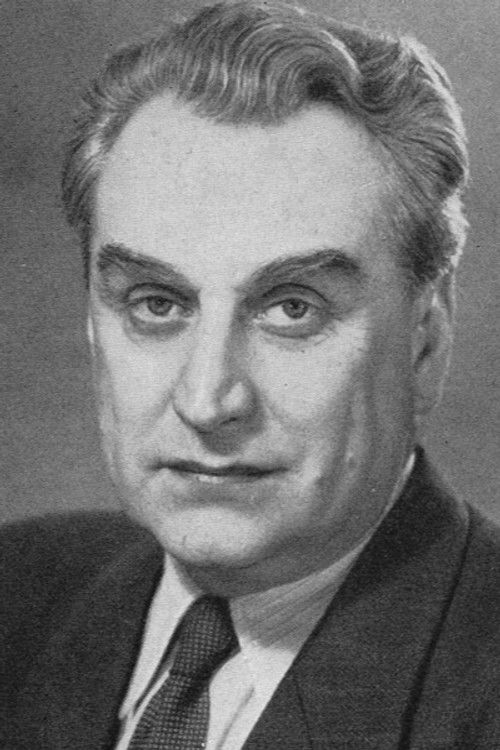
Grigori Aleksandrov
Directing
Biography
Grigori Vasilyevich Aleksandrov or Alexandrov (original family name was Mormonenko; 23 January 1903 - 16 December 1983) was a prominent Soviet film director who was named a People's Artist of the USSR in 1947 and a Hero of Socialist Labor in 1973. He was awarded the Stalin Prizes for 1941 and 1950. Initially associated with Sergei Eisenstein, with whom he worked as a co-director, screenwriter and actor, Aleksandrov became a major director in his own right in the 1930s, when he directed Jolly Fellows and a string of other musical comedies starring his wife Lyubov Orlova. Though Aleksandrov remained active until his death, his musicals, amongst the first made in the Soviet Union, remain his most popular films. They rival Ivan Pyryev's films as the most effective and light-hearted showcase ever designed for Stalin-era USSR. Description above from the Wikipedia article Grigori Aleksandrov, licensed under CC-BY-SA, full list of contributors on Wikipedia.
Known For

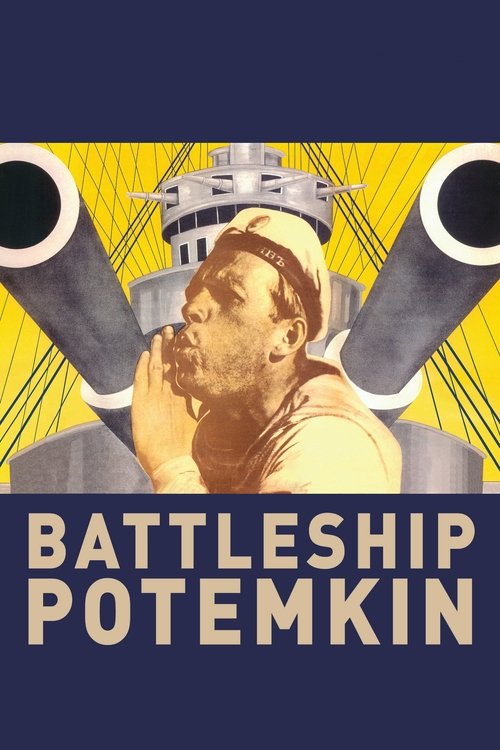
A dramatized account of a great Russian naval mutiny and a resultant public demonstration, showing support, which brought on a police massacre.
Battleship Potemkin

A drab woman scientist, working on machine to harness solar energy, and a pert concert singer look-alike being courted to play her in a movie swap identities and find personal growth, professional success, love, and happiness.
Spring

Eisenstein shows us Mexico in this movie, its history and its culture. He believes, that Mexico can become a modern state.
¡Qué Viva México!

Workers in a factory in pre-revolutionary Russia go on strike and are met by violent suppression.
Strike

Soviet and American soldiers are meeting on the shores of the Elbe river in Germany in 1945.
Meeting on the Elbe

A funny comedy about a lost twins and a lot of good people who are involved in a search for twins' parents.
Twins

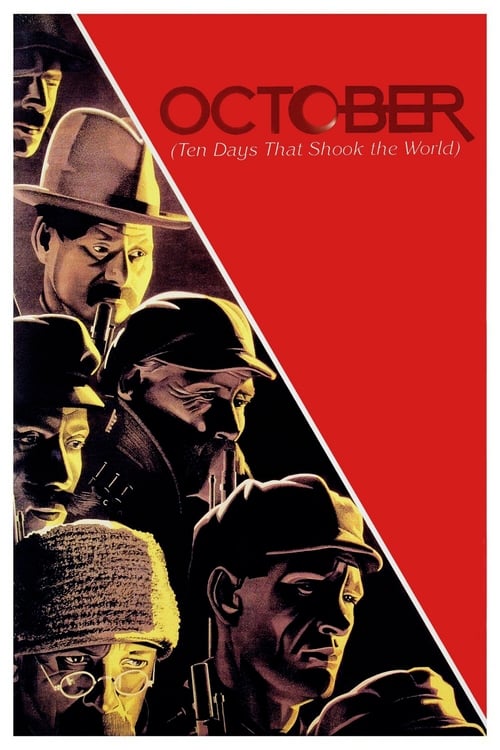
Sergei M. Eisenstein's docu-drama about the 1917 October Revolution in Russia. Made ten years after the events and edited in Eisenstein's 'Soviet Montage' style, it re-enacts in celebratory terms several key scenes from the revolution.
October (Ten Days that Shook the World)

November 1941. One by one, the men leave, leaving only old men, women and children in the village of Bykovka. Ivan Vybornov, the chairman of the collective farm, is also raring to go to the front, but, obeying party discipline, remains in the village and continues to skillfully and energetically lead the collective farm, mobilizing fellow villagers to send bread for the front and starving cities.
Native Fields

Soviet intelligence spouses — Lyudmila ("Lyre") and Fyodor ("Starling") Grekov at the beginning of the Great Patriotic War are tasked with settling in Germany. Personnel intelligence officers with vast experience are successfully introduced into German society and begin to work actively. At the end of the war, during the bombing of Berlin, fate separates them, but then they will meet in the new Germany and continue their work.
Starling and Lyre

Tanya Morozova, an illiterate but industrious textile factory worker, finds happiness through her education and the Stakhanovite movement. She becomes a shock labourer and ascends through the Party ranks, ultimately being elected as a member of the Supreme Soviet.
The Shining Path

Widely claimed to be Joseph Stalin's favorite movie, this classic musical comedy is a must-see. The action takes place on a steamboat on the iconic Volga River, as two groups of performers travel to Moscow to perform in the Moscow Musical Olympiad.
Volga - Volga

The end of the 1950s. The Chinese passenger plane, following the Beijing-Moscow flight, enters a thunderstorm and makes an emergency landing in the Baikal region. In addition to the Soviet citizen Varvara Komarova, all other passengers are foreigners. Using a stop, they explore new cities and get acquainted with the life, work and rest of Soviet people.
Russian Souvenir

An American circus performer finds herself the victim of racism after it is revealed that she's the mother of a mixed-race child. In the midst of the public scandal, she finds happiness, love, and refuge in the USSR.
Circus

March 9th, 1953. A gray, sad day. Clouds float low over the Kremlin towers. A city that unrecognizably grew, prettier and matured - this Moscow froze in solemn grief. The country escorts its father and leader, Joseph Stalin.
Velikoye proshchaniye

A Russian peasant woman is captured by Nazis and sold into slavery in Germany. Shown in Cannes in 1946.
Girl No. 217

A story based on a classic play by Alexander Ostrovsky. The famous actress Kruchinina graciously agrees to tour in a town with which she has heavy memories, and finds there a son, left by her due to circumstances many years ago. He has become embittered from his hard childhood, youth and young adulthood an insignificant and drinking like everyone else, an actor in the local provincial theater.
Guilty Without Guilt

Thematic anthology of : Le retour a la Maison (1923) by Man Ray; Emak-Bakia (1926) by Man Ray; L'Etoile de Mer (1928) by Man Ray; Les Mysteres Du Chateau de Dé (1929) by Man Ray; Rhythmus 21 (1921) by Hans Richter; Vormittagsspuk (1928) by Hans Richter; Anemic Cinema (1926) by Marcel Duchamp; Ballet Mecanique (1924) by Fernand Léger; Le Tempestaire (1947) by Jean Epstein; Romance Sentimentale (1930) by Grigori Aleksandrov and Sergei M. Eisenstein; La Coquille et le Clergyman (1928) by Germaine Dulac; Regen (Rain) (1929) by Joris Ivens and Mannus Franken
Cinema of the avant-garde 1923 - 1930

The main film character, an ordinary peasant Martyn Borylya, decided to get a noble order. Having chosen a little and primitive aim, in the chase of the artificial values, he loses everything.
Martyn Borulya

This film shows contrasting views of women with problematic pregnancies and the outcomes resulting when they seek out a back-alley abortionist, a trained and licensed abortion provider in a clinic, or an obstetrician capable of performing a Caesarian Section. The full film appears to be lost, but shortened versions, including one with dialogue scenes added in Germany in 1935, can be found on the internet. Additionally, Eisenstein's role in making the picture remains unclear: did he direct some or all of it, just edit it, or merely leave it to Alexandrov and Tisse to make? Released in the USA 1930 in a 65 minute (5800 ft.) version with English intertitles and a music track under the title BIRTH.
Misery and Fortune of Woman

Second attempt to create a feature film out of the 200,000-plus feet of film which Soviet film-maker Sergei Eisenstein shot during 1931-32 in Mexico for American socialist author Upton Sinclair, his wife and a small company of investors. The projected film, to be called "Que Viva Mexico", was never completed due to exhaustion of funds and Stalin's demand that Eisenstein return to the USSR (he had been absent since 1929). The first attempt at editing the footage, in the USA, resulted in "Thunder Over Mexico", released in 1934. In 1940, Marie Seton, from the UK, acquired some of the footage from the Sinclairs in an attempt to make a better cutting according to Eisenstein's skeletal outline for the proposed film. This film has apparently been lost.