Directing
No description available.
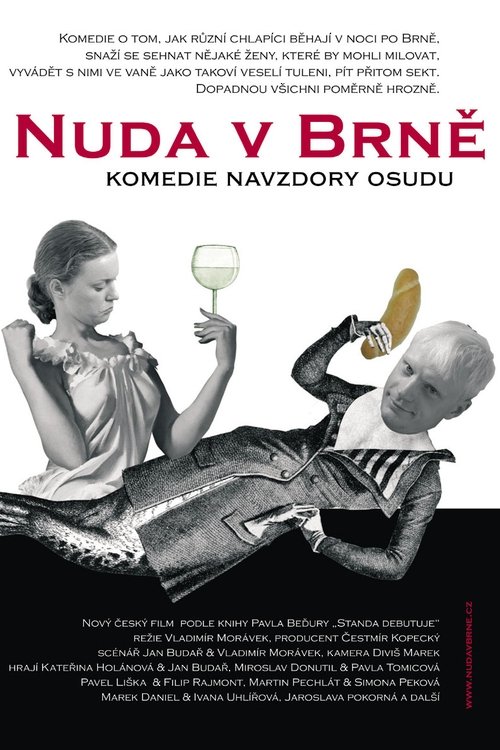
Black-and-white comedy about two young people who want to lose, finally, their innocence, and about life in a very boring city of Brno ...
More than ten years have passed since the famous premiere of the equally famous drama Maryša by the Mrštík brothers at the Husa na provázku Theater in Brno. Vladimír Morávek's new staging provoked a number of enthusiastic responses as well as great indignation. He subsequently left for the theater in Hradec Králové to launch a great era of drama, which he crowned with a return to the scene of the crime – Brno.
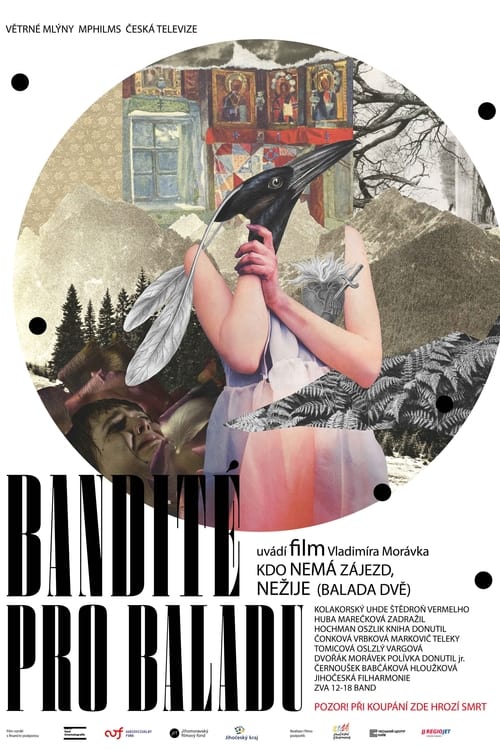
“A burned-out group of Brno intellectuals decides to go to Kolochava in Ukraine to perform ‘A Ballad for a Bandit’ there.” With these words, the author's collective presents their film, in which they use primarily documentary imagery to compose a lyrical grotesque about an epochal trip, which might be their goal. But it doesn't have to be. The main tool of expression here is the film’s edit, which places various shots, statements, and meanings next to each other, often in a sort of productive conflict. Just like in a poem, the “poetic function” of art and its ability to serve as the primary tool for expressing beauty is manifested in full force before our very eyes.
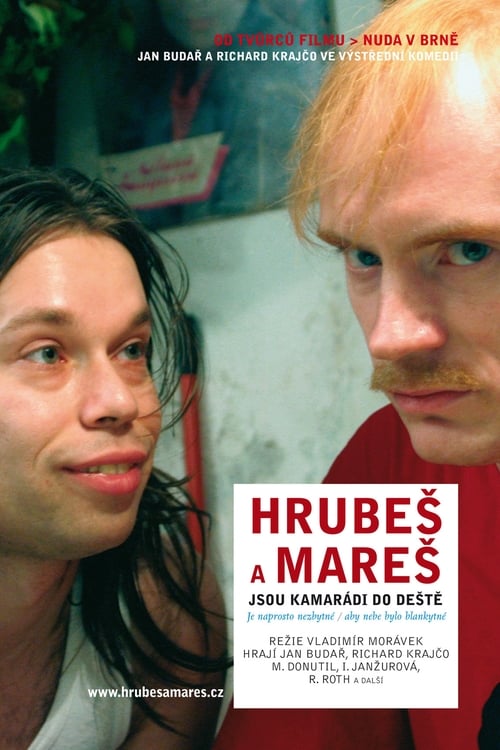
Slovak director Karpatti arrives in Prague to make a name for himself. He has brought all his belongings with him, as he can no longer show his face in Bratislava. Meanwhile, on the roof of an apartment building in Pankrác, Hrubeš and Mareš spit from the seventeenth floor, planning to become important film professionals and longing for love. Then Mareš's grandmother dies, Hrubeš is kicked out of his house by his father, and eleven terminally ill patients do not die. Václav Hrubeš meets President Klaus, and Josef Mareš finds a girlfriend, but for money. At the end, the power goes out for ten minutes throughout Prague 4, and Viliam Karpatti receives an award at the Jihlava Film Festival. It rains for the entire last ten minutes of the film, and planes hover over Prague like phantoms.