Acting
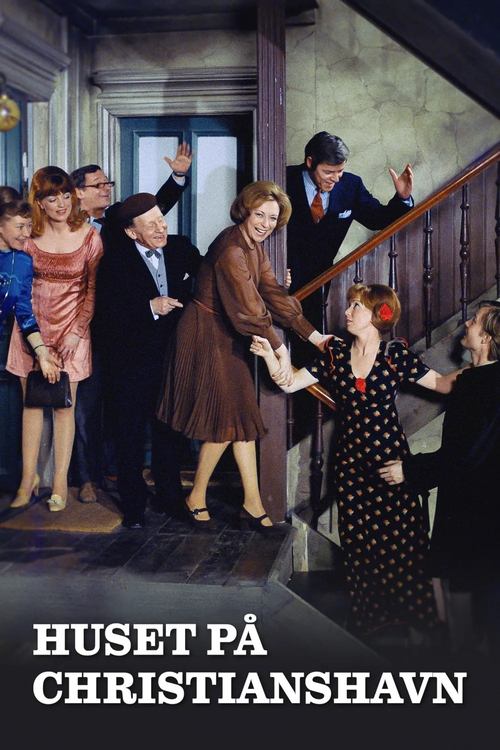
The series follows the residents of an apartment building on Copenhagen's Christianshavn, as they go about their daily lives and challenges. There is Olsen, a mover with an old fashion view of the world, Clausen who runs the local pet shop, Egon the career focused assistant, their wives who work hard to keep their spouses lives together, the young couple Tue and Rikke who recently moved in, the hard working caretaker Meyer, who never puts in to much effort, and of course Emma, the innkeeper of Rottehullet, where all the important decisions are made while running up the bar tab. The series was produced by Nordisk Film for Danmarks Radio TV station between the years 1970-77. The series' first director was Ebbe Langberg, then Erik Balling and Tom Hedegaard respectively. The series was conceived by an author team of well-known Danish authors such Leif Panduro, Benny Andersen, and Lise Nørgaard.
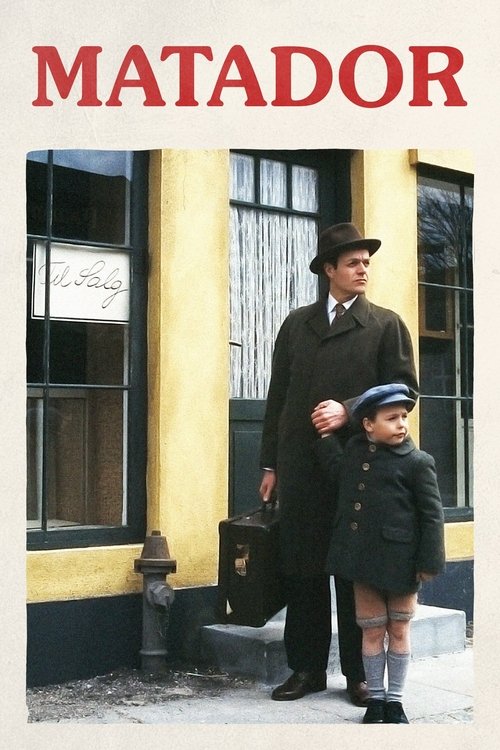
Matador is a Danish TV series produced and shown between 1978 and 1982. It is set in the fictional Danish town of Korsbæk between 1929 and 1947. It follows the lives of a range of characters from across the social spectrum, focusing specifically on the rivalry between the families of two businessmen: The banker Hans Christian Varnæs, an established local worthy, and social climber Mads Skjern, who arrives in town as the series opens. The name Matador was taken from the localised edition of the boardgame Monopoly, also the series' tentative English title. In addition, in contemporary Danish a "matador" is often used to describe a business tycoon, in the series referring to the character of Mads Skjern and his craftiness as a self-made entrepreneur. Directed by famed Danish film maker Erik Balling, Matador was the idea of author Lise Nørgaard who wrote the bulk of the episodes alongside Karen Smith, Jens Louis Petersen and Paul Hammerich. The series is one of the most well-known and popular examples of Danish television and represents the peak of longtime development of Danish TV drama by the public service channel Danmarks Radio. The series has become part of the modern self-understanding of Danes, partly because of its successful mix of melodrama and a distinct warm Danish humour in the depiction of characters, which were portrayed by a wide range of the most popular Danish actors at the time; but also not least because of its accurate portrayal of a turbulent Denmark from around the start of the Great Depression and through Nazi Germany's occupation of Denmark in World War II.
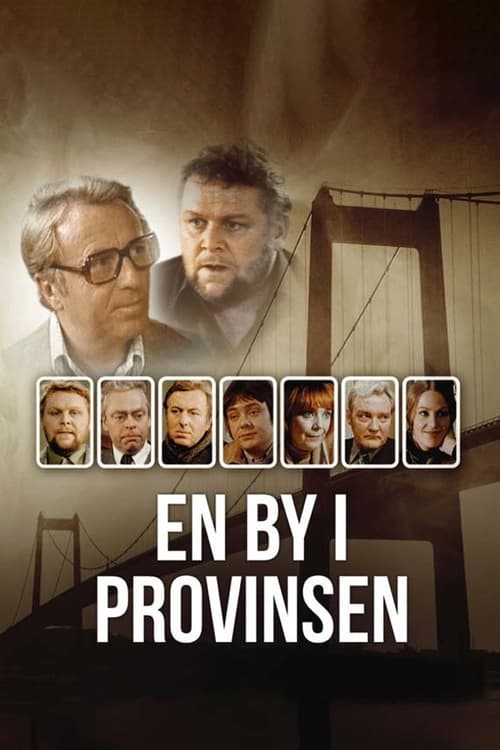
In 1970s Denmark, the criminal police in a provincial town solve different criminal cases, when the police was dominated by men and DNA was not yet a tool in investigation.
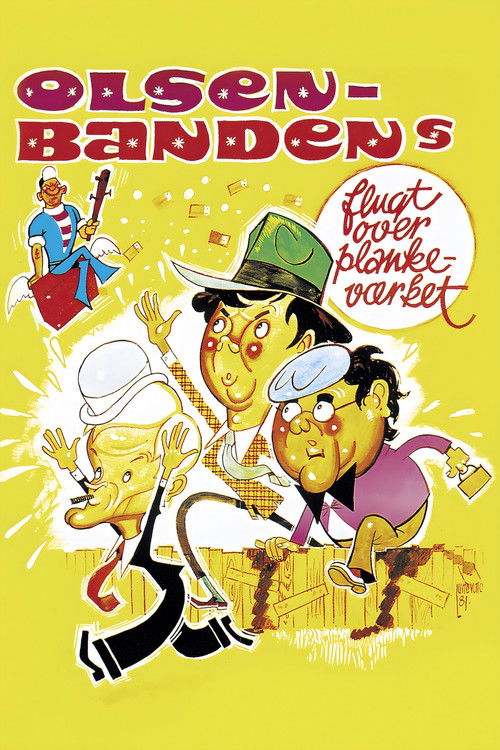
As usual, Egon has an ingenious plan. And, as usual, it works just fine until one of the gang members makes some kind of funny error. This time, however, even Egon's life is in danger, for some international criminals try to get rid of him by throwing him into a container filled with acid.
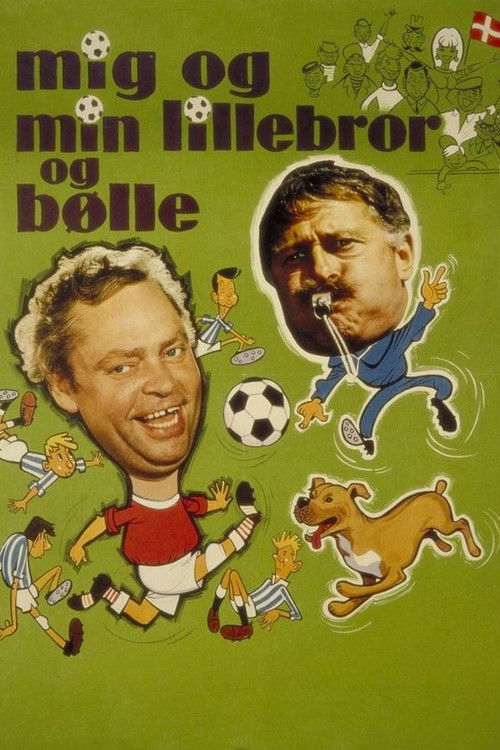
The third film about the two good-natured brothers Søren and Peter and their family on the small island of Bomø. This time, the brothers have acquired a soccer-loving dog named Bølle, who turns out to be able to predict the results of betting pools. This causes chaos in the betting service, on Bomø, and at Christiansborg.
Police constable Møller'og psychiatrist Dr. Mogensen will have something to watch as the Pusle to everyone's surprise finds out that she can do magic. On her birthday she gets sent an ancient, magical figure from her uncle in South America. On the same day Pusle's parents has to travel to London, and the large family is now left to strict aunt Alma.
A young, idealistic business student has ambitions to be a concert pianist, but his obsession with beautiful women keeps him from achieving his goal. To earn money for his tuition, he takes a job as headmaster of a small girls' school. There his weakness for beautiful women is put to the test when he is pursued by a bevy of sexy coeds.
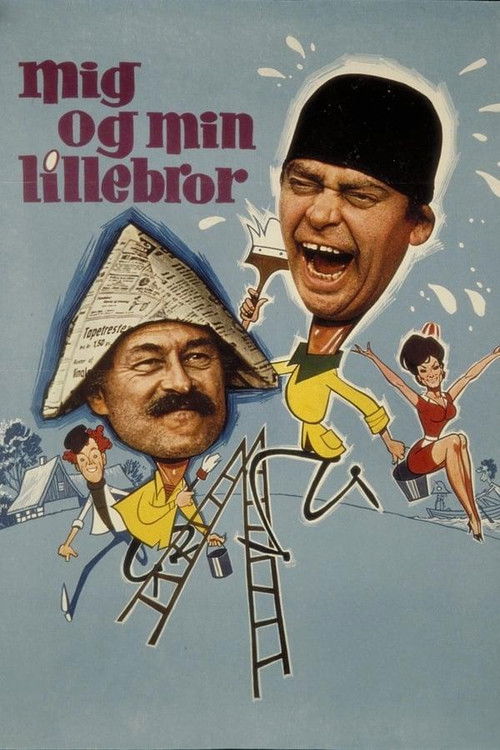
The entire population of Bomø has gathered for the big day. Finally, after 56 years, the bridge connecting Bomø to the mainland has been completed. With the parish council chairman at the helm and the minister cutting the ribbon to make it official, everything should be in perfect order. However, the county governor is absent, as he has a financial dispute with the ferrymen, brothers Søren and Peter Severinsen.
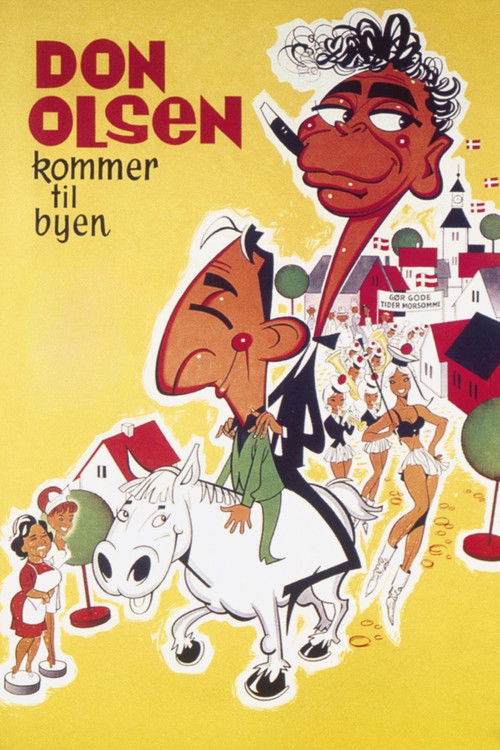
Bank director L.W. Jacobsen resides in a small provincial town. He is not particularly interested in his wife, Elsebeth, but rather in teacher and city council member Miss Mortensen. Thorsen, the town's manufacturer, is a member of the same city council group as Jacobsen. Then Don Olsen comes to town. Olsen is not interested in the upper class, but rather in people. By chance, Thorsen and Olsen meet and soon become drinking buddies. Thorsen drags the milkman's horse home to his apartment in the middle of the night. The scandal is a reality. Thorsen wants to flee, but with Olsen's help, he instead woos the townspeople and Miss Mortensen under the motto "Make good times better."
Due to his gambling addiction, farmer Hans Sværke has brought his farm to the brink of bankruptcy, thereby opening up the opportunity for the wealthy landowner Karius to achieve his goal of taking over the farm. However, parish bailiff Mikkelsen vouches for Sværke and saves him for the time being, and Sværke then leases the farm. Sværke dies, and his talented son Niels takes over the lease. He and the farmer's daughter, Grethe, are happy together, and Niels manages to get her hired at the farm. But Karius' daughter, who is in love with Niels, burns with jealousy and persuades her father to take advantage of Niels' difficult financial situation and take over the farm. Things look bleak for Niels, who has been cornered by the wealthy landowner. But one day while plowing, he sees something glinting in the soil...
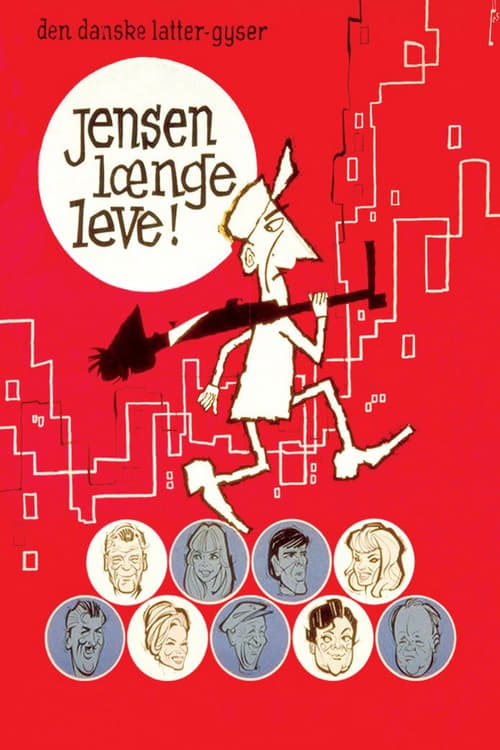
A prisoner who has just escaped from prison finds the body of Jensens, a marshal, in Jensens' shop. Fearing that he will be suspected of murder, he moves the body in a trunk to a forest, where it is to be hidden. On the way, he loses the trunk from his cart and Jensen from the trunk. Immediately afterwards, another gentleman runs over the body, hides it in the back of his cart, wants to bury it, etc.
When Egon Olsen gets out of Vridlose State Prision once again, his friends Benny and Kjeld do not want to know about his new ingenious plan: they are actually WORKING in a shop! Thus, he has to think of something else to get his hands on the money of some international gangster.
Finn and Claus are best friends and both have a thing for their cute friend Eva. They both go to Copenhagen to study law but Claus would rather study music/piano and takes private lessons and Finn isn't the academic type. Who gets Eva?
Lis Holst desperately wants to become an actress. After failing an audition at a theater, she decides to resort to other, more drastic measures. When the director and the theater's writer go to the countryside, Lis goes with them. There, she performs a masterpiece of disguise. When the truth dawns on the theater director and the writer, they decide to take advantage of Lis, as the theater's prima donna has taken up residence. Lis is promised a leading role in the next performance, but then the prima donna recovers and wants her role back.
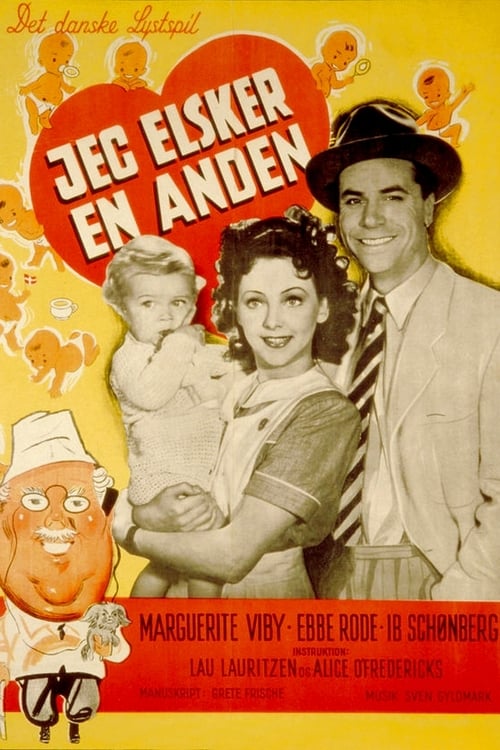
On a dark and rainy evening after the cinema, a small two-seater car drives through the old streets of Copenhagen. It is the young doctor Preben Hansen driving his sweetheart home. She is a nanny and works at a daycare centre in the inner city. She is a sweet and lively girl whom her friends call "Peter." In the doorway, "Peter" encounters a drunk man who will later become important in her life. When the daycare center is about to close, the drunk man may step in with a financial helping hand.
At the Gästhaus "Den Hvide Hest" in the Austrian Alps, romantic entanglements are in full swing. Waiter Leopold is in love with landlady Josepha, who has her eye on charming manufacturer Sigismund, who in turn hits on all women almost as a matter of principle. Klara and Lene also join the battle for the popular manufacturer, while waiter apprentice Mickey would rather just have a goat.
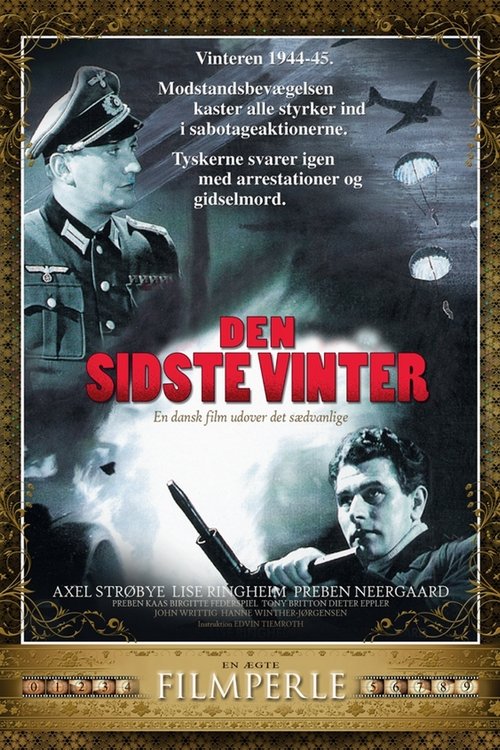
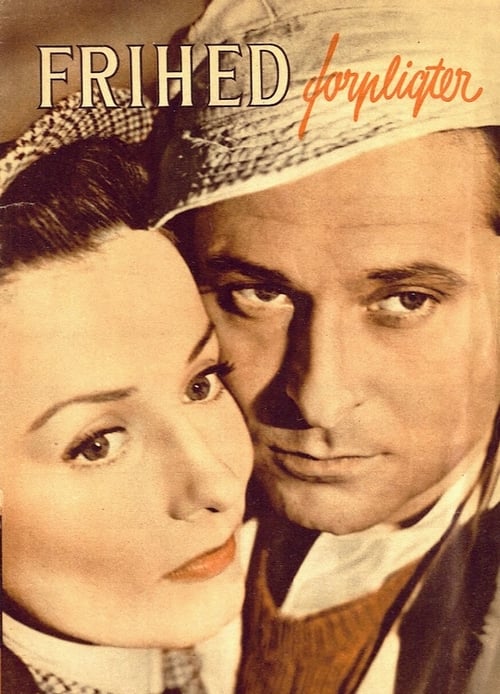
The Danish resistance movement stepped up its activities towards the end of the war. One night, an English agent arrives by plane, is injured and is taken in by local resistance fighters. The agent and the resistance fighters plan actions against the Germans, but there must be a traitor among them, because the Germans are always very close by.
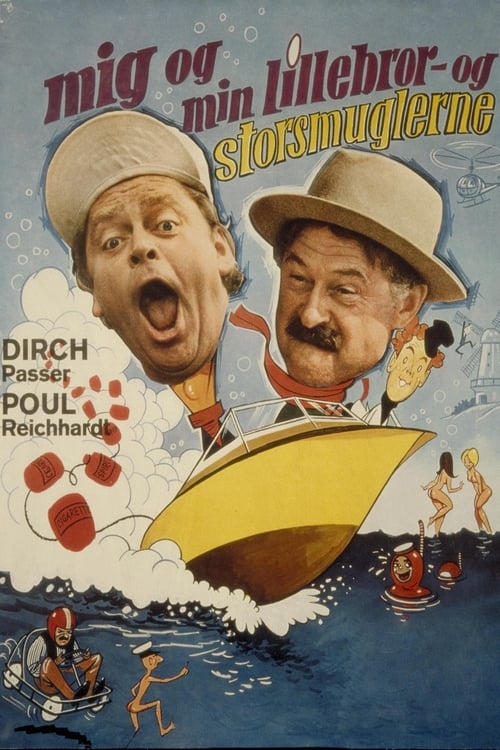
It's not just eels and rubber boots that Søren and Peter catch when they fish in waters teeming with smugglers... The parish council is against serving alcohol at the inn, but luckily for them, brothers Søren and Peter often catch both whisky and cigarettes when they go fishing. The naive brothers believe that their catch is lost property. The parish council chairman, on the other hand, is so tired of the two constantly knocking on doors that he asks them to give away their catch. And then things might start to happen. Not least at the nursing home. But one day, it all comes to an end. The police and customs authorities invade the idyllic Bomø, and all hell breaks loose for the two unfortunate fishermen...
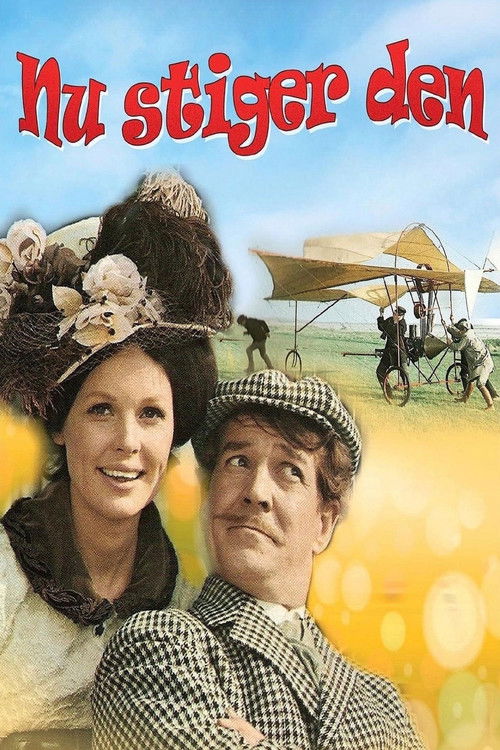
A folk comedy loosely based on the career of Danish inventor and aviation pioneer Jacob Christian Ellehammer. We follow Ellehammer, his loyal assistant Pehtersen, and his patient wife as they battle creditors and widespread ridicule until, on September 12, 1906, Ellehammer becomes the first person in Europe to get a flying machine off the ground on the island of Lindholm.
Danish social democratic propaganda film. During the Occupation, the young freedom fighter Søren had a good working relationship with a comrade in the resistance movement, despite the fact that Søren was a social democrat and his comrade a communist. After the liberation in May 1945, the differences that had been less important during the war begin to stand in Søren's way. Both his friendship with his comrade and his relationship with the wealthy Inger fall apart in the summer of liberation. But through his work in the Social Democratic Party, Søren experiences a renewed enthusiasm and resumes his relationship with Inger. Together, they actively engage in the party's work and both see it as an extension of the struggle for freedom during the occupation. Denmark's entry into NATO is particularly important.