FEEL IT.STREAM
?

Douglas Gordon

Directing

Biography

Douglas Gordon (born 20 September 1966) is a Scottish artist. He won the Turner Prize in 1996, the Premio 2000 at the 47th Venice Biennale in 1997 and the Hugo Boss Prize in 1998. He lives and works in Berlin, Germany.
Known For

Douglas Gordon by Douglas Gordon
N/A

An intimate portrait of the Turner Prize-winning artist. As the boundary between reality and performance blurs, the shifting relationship between filmmaker and subject calls into question who is actually making the film.

Douglas Gordon by Douglas Gordon

2026
Zidane: A 21st Century Portrait
5.9

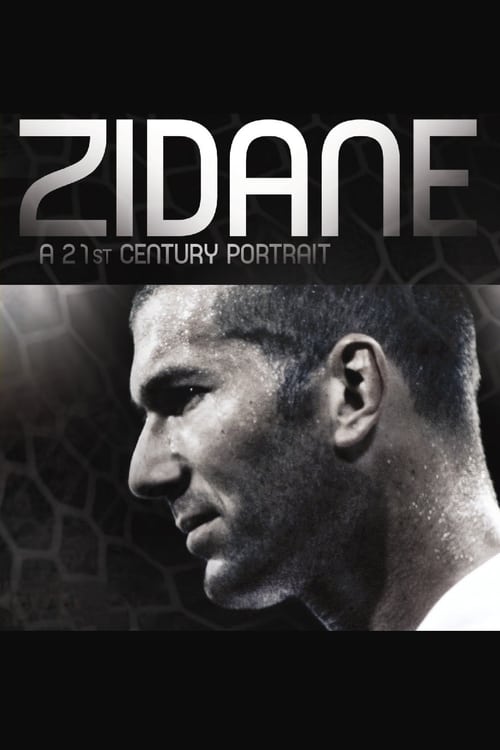
Halfway between a sports documentary and an conceptual art installation, "Zidane" consists in a full-length soccer game (Real Madrid vs. Villareal, April 23, 2005) entirely filmed from the perspective of soccer superstar Zinedine Zidane.

Zidane: A 21st Century Portrait

2006
The New Ten Commandments
8.7

The film was produced by Nick Higgins from Lansdowne Productions and Noémie Mendelle from the Scottish Documentary Institute and has 10 film-chapter directors for each of the 10 chapters of the film. The film's unifying theme is human rights in Scotland with each chapter illustrating one of the "New Ten Commandments" - 10 articles chosen from the Universal Declaration of Human Rights. The 10 film chapters of The New Ten Commandments 1. The Right to Freedom of Assembly - Dir, David Graham Scott 2. The Right not to be enslaved - Dir, Nick Higgins 3. The Right to a fair trial - Dir, Sana Bilgrami 4. The Right to freedom of expression - Dir, Doug Aubrey 5. The Right to life - Dir, Kenny Glenaan 6. The Right to liberty - Dir, Irvine Welsh & Mark Cousins 7. The Right not to be tortured - Dir, Douglas Gordon 8. The Right to asylum - Dir, Anna Jones 9. The Right to privacy - Dir, Alice Nelson 10. The Right to freedom of thought - Dir, Mark Cousins & Tilda Swinton.

The New Ten Commandments

2008
365 Day Project
10.0

This exhibition focuses on Jonas Mekas’ 365 Day Project, a succession of films and videos in calendar form. Every day as of January 1st, 2007 and for an entire year, as indicated in the title, a large public (the artist's friends, as well as unknowns) were invited to view a diary of short films of various lengths (from one to twenty minutes) on the Internet. A movie was posted each day, adding to the previously posted pieces, resulting altogether in nearly thirty-eight hours of moving images.

365 Day Project

2007
24 Hour Psycho
4.0

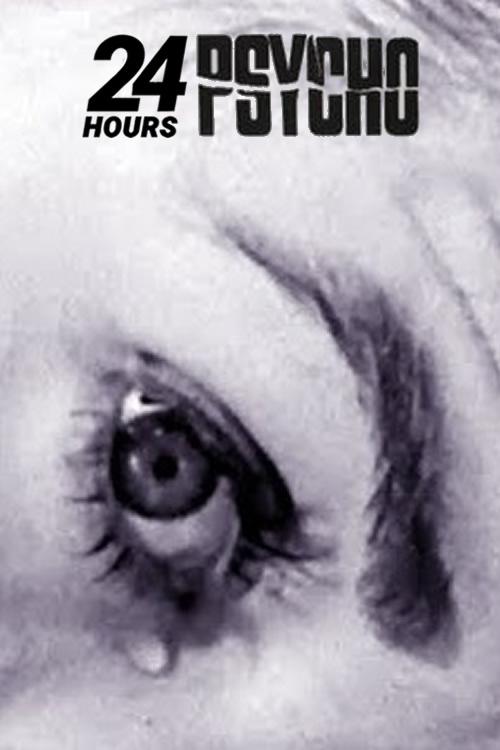
24 Hour Psycho is the title of an art installation created by artist Douglas Gordon in 1993. The work consists entirely of an appropriation of Alfred Hitchcock's 1960 Psycho slowed down to approximately two frames a second, rather than the usual 24. As a result it lasts for exactly 24 hours, rather than the original 109 minutes. The film was an important work in Gordon's early career, and is said to introduce themes common to his work, such as "recognition and repetition, time and memory, complicity and duplicity, authorship and authenticity, darkness and light."

24 Hour Psycho

1993
No image
10.0

A cinematic experience by Douglas Gordon - in which the film D.O.A. is screened simultaneously on three screens beside one another, but at slightly different speeds. The films quickly fall out of synch with one another. Déjà-vu uses footage from D.O.A. 1949-50, a Hollywood thriller directed by Rudolph Mateé. The film has been transferred to video and is projected simultaneously on three parallel screens at normal speed as well as slightly faster and slightly slower - 25, 24 and 23 frames per second (left to right). This has the effect of making the three identical narratives diverge increasingly over time, and inducing in the viewer an experience similar to déjà-vu.

Déjà-Vu

2000
My Name Is Hmmm...
5.5

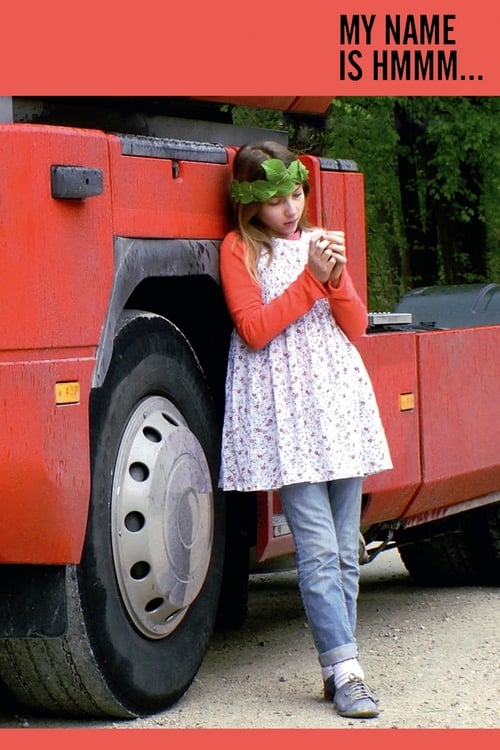
Céline, 11, meets Peter, 40. Together they go on a "luminous journey" in his beautiful red truck. She, escaping her desperate and incestuous father; he, far from his native Scotland and the sad memory of his lost wife and daughter. In the course of a few days, a few words, Céline experiences her first true moments of childhood and lightness, exhilaration and trust. Peter goes towards the last days of a life that he offers, like a sublime and aging angel, to this wounded child.

My Name Is Hmmm...

2013
K.364: A Journey by Train
N/A

Avri Levitan and Roi Shiloah are a pair of acclaimed classical musicians from Israel who were booked to play a special concert in Poland, performing Mozart's "Concert Symphony in E-Flat Major" with one of the nation's leading orchestras, the Amadeus Chamber Orchestra of the Polish Radio. However, the two musicians chose an unusual route to get there -- viola player Levitan and violinist Shiloah took the train from Berlin to Warsaw, in effect following the same path their parents were forced to use when they were sent to the Third Reich's death camps in 1939. Filmmaker Douglas Gordon and his camera crew were on hand for the trip, and K.364: A Journey By Train is a documentary that contrasts the beauty of Mozart's music and the enthusiasm of two world class musicians with the legacy of one of the darkest episodes in human history.

K.364: A Journey by Train

2010
Douglas Gordon sings the best of Lou Reed & The Velvet Underground (For Bas Jan Ader)
N/A

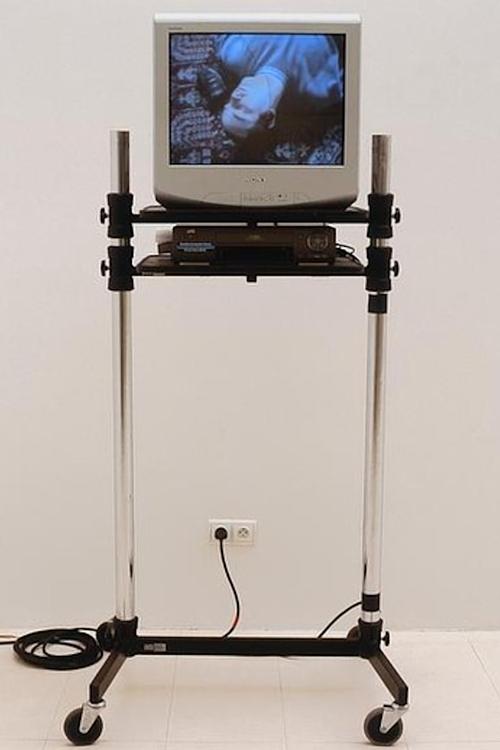
In the present work, the artists appears lying on his back, his eyes mostly closed, dreamingly listening to a walkman that plays, a recording of 'The Best of Lou Reed and the Velvet Underground'. The artist can hear the music through his earphones, but as viewers we are only privy to the sound of his voice that whispers the melody. As we listen to the hypnotic interpretion of the familiar songs - as emblematic for pop music history as 'Psycho' is for film - we are forced to mentally 'reconstruct' the remaining orchestration, instrumentation and vocals. We must attempt to reassemble something we already know to be a fact by negotiating the sticky mess of interpretation, meaning, and memory.

Douglas Gordon sings the best of Lou Reed & The Velvet Underground (For Bas Jan Ader)

1993
Chew the Fat
N/A

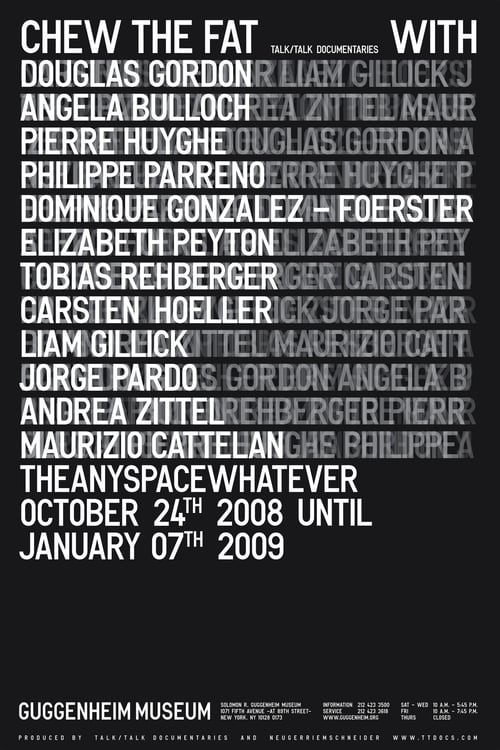
"Chew The Fat" (Informal) - To have a long friendly conversation with someone. In the film project 'Chew The Fat', the artist Rirkrit Tiravanija, living in New York portraits a group of 12 artists (Douglas Gordon, Angela Bulloch, Pierre Huyghe, Philippe Parreno, Dominique Gonzalez - Foerster, Elizabeth Peyton, Tobias Rehberger, Carsten Hoeller, Liam Gillick, Jorge Pardo, Andrea Zittel, Maurizio Cattelan). The artists, all chosen by Tiravanija, belong to the same generation as himself and, like him, have advanced during the nineties to achieve international success. Most importantly, all are good friends of Tiravanija. This creates a particularly relaxed situation in which conversation can flow naturally between the two with personal issues coming up as easily and often as those to do with work or career.

Chew the Fat

2011
No image
N/A

A cinematic backdrop, created by Douglas Gordon, for Rufus Wainwright, in which the singer's eyes are filmed in slow motion and overlapped. The film is shown here accompanied by Wainwright's Sonnet 10 - but the film was also shown as a video backdrop during the singer's live concerts.

Making Eyes

2010
I Had Nowhere to Go
N/A

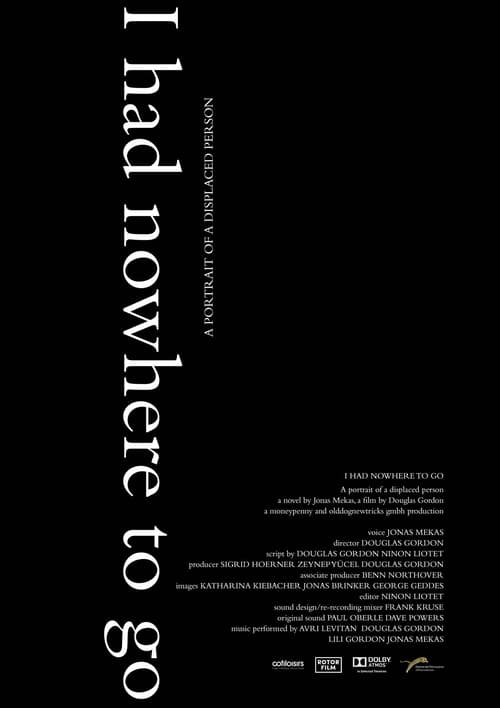
I Had Nowhere To Go is based on Jonas Mekas’s diary. It’s been over 70 years since he left his village in Lithuania to escape Nazi persecution. He was 22 years old. Today he is one of the last surviving members of a displaced generation and one of the greatest documenters of the human experience.

I Had Nowhere to Go

2016
Domestic (as long as it lasts)
N/A

Domestic (as long as it lasts) was made in 2002 in Gordon’s one-bedroom apartment in downtown New York City. It shows the artist’s foot repeatedly kicking the camera around a clean, quiet domestic space until the video blacks out. The victim of the booting, the camera itself, is recording the footage we see. The viewer is disoriented by the film’s upsetting of the conventional relationship between documenting and participating, which makes the camera complicit in the act.

Domestic (as long as it lasts)

2002
No image
N/A

An avant-garde film presented as part of an exhibit at the Museum of Modern Art. From MoMA's catalog: "For the monumental installation Play Dead; Real Time, (director Douglas) Gordon arranged for a circus elephant to be transported to Gagosian Gallery, in New York City, where he filmed it obeying a series of commands (repeatedly lying down and then awkwardly struggling to rise). Like many of Gordon's protagonists, the elephant is subject to greater forces, beyond its controL Simultaneously presenting several different versions of the scene, in front and rear projections and on a monitor, the work depicts the event from a range of perspectives rather than from a single static viewpoint."

Play Dead: Real Time

2003
No image
N/A

To celebrate the 60th anniversary of the Universal Declaration of Human Rights, Lansdowne Productions and the Scottish Documentary Institute gathered together some of the most talented filmmakers and visual artists based in Scotland. Collectively they created the feature length documentary, the New Ten Commandments. This short, The Right not to be Tortured is one of those commandments.

The Right to Not Be Tortured

2009
No image
N/A

Feature Film is a video installation by the Scottish artist Douglas Gordon. It is comprised of two large wall projections showing the same closely cropped footage of a conductor’s hands and face.

Feature Film

1999
The Making of Monster
N/A

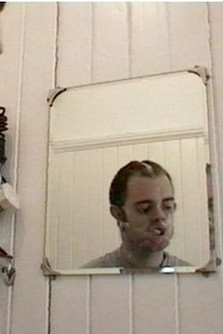
In The Making of Monster the artist’s face becomes grotesque through the application of strips of transparent adhesive tape, typical of Douglas Gordon’s performance-based films that often depict his own body in action. Also characteristic of his work, the scene takes place in front of a mirror, suggesting the kind of personal self-reflection that one is capable of – both good and evil. The video makes clear cinematographic reference to the ‘alter-ego’ transformation in Mamoulian’s Dr. Jekyll and Mr. Hyde, and to the “You looking at me?” sequence performed in front of a mirror by Robert De Niro in Scorsese’s Taxi Driver, which also inspired Gordon’s Through a Looking Glass (1999).

The Making of Monster