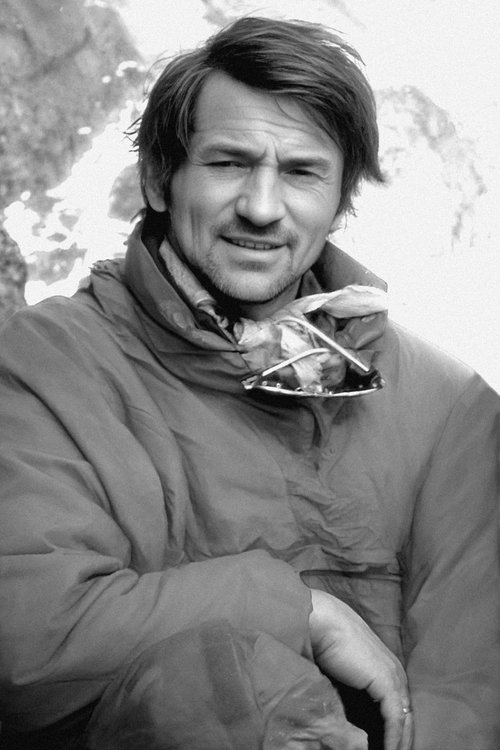
Claude Jager
Acting
Biography
Claude Jager, born in 1940 in Elvange, Moselle, is a French mountaineer and guide. He discovered the mountains during his studies at the National Institute of Applied Sciences in Lyon, where he befriended climbers such as Marc Martinetti, Jean-Paul Paris, and Yannick Seigneur, with whom he completed his first mountaineering expeditions. An aspiring guide since 1964, he opened numerous new routes in the following years. Appointed a teacher at the Lycée du Fayet, he met Walter Cecchinel, with whom he completed a series of remarkable winter ascents. His career is marked by major achievements, including the first ascent of the northeast couloir of Les Drus, made with Walter Cecchinel from December 28 to 31, 1973. This route, considered one of the most difficult in the Alps, is a steep ice couloir, exposed to avalanches and framed by vertical slabs. The feat was hailed at the time as a technical achievement and a pinnacle of winter mountaineering. Claude Jager also participated in the French expedition to the west pillar of Makalu (8,481 m) in 1971, led by Robert Paragot. This expedition marked the history of Himalayan mountaineering by opening a new route on one of the world's highest peaks, in extreme weather conditions and at the cost of total physical and mental dedication. Alongside his guiding activities, Claude Jager worked as a high school teacher, passing on his passion for the mountains to many young people. After a rich and committed career, he settled in Chamonix, where, at over 80 years old, he continues to explore the trails and contemplate the peaks that have marked his life as a mountaineer.
Known For

The French Alpine Club's film about the French expedition to conquer Makalu (8481m) via the west pillar in Nepal, which began on February 24, 1971. Composed of 11 mountaineers, Robert Paragot (expedition leader), Georges Payot, Lucien Berardini, Yannick Seigneur, Claude Jager, Jean-Paul Paris, Jean-Claude Mosca, François Guillot, Bernard Mellet, Robert Jacob and Jacques Marchal (surgeon), it took twenty-five days of walking on the Himalayan trails with 460 porters and 18 Sherpas to transport 14 tons of equipment to reach the base camp. Finally, it was Mellet and Seigneur who managed to reach the summit on May 23, 1971: 8481 m, temperature - 30°, oxygen 30%, no wind.
Makalu 8481m - West Pillar
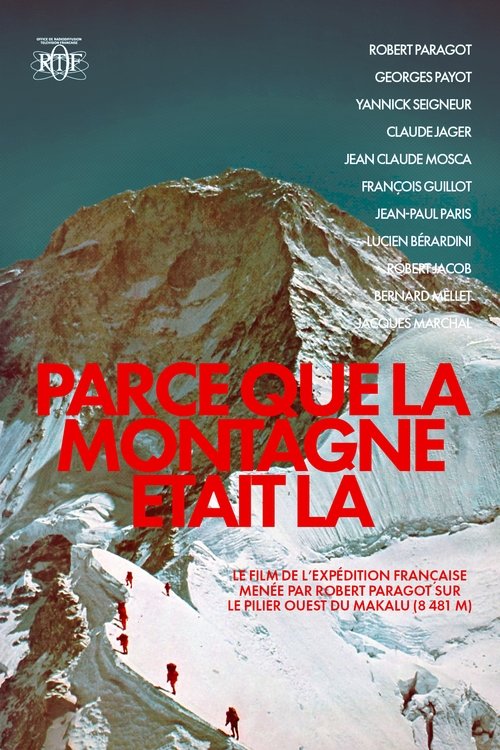
On May 23, 1971, a French expedition led by Robert Paragot successfully climbed Makalu via its west pillar. Makalu is one of the five highest peaks in the world, located in the Himalayas on the Nepalese-Tibetan border. Jean-Pierre Janssen and Lucien Bérardini filmed this expedition, where Robert Paragot spoke about the expedition conditions, life at altitude, and his state of mind as expedition leader. On the return to base camp, Jean-Pierre Janssen interviewed Lucien Berardini, Georges Payot, Jean-Claude Mosca, François Guillot, and Jean-Paul Paris, all of whom played a key role in bringing Bernard Mellet and Yannick Seigneur to the summit. Expedition members: Robert Paragot (expedition leader), Georges Payot, Yannick Seigneur, Claude Jager, Jean-Claude Mosca, François Guillot, Bernard Mellet, Lucien Bérardini, Jean-Paul Paris, Robert Jacob, Jacques Marchal (surgeon).
Because The Mountain Was There
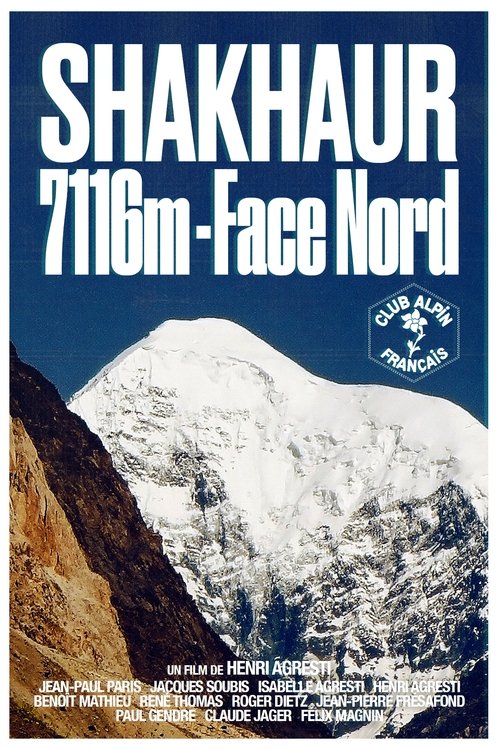
This film - without commentary and simply accompanied by local music - relates the 1969 ascent of the north face of Kohe Shakhawr, a Himalayan peak located on the border with Afghanistan, by mountaineers Benoît Mathieu, Jacques Soubis, René Thomas, Jean-Paul Paris, Isabelle Agresti, Henri Agresti, Roger Dietz, Jean-Pierre Frésafond, Paul Gendre, Claude Jager and Félix Magnin. As is often the case in Henri Agresti's films, there is an encounter with other peoples, other cultures, documented at length in the introduction. Then, after the interminable approach, the ascent begins: distribution of camps, successive assaults on the mountain, walking on steep scree and snowy slopes, climbing on icy walls... The arrival at the summit, without the aid of oxygen devices, seems to take place in slow motion: exhaustion mixes with the joy of the victorious mountaineers who will celebrate their success on their return to base camp on August 24, 1969.