Writing
No description available.
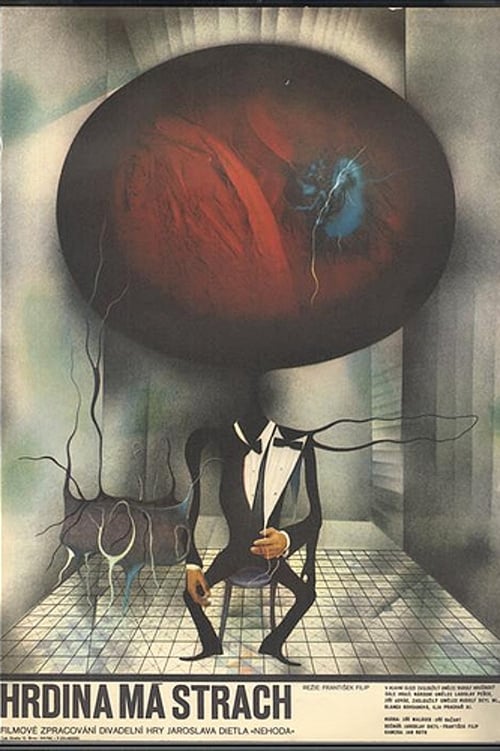
Honza Vavrinec (Rudolf Hrusínský) works in the investment department of a large office. One day he gets involved in the case of an unjustly convicted worker who mistakenly considers him a parliamentary deputy. Honza as a "deputy" interferes in the case and helps the worker. Encouraged by the success and possibly also out of love for the beautiful secretary Svatava (Blanka Bohdanová), the then shy and fearful Honza stands up for the chief of the department, Hofmánek (Ladislav Pesek), who has been removed from his position.
At a village railway station in occupied Czechoslovakia, a bumbling dispatcher’s apprentice longs to liberate himself from his virginity. Oblivious to the war and the resistance that surrounds him, this young man embarks on a journey of sexual awakening and self-discovery, encountering a universe of frustration, eroticism, and adventure within his sleepy backwater depot.
JUDr. Kroupa will take over as President of the Civil Court from his colleague who is retiring. His job description is mostly to judge married couples who are divorcing and arguing over alimony, with the very least concern for the welfare of their children. With his new job, Kroupa "inherits" a handsome but peculiar secretary, Zdenka, who takes a liking to him. However, his attempts at courtship are occasionally thwarted by strange events...
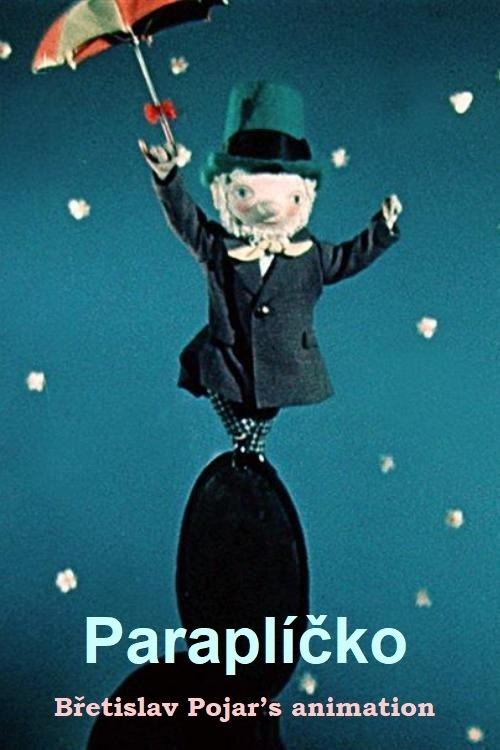
Hurvinek cannot go to a circus because he injured himself when sliding down the stair rail. He daydreams that he is an acrobat riding a scooter and an animal-trainer taming beasts. (MUBI)
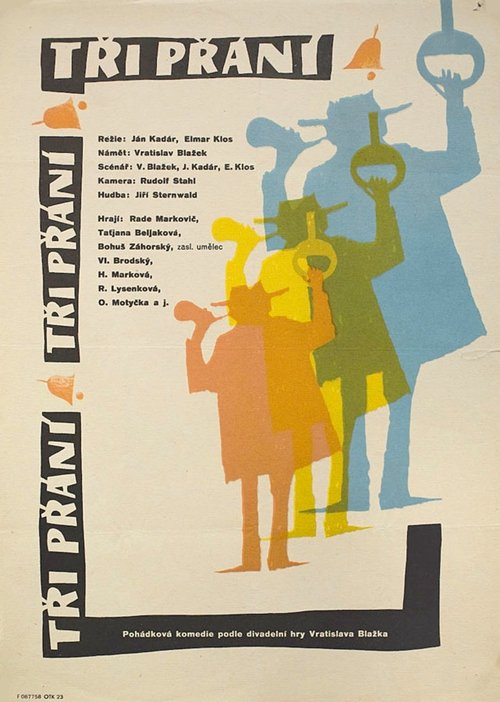
The sad hero of the story, Petr, an ordinary lawyer in a construction company, is crowded into a small apartment in Žižkov with his wife and grandparents, desperately struggling with the lack of money. One day he offers an old man a seat on a crowded trolley bus and is generously rewarded for his good deed, for the unknown old man is a fabulous grandfather. He gives Peter a magic bell and the opportunity to make three wishes, but the first two slip through his fingers. For the third, the astonished man must take time to think...
Lemuel Gulliver has had a car accident and continues his journey across the unknown countryside on foot. On the road he finds a dead rabbit dressed like a man and takes a watch from its waistcoat breast pocket. The half-ruined house that he enters reminds Lemuel of his childhood and brings up a painful memory of a dearly loved girl Markéta who was drowned years ago. Gulliver finds himself in Balnibarbi, a country where he doesn't understand the laws and habits and so continually offends against public decency. It is a day when people are ordered to keep their mouths shut and they force their visitor to follow suit. He faces harsh interrogation and finds it difficult to explain that he is not the rabbit Oscar whose watch has been found in his possession.
A satire of the Great American Way, with Lemonade Joe a "clean living" gunfighter who drinks only Kola-Loca Lemonade and convinces everyone else in town (with his gun skills) that all "real men" drink ONLY lemonade!
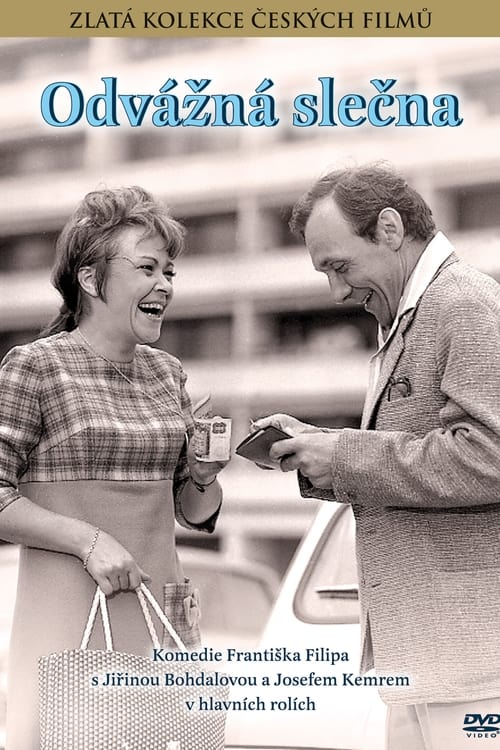
Tram driver Marie has far too much to do after her shift is over. But she likes to do it all since she loves her husband Václav sincerely. One day she spots him on the Lesser Town Square in Prague, kissing an attractive blonde good-bye. It seems to Marie that her small comfortable world has collapsed and she walks out of the tram in tears. But her sadness does not last long. She wipes off the tears and begins to act. She withdraws all the money from their savings books and buys off all the latest models from the Fashion Works. The visit to the beauty salon then completes her transformation into a lady.
An anthology of three absurd, ironic tales inspired by Čapek’s “Tales from One Pocket” and “Fables and Side Stories,” each showing uncanny forces disrupting ordinary lives: in Krejčík’s “Glorie,” a gentle clerk is haunted by a sudden halo; the other two segments by Mach and Makovec similarly blend everyday routines with ironic, supernatural twists.
The theft of a pearl necklace and subsequent murder took place at the Tartaros cabaret. All this could compromise the minister, who is an admirer of the singer Clara. The real culprits must be found as soon as possible...
A stuffy middle-aged foreigner, a businessman named Fabricius, lonely and looking for a night's diversion, finds it in the form of a mysterious blonde. In an abandoned cemetery, she tells him three tales involving black magic and erotic obsession. In "The Last Golem," a young rabbi struggles to fashion a massive, silent giant out of living clay — until he's distracted by a mute servant girl. In the second episode, "Bread Slippers," an 18th-century countess indulges her passion for sweet cakes, adulterous affairs, and secret kisses with pretty maids until a mysterious visitor whisks her away to an abandoned mansion, where Fate has a different kind of dance in store for her. And in the final story, "Poisoned Poisoner," a ravishing murderess in the Middle Ages dispatches lecherous merchants to the tune of upbeat '60s Czech pop songs.
A musical comedy about two indistinguishably similar siblings who love music, but each of them is completely different. Pavel Fořt is a professor of classical music at a pedagogical institute, his brother is a jazz musician and plays music in America. When the twin brother suddenly appears in Prague, they switch roles.
The 17-year-old student Rosy (Heidi Hansen) wants to improve her pocket money: For a pledge of at least a hundred marks, she hands over a key to older men and allegedly her address. Lots of love-goers fall in on the trick. - Fluent comedy.
A doctor of social sciences - a specialist in failing marriages - becomes jealous. He imagines his skater wife in various situations, but always on skates.
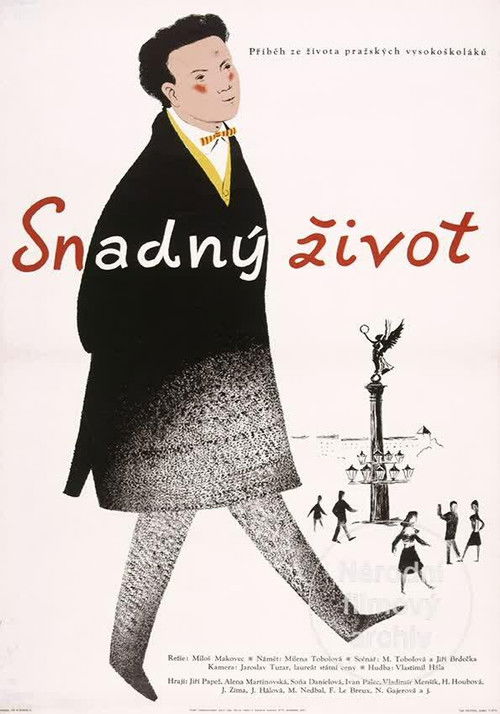
Depiction of Czech students in the 1950s. The kids are less interested in communism than in rock n’ roll. Czech authorities deemed the work decadent and subversive, which led to the director being kicked out of film school.
We learn that the greatest virtue of socialist competition is collective cooperation. This is what the young, physically fit assembler refuses to understand. He suspects his co-workers of overlooking his merits out of jealousy. And it takes him a long time to understand that the individual alone can do nothing, that only the collective has the necessary strength - and therefore the truth.
African student Omar would like to return home to Angola, but he is enrolled in a three-year postgraduate research fellowship at a clinic in Prague. One day while seeing off a friend at the airport, he and a girl named Mariama are brought together by chance as he offers to accompany her in an unfamiliar city toward the International Student Club, where she plays bass in a jazz orchestra.