Acting
Polizeiruf 110 is a long-running German language detective television series. The first episode was broadcast 27 June 1971 in the German Democratic Republic, and after the dissolution of Fernsehen der DDR the series was picked up by ARD. It was originally created as a counterpart to the West German series Tatort, and quickly became a public favorite.
Wolffs Revier is a German television series.
No description available.
Two adolescents, Sauly and Mick, get to know each other while hitchhiking and stick together for the long haul. They both want to reach the ocean, which is some thousand kilometers away. An old car picks them up, but the trip ends shortly thereafter in a sleazy motel. At the bar, a man named Landolfi approaches them. He explains to Sauly that he must have sold his guardian angel to a man by the name of Miller in the city of Prince. Though the boys do not believe in guardian angels, Sauly slowly succumbs to his own fears. He would like to have his guardian angel back again. On their trip, Sauly becomes sick. Mick works on a farm to pay the doctor's bills. Once Sauly is well, they travel farther - until they reach Prince. In this mysterious city, all of the people are named Miller, and once Sauly and Mick finally are at the ocean, they meet Landolfi once more.
The film tells the tragic fate of railroad guard Thiel at the end of the 19th century. Thiel, who spends his days in the dull, monotonous fulfillment of his duties, has lost his gentle, quiet wife Minna. He remarries out of concern for his young son Tobias. His second wife Lene, with whom he also has a child, is superior to him in vitality and has a rough passion. He discovers that his child from his first marriage is being discriminated against and tormented by her - Thiel withdraws more and more into himself and becomes lonely. When Tobias is killed in an accident, he blames Lene, and disaster is inevitable...
The puppet player Sebastian Fußberg moves through the country at the end of the fifties. Despite his age, an unwavering dreamer and idealist. But also a torn person who cannot detach himself from the shadows of his past.
On a forest road in the Brandenburg March, village teacher Potsch accidentally encounters the distinguished Professor Menzel, who got stuck there in his car. In the conversation that ensues, Menzel and Pötsch quickly discover that they both are great admirers of the early 19th-century writer Max von Schwedenow who was born in the area.
Seven-year-old Kati is glad that despite her spastic disability she is allowed to attend a normal school. Her parents made that possible. In her first year there, she is supposed to prove that she can get along at the school and she does her utmost to keep up with her classmates. Her disability, however, is greeted with constant mockery and disrespect. Even her teachers have a hard time treating her equally. When Kati fails math, she has to attend a special school. Katie is devastated but her friends help her to cope with the new situation.
This elaborate two-part television film features a section from the life of communist worker leader Ernst Thälmann. It begins with the bloody riots on May 1, 1929 in Berlin, in which police officers shot at demonstrating workers, and ends with February 7, 1933, when Thälmann appeared as a speaker at the illegal meeting of the Central Committee of the Communist Party of Germany in goat neck. This period was marked by the struggle of the Communists against the ever stronger National Socialists and the rise of Adolf Hitler.
The story of a young German boy and his father who befriend a Jewish family during WWII.
Two men and two women in a hotel.
Fifteen-year-old Heinz Stielke is a Hitler Youth fanatic who is devastated to learn a hidden truth about his respected father who was a German officer in WWII: He was Jewish. Pushed out of his community after the discovery, young Heinz falls into a tailspin of alienation and anger. He is subsequently thrust into a series of social collisions across the war-torn German fatherland.
Maria, a young student sees her brother Dieter going to prison for sedition against the state. She starts an affair with Paul, a judge who turns out to be the one who sentenced her brother, which eventually leads to a confrontation.
In May 1945, a woman in Marienbad reports a murder - committed in 1933 against the German emigrant Professor Lessing. She also names the murderer. Against the wishes of his superior, who does not feel responsible for this case - it was a fascist femicide - Inspector Šedý picks up the trail and arrests the murderer, the German Eckert. Eckert was a fugitive at the trial in 1933, and now the evidence is no longer available. Nevertheless, Šedý does everything he can to convict him. He finds witnesses who support him - anti-fascists, but also former collaborators who want to clear themselves. Reconstructing the case at the crime scene, Šedý is able to prove that Eckert was at least an accessory. He is convicted. After his release from prison, Eckert goes to West Germany, where he demands compensation from his former clients.
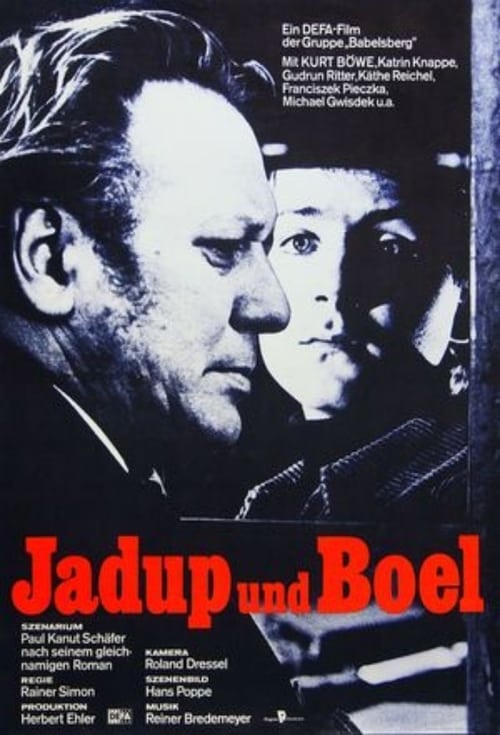
In a small town, everyone has tried to forget what happened shortly after WWII. That is, until a stranger finds a book that Jadup (Kurt Böwe) gave to the young refugee Boel (Katrin Knappe), who resettled in the town over 30 years ago. Painful memories about Boel and the post-war period begin to surface and shake up the whole town. Boel vanished back then and nobody knew why. Word spread about a rape and some tried to blame a Russian soldier. Jadup, the town's respected and popular mayor, remembers, though, how he mistrusted Boel and did not help her through this difficult time; HE didn't even notice THAT Boel loved him. Jadup's confrontation with the past gives him a new, critical view of his current situation and surroundings.
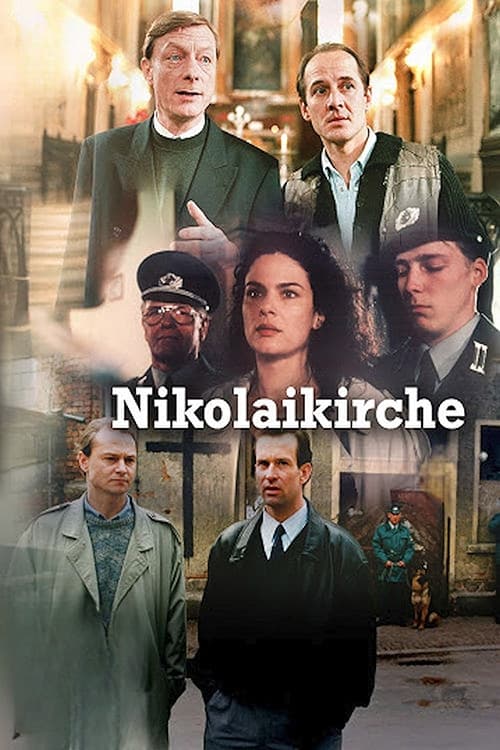
The story of a Leipzig family from 1987 to the Monday demonstrations in 1989. After the death of her father, a high-ranking officer in the People's Police, the daughter joins the resistance movement around St. Nicholas Church. Phenomena such as obedience, followership, spying and resistance are illustrated in this haunting film based on individual people. A film that provides food for thought for the discussion about the fall of the Berlin Wall and recapitulates contemporary history.
1942. The members of the Voß family, mother, two daughters, a daughter-in-law, and a son-in-law, are living in a house at the river. A fellow soldier of son Paul, who fights at the eastern front, delivers his greetings and an embroidered Russian blouse for Emmi, Paul′s wife. Daughter Agnes, whose husband is also fighting in the war, receives a fur vest from the junior partner who is stalking her. Obviously, the vest is also loot from the eastern front. When the family receives news that Emmi′s husband has been killed in action, the war finally enters the house at the river. Emmi commits suicide while Agnes′s husband returns as a cripple from the war front. At home, he has to learn what a price his wife had to pay for the "Russian fur".
The architect Daniel Brenner is in his late thirties when he receives his first challenging and lucrative commission: to design a cultural center for a satellite town in East-Berlin. He accepts the offer under the condition that he gets to choose who he works with. This way, he reunites with former colleagues and friends - most of them architects or students of architecture who have since chosen a different profession due to personal restraint or economic confinement. Together, they develop a concept which they hope will be more appealing to the public than the conventional and dull constructions common to the German Democratic Republic. However, their ambitious plans are once and again foiled by their conservative supervisors. As frustration grows, Daniel has trouble keeping his career in balance with his family-life: his wife Wanda wants to leave for West-Germany.
Otto Scheidel (Manfred Krug) has been captain of the Elbe steamer Jenissei for over twenty years, but his ship, the last of its kind, is going to be converted into a floating restaurant. Otto, whose his strong attachment to the ship has already cost him his relationship with his girlfriend Caramba (Renate Krößner), refuses to take another job and instead joins a railway construction brigade.
A little boy tries to keep a huge Newfoundland dog in his family's apartment.