
Lutz Bacher
Directing
Biography
Lutz Bacher (1943–2019) lived and worked in Berkeley and New York. Her works take various forms and formats, many of which include elements from popular culture, found objects, and personal artifacts that address questions of identity as expressed through sexuality and the human body. Solo exhibitions include: Raven Row, London; Galerie Buchholz, Berlin, New York, and Cologne; Fridericianum, Kassel; Treize, Paris; K21, Kunstsammlung Nordrhein-Westfalen, Düsseldorf; Lafayette Anticipations, Paris; KADIST, San Francisco; Secession, Vienna; Greene Naftali, New York; Kunsthalle Zürich; ICA London; and MoMA PS1, New York. Her work has been included in group shows at Minnesota Street Project, San Francisco; greengrassi, London; MACA Museo de Arte Contemporáneo de Alicante; CAPC Musée d’Art Contemporain de Bordeaux; Forde, Geneva; SFMOMA, San Francisco; Henry Art Gallery, Seattle; Kunstverein Eisenstadt; Cushion Works, San Francisco; Fondazione Prada, Venice; KW Institute for Contemporary Art, Berlin; Galerie Barbara Weiss, Berlin; Kunsthalle Bern; mumok – Museum moderner Kunst Stiftung Ludwig Wien; and Julia Stoschek Collection, Düsseldorf.
Known For

We watch a very slender woman with close-cropped dark hair working at white desk in a small, white, cubicle-like office. Positioned above and to the side of her desk, the camera's wide-angle lens distorts the scene, rendering straight lines as curves, and producing a sense of deep spacial recession in a confined room. Forty-minutes long, Bacher's video distills individual frames from documentary footage, reanimating them as a succession of stills. Time-code numbers at the top of the frame record the date and time of each image. [Overview courtesy of University of California, Riverside]
Closed Circuit
In the fall of 1994, Lutz Bacher sat down camera in hand to find out what her colleagues, friends, and family thought about her. Each conversation was taped and the resulting video, Do You Love Me?, became an artwork known mostly by hearsay, as it is 12 hours long and has rarely been exhibited.
Do You Love Me?

Digital video authored to DVD, color/silent, Carpet
Snow

“'Tomas,' a woman asks between kisses, 'what are you thinking?' To which Tomas replies: 'I’m thinking how happy I am.' The clip loops—the lovers locked in this tender moment, accompanied by piano music and the thrum of rain and windscreen wipers—and with every repeat becomes more cloying and meaningless." Michael Kurtz, e-flux
What Are You Thinking?
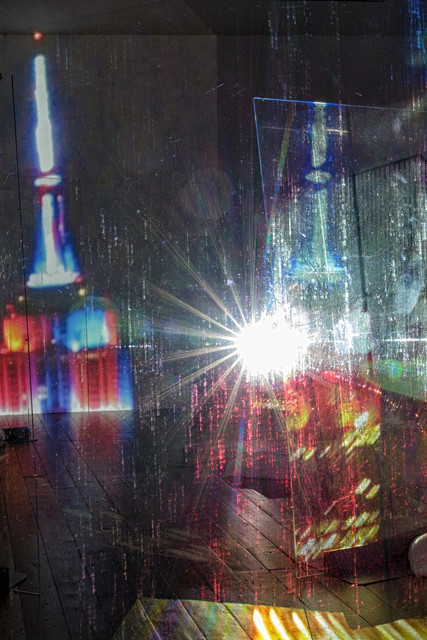
Empire (2014) is a direct reference to Andy Warhol’s eponymous 1964 film, which consists of a single eight-hour-long shot of the Empire State Building. In Bacher’s film, images of the iconic skyscraper—illuminated by twinkling red, white, and blue lights—are fragmented through plexiglass prisms, turning a symbol of American modernism into something unruly, unstable, and fugitive. The images lose integrity each time they are refracted or reflected. Paired with a discordant soundtrack, this work creates a hallucinatory spectacle suggestive of an era of deep uncertainty, marked by climate change and sociopolitical turmoil. [Overview courtesy of MoMA]
Empire

Impulsively, Bacher boarded a seaplane in Manhattan. Once above the city, she videotaped the buildings below. Manhatta (1999) hovers over, zooms into and fractures the unfolding panorama of New York into frayed pixels. Such rippling pixelation was not premeditated, but only a happy accident. Bacher transferred the videotape to DVD in reverse and anomalous, glitching playback appeared. Like other moments of disruption and decay in this exhibition, Bacher used the defect to evoke feeling, much like how distortion is used in music. The artwork takes on other contours when the World Trade Center towers come into view, totally intact. It is eerie how Bacher’s footage carries around its edges the luminous ring of coincidence, fate or premonition, how it evokes but does not show that great historical trauma and how it calls to mind all the other operational footage we have seen from drones, flight decks and other crafts of violence.