Frank Eidlitz
Directing
Known For

This short film features Frank Eidlitz’s early experiments with light, colour and motion. Commissioned by the television network National Broadcasting Company (NBC) to reinterpret the station’s classic peacock logo, Eidlitz produced a series of film experiments with kaleidoscopic spinning lights. To create these visuals, Eidlitz covered a series of disks with pieces of reflective paper and fluorescent colours, which he then placed on an apparatus that spun the disks at a high speed. The motion could be varied and stopped at any time, allowing the artist to create varying designs and images. Opening with a close-up of a woman’s face covered in reflected lights, the majority of the film is comprised of flashing lights and spinning colours. The NBC peacock symbol appears intermittently throughout the film, at the forefront of the image.
NBC

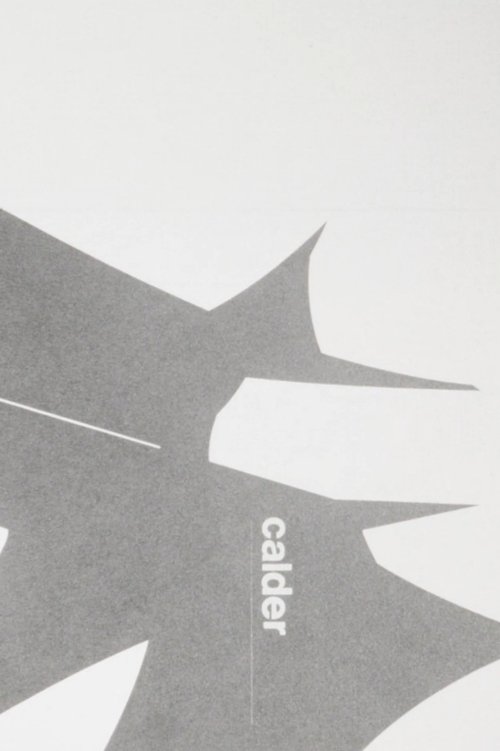
The 1966 construction of Alexander Calder's 'La Grande Voile' (The Big Sail), a monumental sculpture installed in McDermott Court at MIT in Cambridge.
Calder

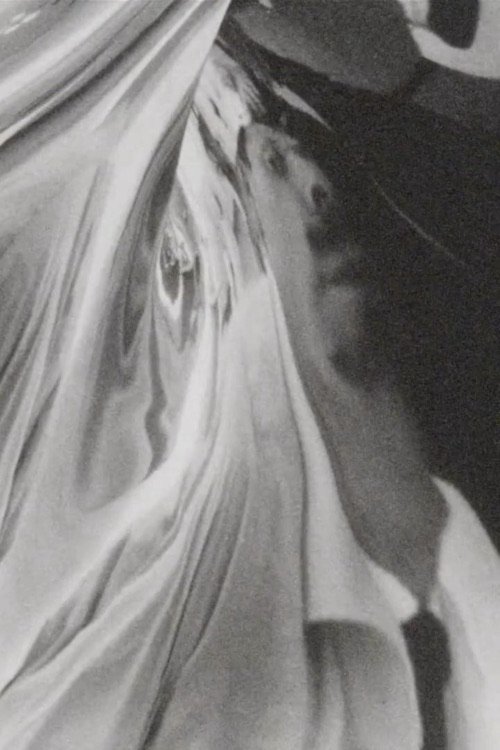
This short black-and-white film by Frank Eidlitz features footage of visual design elements and art objects centred on optical illusion. It includes patterns of lines, geometric shapes and textured surfaces. Opening with a designed title card reading 'Film & Design, Frank Eidlitz', the film also contains a self-portrait: the artist appearing in the reflected surface of a curved metal sculpture, his face warped by the concave and convex surface.
Light

This short film, conceived by Frank Eidlitz and photographed by Maurice Amar, is titled ‘Raga Doll’ and explores experiments with light and movement. Its frenetic pace features fragmented footage of a woman dancing, overlaid with flashing lights and shapes. The accompanying soundtrack is frantic and wild, featuring fast-paced drums and vocal screams.
Raga Doll

This film opens with footage of a woman’s silhouette dancing, overlaid with flashing geometric shapes in red and green. The film then focuses on the woman’s face and subsequently the silhouette of her legs, exploring movement, shadow and light.
Raga Shadow

The film features coloured glitter, spinning lights and metallic reflective surfaces accompanied by the NBC peacock. As well as the disk experiments, the film features several of Eidlitz’s other visual experiments, including close-ups of moving liquid in glass prisms, thick daubs of paint and textured surfaces.
Frank Eidlitz Design Centre

This short film by Frank Eidlitz shows a snippet of Australian artist Brett Whiteley at home with his wife Wendy and daughter Arkie. It was likely filmed in late 1966 or early 1967, before the Whiteleys moved to New York in late 1967. The film shows the artist and his family at home in the evening, reading the newspaper and watching television. Whiteley’s paintings line the walls of the living space, including ‘Fidgeting with Infinity’ (1966), a large triptych painting that dominates the space.
Brett Whiteley

This film focuses on Gyorgy Kepes, an influential Hungarian-American artist with whom Frank Eidlitz studied in 1966. Kepes, a professor at MIT, founded the Center for Advanced Visual Studies (CAVS) in 1967 to facilitate the intersection between art, science and technology. The film, though silent, features Kepes speaking at a seminar. It includes title cards towards the beginning, including one introducing Gyorgy Kepes and another showing a brochure for a symposium accompanying the exhibition in January 1966. It also includes close-ups of Kepes’ influential books, including editions in a variety of languages.
Gyorgy Kepes

This film by Frank Eidlitz contains close-ups of art and design objects on display, as well as light experiments. Objects that appear on film include details of a religious fresco, Jean Arps’ ‘Lion of the Cyclades: Seated’ (1957), metallic sculptures and glass prisms. Some sections are filmed within the exhibition ‘Light as a Creative Medium’, which was curated by Gyorgy Kepes at the Carpenter Center for the Visual Arts at Harvard University in 1965, organised in conjunction with MIT. Interspersed throughout are some of Eidlitz’s light experiments, playing with light, colour and movement. The soundtrack is similarly experimental, consisting of fragments of music, radio voices and electronic noise.