Directing
Mapuche visual artist.
In 1995, the Chilean state made a grave mistake when it detained Marcelina (68), an Indigenous spiritual authority, a machi of the Mapuche people. The police stripped her of her jewelry and traditional clothing and sent her to a men’s prison despite her identifying as a woman. She was unjustly accused of murdering a patient through witchcraft, triggering feelings that led her to leave her community, even after her innocence was proven. Thirty years later, Cons (34) delves into her story—into a world foreign to her—confronting lessons and prejudices she had never known.
No description available.
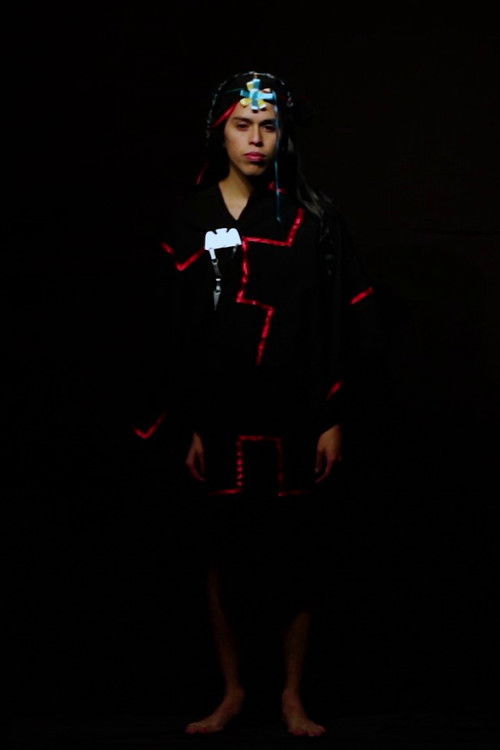
You Will Never Be a Weye is a video performance by Chilean artistə Seba Calfuqueo inspired by the ancestral culture of the Machis Weyes, which, despite its vital role, was historically concealed after the arrival of the Spanish conquistadores on Chilean soil, and not accepted by the imported models of society, religion and patriarchy, despite his vital role for Mapuche people. Archival documents on Machis Weyes culture are almost completely non-existent, yet they are reported in the 1673 book El Cautiverio Feliz by the Spanish writer Francisco Ñúñez de Pineda y Bascuñán. In this book, he states referring to a Machi Weye: “He resembled Lucifer in features, size and costume. He wore no underwear because he was of those called hueyes”.
The early 20th century fable “The Fox and the Otter,” from the Historia y Conocimiento Oral Mapuche: Sobrevivientes de la campaña del desierto y ocupación de la Araucanía (1899–1926), tells the story of a homoerotic relationship between two animals – a fox and an otter, both males – where anal penetration is seen as an offense to masculinity. This 3D animated video proposes a new version of the fable, where its protagonist is a transgender vixen who, by means of its charms, achieves to attract the otter, unsettling colonial constructions about desire and heterosexuality and allowing to break these paradigms and create new cosmologies.
Draped in an electric blue fabric, the artist acts as a conduit between the tangile and the spiritual, blurring the boundaries between human form and natural elements.