Werner Dissel
Acting
Biography
Werner Friedrich Dissel (26 August 1912 – 22 January 2003) was a German actor, director, and resistance fighter against the Nazi regime. Dissel's began working as a newspaper photographer in the late 1920s. After the Nazis' rise to power, he became a member of an antifascist group headed by Harro Schulze-Boysen, and was involved in the resistance newspaper Wille zum Reich. Dissel was caught and imprisoned from 1937 to 1939. During his time in prison, the Gestapo arranged for Boysen to visit him, in the hope that something incriminating would be said while the two would be left alone in a tapped room; Boysen passed a cigarette pack to Dissel, on which he wrote that the police had no concrete evidence against him. After his release, Boysen convinced him to volunteer into the Wehrmacht, so he could "destroy Hitler's army from within". Dissel joined the armed forces shortly before the German Invasion of Poland, and served in a military meteorology unit. At 1942, he barely avoided an arrest during the Gestapo's crackdown on the Red Orchestra. After the war, he openly joined the KPD and decided to pursue his old dream to become an actor. Dissel joined a cabaret in Wiesbaden, and in 1950 emigrated to East Germany. There he appeared in numerous plays, TV shows and movies. He worked with the Berliner Ensemble, DEFA and DFF. He continued his acting career after the reunification. In total, he appeared in more than a hundred film and television productions. He received the Art Prize of the German Democratic Republic at a collective awarding in October 1986. Source: Article "Werner Dissel" from Wikipedia in English, licensed under CC-BY-SA.

Known For

Polizeiruf 110 is a long-running German language detective television series. The first episode was broadcast 27 June 1971 in the German Democratic Republic, and after the dissolution of Fernsehen der DDR the series was picked up by ARD. It was originally created as a counterpart to the West German series Tatort, and quickly became a public favorite.
Polizeiruf 110

A long-running German television series about a two-man team of highway police, originally set in Berlin and later in North Rhine-Westphalia.
Alarm for Cobra 11: The Motorway Police

German soap opera about the staff of the fictional hospital "Sachsenklinik" in the city of Leipzig.
In aller Freundschaft

Der Staatsanwalt hat das Wort was an East German television series.
Der Staatsanwalt hat das Wort

No description available.
Der letzte Zeuge

No description available.
Auf eigene Gefahr
No description available.
The German Bronx

Immenhof is a German television series.
Immenhof

In 19th century France, Jean Valjean, a man imprisoned for stealing bread, must flee a relentless policeman named Javert. The pursuit consumes both men's lives, and soon Valjean finds himself in the midst of the student revolutions in France.
Les Misérables

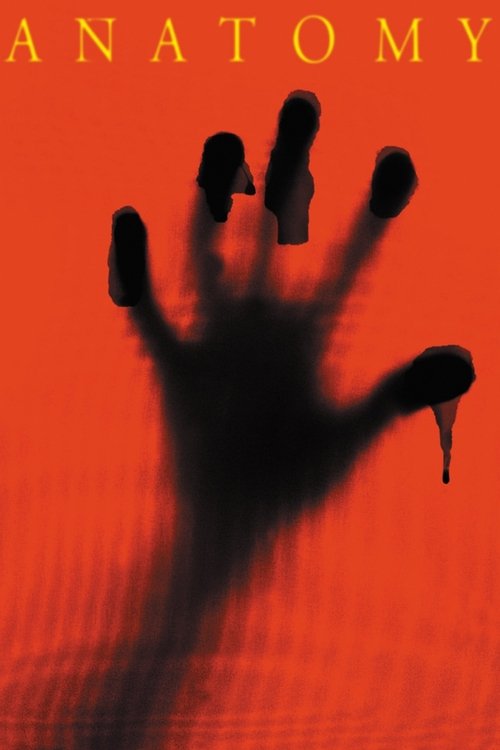
Medical student Paula wins a place at an exclusive Heidelberg medical school. When the body of a young man she met on the train turns up on her dissection table, she begins to investigate the mysterious circumstances surrounding his death.
Anatomy

This five part epic war drama gives a dramatized detailed account of Soviet Union's war against Nazi Germany during world war two. Each of the five parts represents a separate major eastern front campaign.
Liberation - Part 3 : Direction of the Main Blow

Barfuß ins Bett is a German family television series, broadcast in 14 parts between 1988 and 1990.
Barfuß ins Bett

Motzki is a German television series.
Motzki

Philipp, a closeted teacher, is dating a female colleague to keep up appearances. One night he stumbles into a gay bar and falls for a man. Transformed by this love, he is no longer afraid to face up to who he is.
Coming Out

The "Fiery Arc" tells of a grandiose battle on the Kursk Bulge in the summer of 1943. Here was the largest tank battle in the history of World War II. Along with the personal fate of the heroes, the film shows battle scenes, the activities of headquarters and intelligence, those who worked at the front and in the rear.
Liberation - Part 1 : The Fire Bulge

1949. Grafenberg in Brandenburg shortly before the foundation of the GDR. Here lives Michel Hollmann and works in roadmaking. His purpose in life are his wife Lotte and the two children Gerda and Heinz, for whom he is reconstructing a summerhouse into a “nest”. In Grafenberg, his siblings are living as well: His brother Karl, the mayor, and sister-in-law Edith, who works in a textile factory, with their son Jürgen. Edeltraut, his sister, has married the lamp fabricant Berthold Bennert and leads a well-off life. They as well have a son: Harald. Part of the family are further sister Hanna and brother-in-law Hermann, who is a fisherman on one of the local lakes and conducts a tenacious private war against old Stegewald and his presumptive prince-electoral rights. They are living their lives with their large and small conflicts, with different intentions, and yet remain connected always.
Die Lange Strasse

On the run from police in America, Antonio Morena, a former World War II aviator and black-marketeer, finds himself in South America working for the all-powerful United Fruit Company, known to the natives as "the Green Monster".
The Green Monster

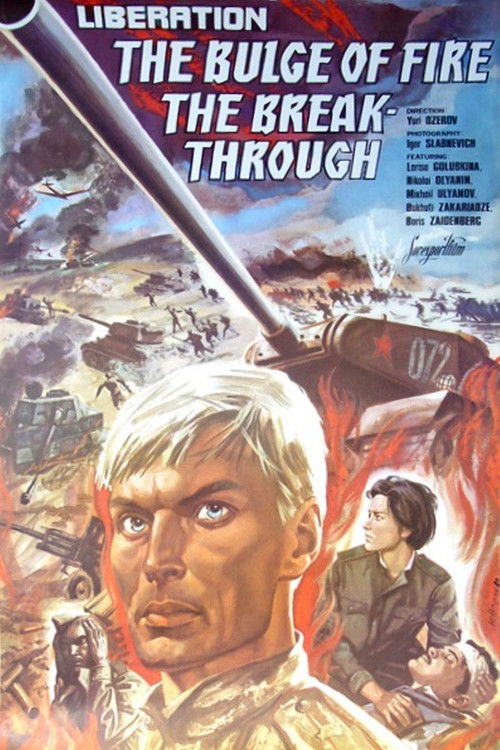
Fascist Italy's prime-minister Mussolini is arrested following the Allies landing in Sicily. Meanwhile, Soviet troops plan their offense towards Kyiv. Lt. Col. Lukin's regiment crosses the Dnieper river as the division's vanguard. Unbeknownst to them, they're merely a ploy to mislead the Germans so the rest of the army can catch them off guard.
Liberation - Part 2 : Breakthrough
No description available.
Geheimkommando Ciupaga

Based on a true story of inmates at KZ Buchenwald that risked their lives to hide a small Jewish boy shortly before the liberation of the camp.