Mariella Buscemi
Writing
Known For
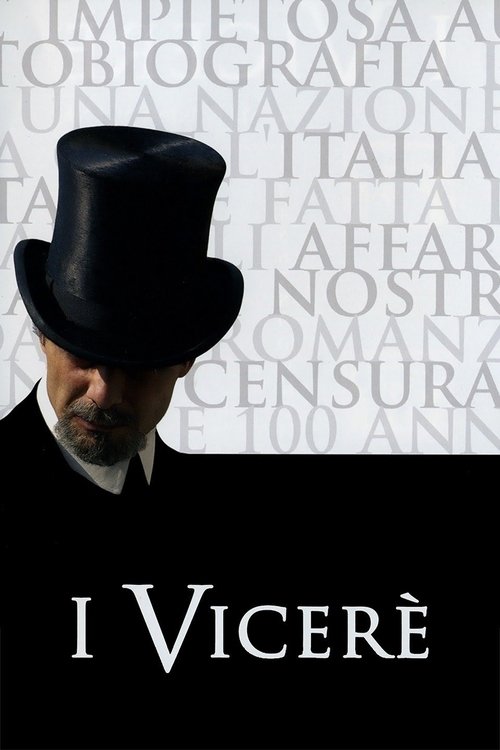
In late 19th-century Sicily, the noble Uzeda family—whose lineage dates back to the ancient viceroys that ruled those lands—fights to preserve its waning power in the face of the newly unified Italian regime.
I Vicerè

Margherita is a 14 year old living in Milano, who shares everything with her friends. They discuss clothes, music, school and that first kiss. A delightful coming-of-age film in which the here and now is all that really matters. Where every little thing is so very important and where feelings sometimes bubble over. In your teens, there’s no room for anything but friendship and love.
That's Life
The film Les temps des Assassins is not only an extraordinary work, but it is also an extraordinary exegesis of Rimbaud's clairvoyance. It begins with the seer: the reflection of a fight in the glass of her glasses, while the wind moves her hair, how the clouds move, how the duelists move, perhaps the murderers. But "I is another," Rimbaud wrote. To be, to know how to be a witness, the visionary must begin a journey to discover the depth of this "other" which is the self. Meet houses, antennas, clouds along the road that winds fast through the car windows, while the sun beats on the glass, refracts on the glasses, making the visionary's gaze invisible. And then there are the mysterious intermittences: the galleries, "the connections, the passages, the representations", which, according to Novalis, are the landscape of the unknown self. And here fragments emerge that are no longer composed in a landscape: a gun, a face, a head, a body, a mouth wide open in the silent scream, and colors.
Les Temps Des Assassins
Inspired by the short story Aurélia (1854) by Gérard de Nerval, which will influence André Breton and the Surrealists, the film tells, with a contracted rhythm and visual accelerations / dilations, the daily experience of a woman projecting her into an interior dimension where reality and myth are mixed and fused by a dreamlike syntax. In the "descent into hell" of consciousness, Aurélia ends up by detaching herself from her identity as a woman of today to take on the multiple features prefigured, from time to time, by her imagination. Aurélia's frenetic final dance serves as a ceremony to exorcise evil, the furious rediscovery of the “double” savage buried within each of us, the abrupt awakening of the possessed bacchant, liberated vitalism, myth, explosion of fantastic energies. Aurélia faces a discourse on filmic time: real time is decomposed analyzed accelerated in lightning-fast mental paths from a stream of consciousness.
Aurélia
Catabasi is intimately interrelated with Anabasi, constituting the second phase of the search for the self. Etymologically, "catabasis" means the descent, the return (as opposed to "anabasis": the ascent). In this film, the Woman tries to return to herself, to the depths of physiological life, to rediscover her lost identity in her own body through dance. Dazzling images spring from his liberating dance, culminating in a rite of anthropological origin (some African peoples still living at an ethnological level practice a similar dance, based on jumps upwards). In the body, the Woman finds unsuspected energies buried, releasing a vitalism that contemporary capitalist society tends to exorcise as its insidious enemy.
Catabasi
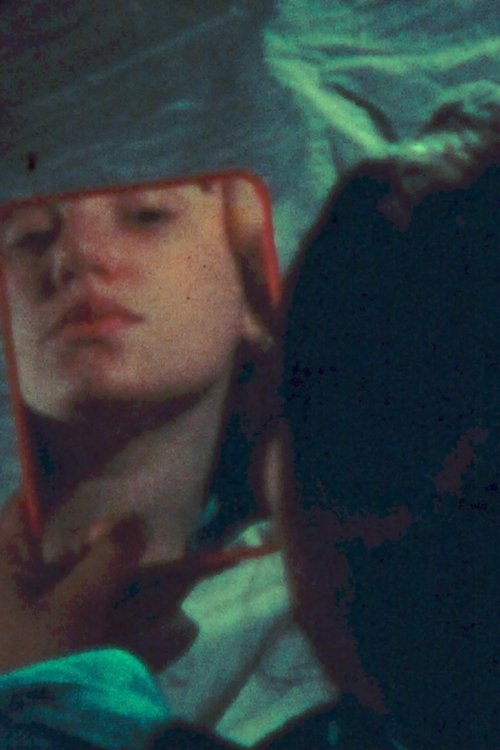
In Anabasi there is a fantastic projection of something strictly private, autobiographical: the author's relationship with his wife, which is poetically transfigured and goes through a series of metamorphoses: woman-fruit, woman-earth, praying mantis. (…) The recurring places inhabited or traveled by the Woman are the House and the Garden, a physical and mental place that becomes, from time to time, a primeval Eden and a Labyrinth full of dark presences. The Woman walks through the Garden-Labyrinth in search of a lost symbiosis with nature. Continuously enters and exits the Oedipal Womb-House. The vineyard and the cosmos in formation and perennial metamorphosis spring from his own body. At times they seem to incorporate it within themselves, in a panic relationship of total identification. The Garden, the Vineyard, the Sun allude to solar and telluric symbolism, to the great seasonal myths of fertility.
Anabasi
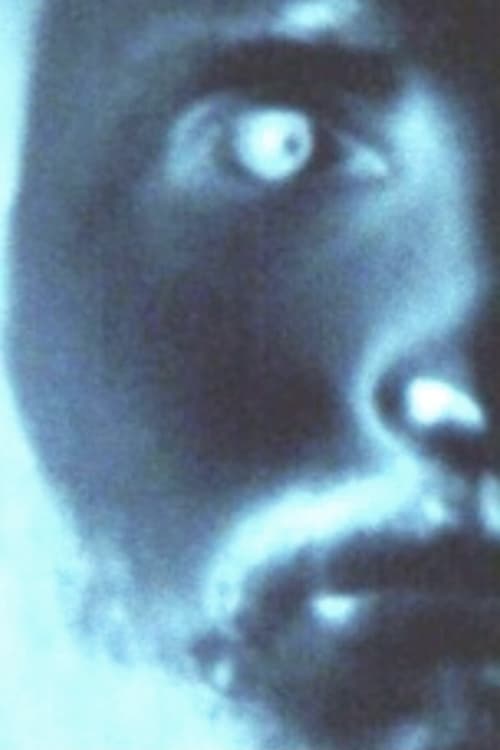
Structural film conceived as an architectural construction where compositional rigor slows down and incorporates a Dionysian feeling of existence, wants to represent through almost physical blocks of frames a feeling of horror for the violence that pervades the contemporary world: lifeless bodies abandoned in cars lost in the bush, the advance of a marching army, a face that deforms into an expressionist scream, other faces, alternation of positive and negative frames: visual leitmotifs that recur obsessively.
Composizione Per Sequenze E Frequenze
A videopoem by Arcangelo Mazzoleni.
Elegia Per Una Figlia Del Fuoco
Four integrative short films for a multimedia theatre play.
DIKTAT: Il Tempo Del Titano
Short graduation film inspired by Anaïs Nin's private manuscript diary and Antonin Artaud's "Letters From Rodez".
Dai Diari Di Anaïs Nin
he white wings of a dove seem to come out of the darkness of the infinite night of the soul. As if looking for an escape route, the dove plows through the space of a house, flies grazing over a house of cards, flies over a baroque table set ... The television screen, teeming with pixels, swallows the eye projecting it into an unknown deep space of nature technological. Visions of medieval and contemporary battles, baroque allegories, Bosch and Dulle Griet and hedonistic paradises alternate with dazzling images: a sicilian performance by the Living Theater, faces that splash from the screen, overlap, suddenly emerge from the unconscious. Each moment of vision contains Time, which pulsates on the screen, compressed and flashing, at the speed of 24 frames per second.
Lo Spazio Interiore
Integrative short film for a multimedia theatre play.
EURIDICE
The chromatic research based mainly on primary colors yearns for the incandescence of red, for strong tonal contrasts, with the gaze turned to an anti-naturalistic, subjective, internalized color, which looks to the Fauves, Munch and German Expressionists but also to Boccioni and Picasso for the metamorphosis of the human figure (here the female body) and his struggle against Euclidean geometry; to the Suprematists and Constructivists, cited in the geometric forms: sharp spiers of piercing light, flashes of lightning, triangles like blades that cut the screen and chase the evanescent bodies in the dark.
Mandala Opus #7 - Poema Dell'Estasi
This" theory of the eye "is clarified even more in From body to cosmos of 1994. The film begins with a flight of fast clouds in the sky, with their elusive shapes, which capture and make the smoke of Etna cloud, like if heaven and earth were caught in a single, unstoppable flight. But here it is Mazzoleni's own eye, which emerges several times, that disrupts the visible. Inside and outside are mixed: bodies, totemic and vegetable masks. Reality decomposes, reveals its hidden colors, those that are hidden in the heart of things at the time of creation, according to a myth of Lurian Kabbalah. Clouds, a meadow blown by the wind, the moving shadow of a room: everything escapes again, elusive. But the eye of the machine, but the eye behind the machine, also catches a naked and unarmed eye that appears among things: the seer is also what he sees. I is another. I is also a thing among things.