Camera
No description available.
Marek is a 15-year-old from a provincial village who runs away to Prague when he begins to fail at school. He is mugged shortly after arriving in the city and is rescued by Honza with the promise of work. Marek is taken to an apartment, drugged, and becomes a male prostitute. He is a bit smarter than his colleagues and teams up with a friend, David, in order to go after bigger scores – to cash in and get out. They manage to stash away a bit of money, but when it comes time to return home, Marek loses his nerve and is soon back in the city.
The film is a metaphor for the Cold War. It depicts two neighbouring nations: peace loving Fortuna and the not so peaceful land of the Steel City.
Experienced StB investigators in the 1950s dismantle a terrorist action against the collectivisation of a village in the foothill village of Mezilesí. The screenwriter returned to the schemes that were common in our countries in the 1950s.
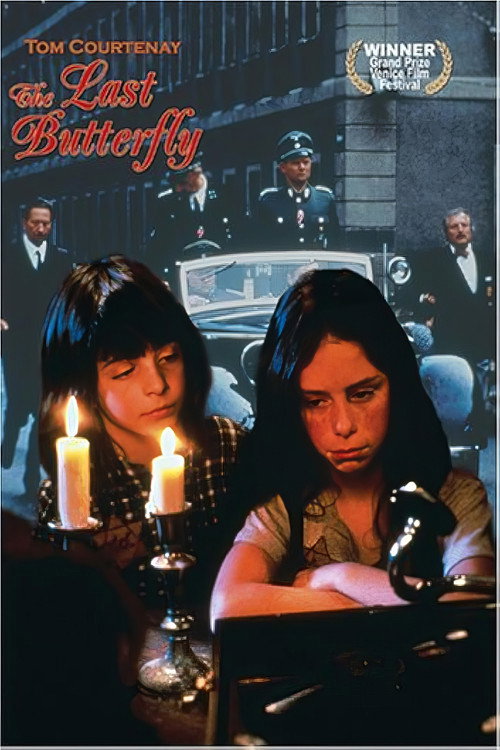
Stage mime Antoine Moreau is compelled by the Gestapo to put on a performance for the children of Terezin, a "model" concentration camp, to convince the Red Cross observers that the camp is truly what it seems. Reluctant at first, Moreau slowly learns the true nature of the camp, including the meaning of the "transports" on which people leave. With a world-class orchestra (made up of people interned in the camp) and a cast of children, Moreau stages a show to end all shows.
The economic crisis in the early 1930s also affected the inhabitants of the distinctive Moravian-Slovak countryside. The protagonist and his family returned to their native cottage from the city because he could not find work anywhere. But his younger brother does not welcome him with open arms...
The film was based on the novel "Milión" by Karel Štorkán. The book and the film depict the events surrounding the great construction disaster in Prague in 1928, in which 46 construction workers died. The disaster thrilled the entire republic at the time, yet was never fully explained. The filmmakers focus on the story of Ing. Vondrák, the designer of the construction.
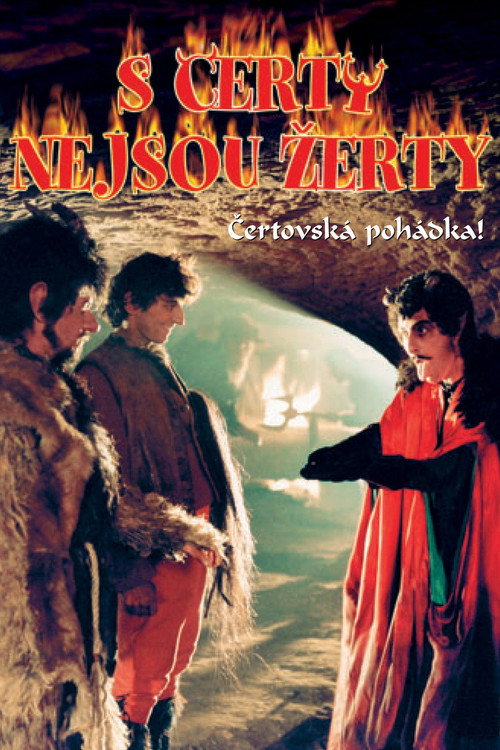
Dorota, a bad woman married the miller, out of sheer greed drives him to death. She then took the mill away from his son Peter and threw him out of the hime. Lucifer, who is known to rule in hell, sends out the devil Janek. He is supposed to fetch Dorota because the measure of her earthly sins is overflowing. But the devil himself can not handle this evil woman and flees to the military. There he meets Peter. By joining forces, they finally succeed in transporting the wicked Dorota to hell. Since then hell is hell. But for Peter, who is suddenly in possession of a magic mantle, begins a nice time, because strangely, the prince shows great interest in him.
Honza Pavelka (Jan Hrusínský) wins the junior motorbike speed races. His thirteen-year-old brother Martin (Roman Cada), his assistant and biggest fan, answers the questions of his schoolfriend Pavlína in a superior tone. Student Zuzana (Libuse Safránková), who gave her scarf to Honza to wear around his neck for the races as a talisman is Honza's girlfriend. He met her when he came to her parent's home to repair the TV set. Honza declines an invitation to celebration with his friends. He goes off with Zuzana instead, but she refuses his intimate advances. The offended young man, who is about to serve his two years in the army, tries to blackmail her emotionally and the couple breaks up. Martin tries various schemes to bring them together again.
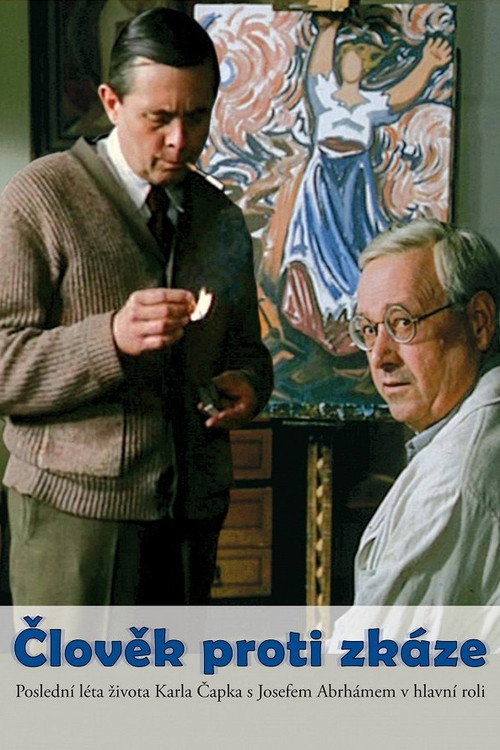
Biography of Karel Čapek.
Dr. Lorenc selects excerpts from older Czech films for a symposium on laughter.
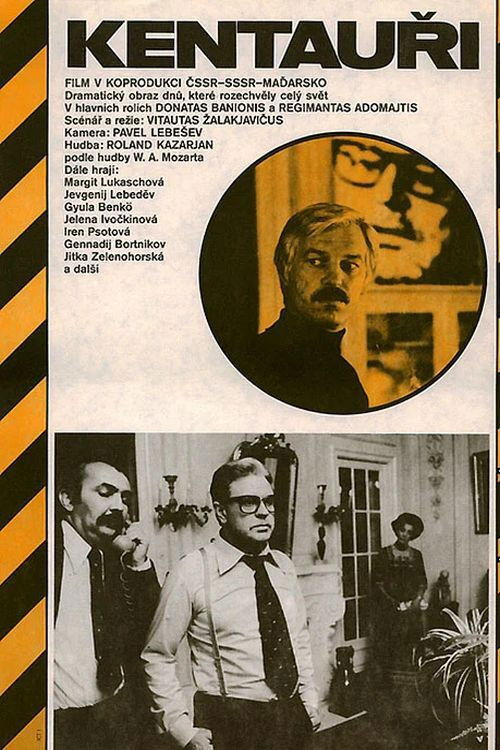
A political conspiracy is brewing in an unnamed Latin American country. Everything is in play: blackmail, bribery, political assassinations, newspaper slander. The operation, code-named "Centaur", is conceived in Washington.
In this movie, TV sets are full of life. If a person is in TV (e.g. because it was filmed on the street) it has a double that's right in the TV set. This double needs energy from the true character to survive. Each time, the real human watches TV, his Double will pull life energy from him. So there's a mysterious Death-serial. Many persons die in front of their TV set and nobody knows why. Olda, the main character, is one of the persons, that get more and more weak. He is near death, till Fisarek, the natural healer appears. He teaches Olda how he can resist this magic force and how he can fight it.
The year is 1936, the nervous atmosphere of the Nazi threat penetrates into the sport. Upgrade boxe Vilda Jakub will compete with German Kurt Schaller. The Nazis decisions are used in order to win his master even the dirtiest means. Vilda inspect their game and focus on the preparation of environmental events. The story culminates in the victory of one of the two lovers, between which Vilda tense moments in the decision.
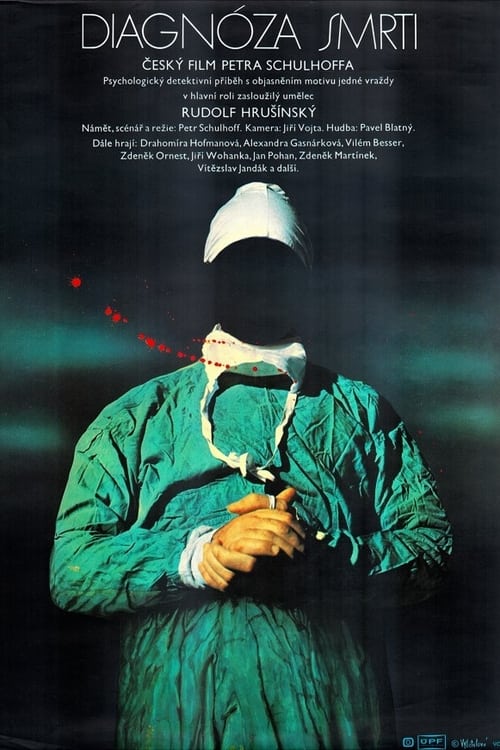
Two seriously injured patients are brought to the hospital at almost the same time: truck driver Honza Linhart, who had an accident, and a young woman found unconscious in a forest by a man picking mushrooms. The woman is identified as Katerina Marková, the divorced mother of a young girl. Major Kalas (Rudolf Hrusínský) suspects that she is a victim of mugging since a bloodstained small ax has been found near the site of the crime and, according to witnesses, Ms Marková was missing her watch and a bracelet, from which a gemstone has also been discovered. Linhart has lost his only kidney in the accident; in order to live a normal life again, he will need a kidney transplant from the mugged woman if she dies.
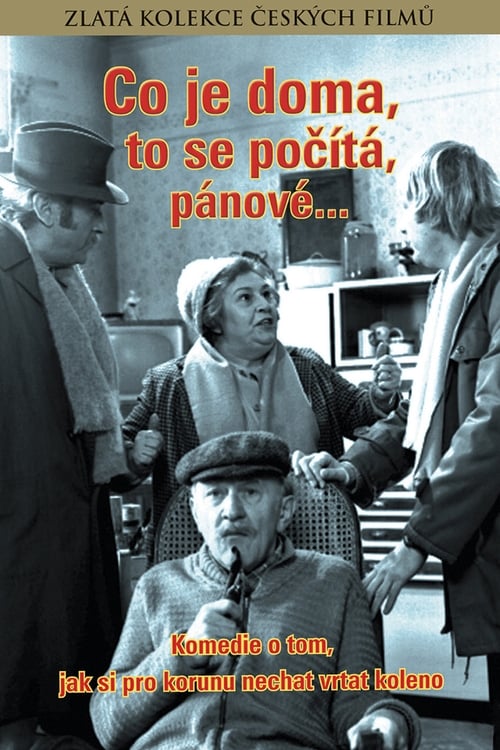
A psychological film about the sense of self-fulfillment of a divorced couple over 30 who feel that life is slipping through their fingers. While she, a nurse by profession, is adapting better, he, unreliable and always improvising, is searching in vain for his clue and even tries to get back to his ex-wife.
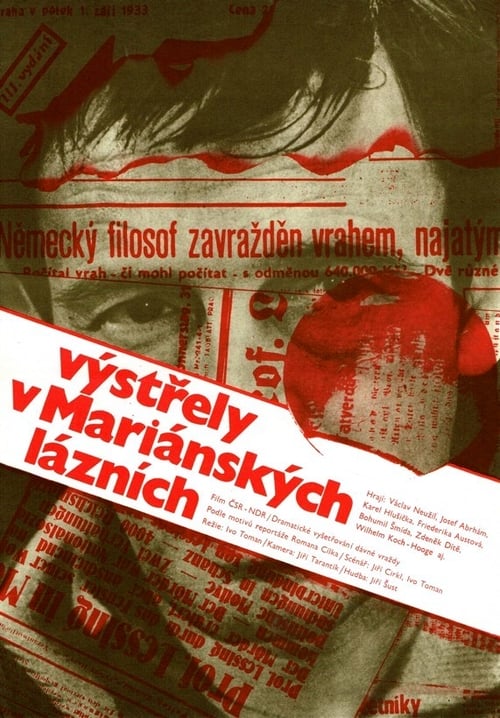
In May 1945, a woman in Marienbad reports a murder - committed in 1933 against the German emigrant Professor Lessing. She also names the murderer. Against the wishes of his superior, who does not feel responsible for this case - it was a fascist femicide - Inspector Šedý picks up the trail and arrests the murderer, the German Eckert. Eckert was a fugitive at the trial in 1933, and now the evidence is no longer available. Nevertheless, Šedý does everything he can to convict him. He finds witnesses who support him - anti-fascists, but also former collaborators who want to clear themselves. Reconstructing the case at the crime scene, Šedý is able to prove that Eckert was at least an accessory. He is convicted. After his release from prison, Eckert goes to West Germany, where he demands compensation from his former clients.
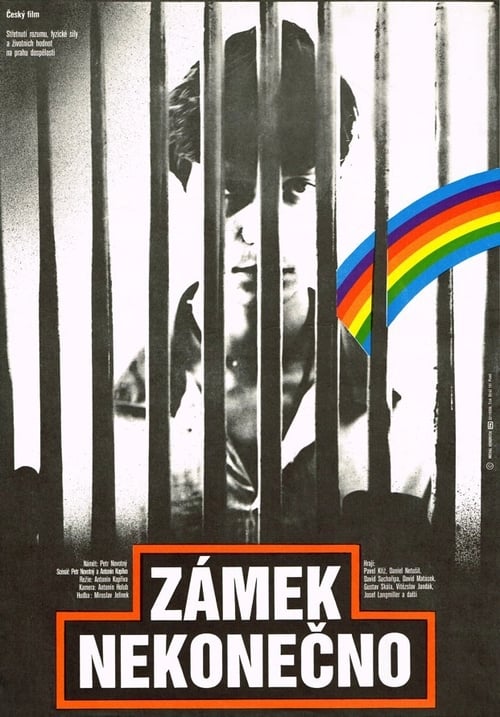
Technical school student Pavel Brychta, arrives at a youth correctional facility located within a chateau in Konečno. He is an atypical, but not hopeless case for the institution. Pavel comes from a well-off family and his antisocial behaviour on the verge of criminality was some kind of response to his difficult relationship with his authoritative father. However, it takes quite some effort for Pavel to find his place in this environment of bullying, and also diverse methods from the tutors
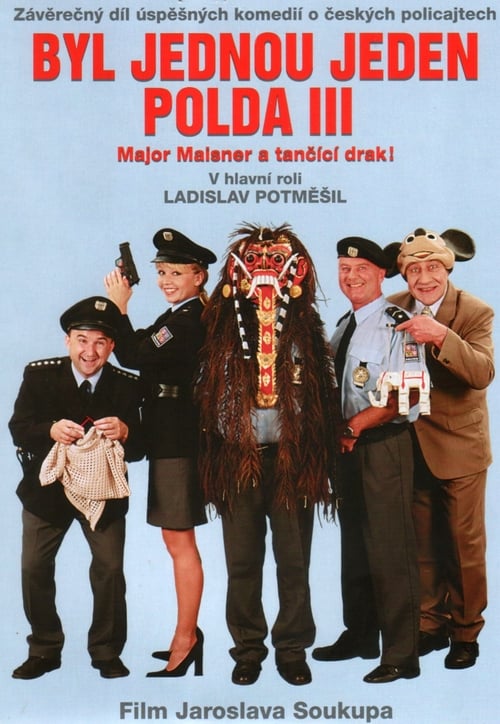
Major Maisner, head of Interpol for Central Europe and neighboring Asian countries, is fulfilling his mission in Bangkok, Thailand. When he returns from his mission, he has no idea that his doppelganger, sent here by the Thai mafia, is acting on his behalf in the Czech Republic.
For the Novák and Bartáček families, money is king, and they'll do just about anything to get it. While René Novák pitches his parents a lucrative scheme to swindle as many people with the last name Novák in the country as possible, the Bartáček clan decides to pretend to be much poorer than they really are in order to siphon some dollars from an American relative. And it doesn't take long before these separate scams start to intertwine.