Mikhail Boyarskiy
Acting
Biography
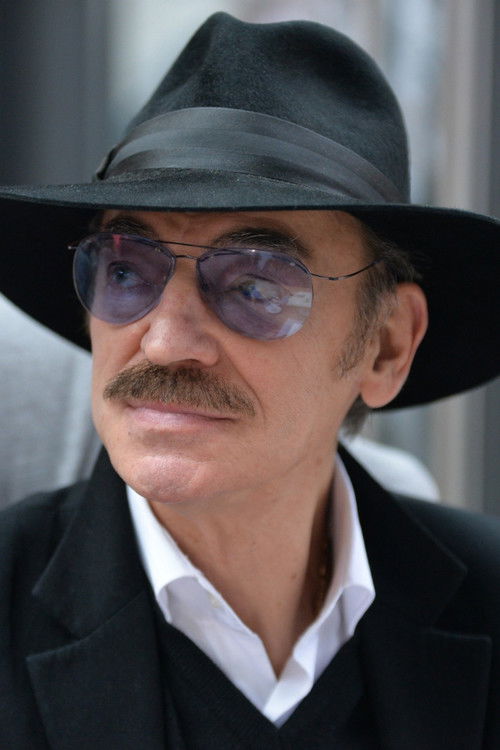
Mikhail Sergeevich Boyarskiy - born in Leningrad, RSFSR, USSR - Soviet and Russian theater and film actor, singer, musician, People's Artist of the RSFSR (1990). From 1988 to 2007, he was the artistic director of the Benefis Theater he created in St. Petersburg. After school, he entered the Leningrad State Institute of Theater, Music and Cinematography (L.F. Makariev’s course), after graduating in 1972, he got an audition for the director of the Lensoviet Theater Igor Petrovich Vladimirov and was accepted into the troupe. He began his theatrical career with participation in extras - in the play "Crime and Punishment" by F.M. Dostoevskiy, where he played a student. Much greater popularity was brought to Mikhail Boyarsky by the main role of the Troubadour in G. Gladkov's musical "The Troubadour and His Friends". Boyarskiy was accidentally noticed by employees of the Moldovan film studio and invited to the film "Bridges" (1973), where the actor starred with Mihai Volontir. Boyarsky's second film work was the episodic role of the Italian tenor Ninardi in Leonid Kvinikhidze's musical vaudeville "Straw Hat" (1974). Fame came to him in 1975 - after the role of Silva in the film "Elder Son". The role of the Wolf in the Soviet-Romanian musical fairy tale "Mama" (1976) also became noticeable. One of the actor's best works was Teodoro in Jan Fried's musical television film Dog in the Manger (1977) based on a play by Lope de Vega. Awards: Order of Friendship (January 22, 2002), Order of Merit for the Fatherland, IV degree (December 25, 2009), Order of Honor (September 21, 2020), Friendship Order (July 19, 2001), Medal "In Commemoration of the 300th Anniversary of St. Petersburg "(2003), Order of Honor (October 25, 2011, Moldova), People's Artist of the RSFSR (December 18, 1990), Honored Artist of the RSFSR (November 26, 1984), Badge of Honor "For Services to St. Petersburg" (2019).
Known For

KVN is a Russian humour TV show and competition where teams compete by giving funny answers to questions and showing prepared sketches. The programme was first aired by the First Soviet Channel on November 8, 1961. Eleven years later, in 1972, when few programmes were being broadcast live, Soviet censors found the students' impromptu jokes offensive and anti-Soviet and banned KVN. The show was revived fourteen years later during the Perestroika era in 1986, with Alexander Maslyakov as its host. It is one of the longest-running TV programmes on Russian Television. It also has its own holiday on November 8, the birthday of the game, which KVN players celebrate every year since it was announced and widely celebrated for the first time in 2001.
KVN Major League

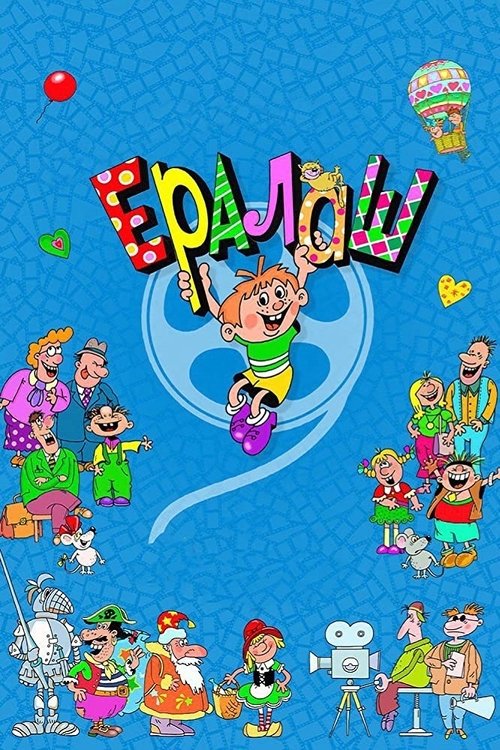
The children's humorous film magazine "Yeralash" is a one-of-a-kind work of cinematography that ironically approaches the solution of everyday problems, focusing on the views and needs of modern society, allowing different generations to achieve mutual understanding.
Yeralash

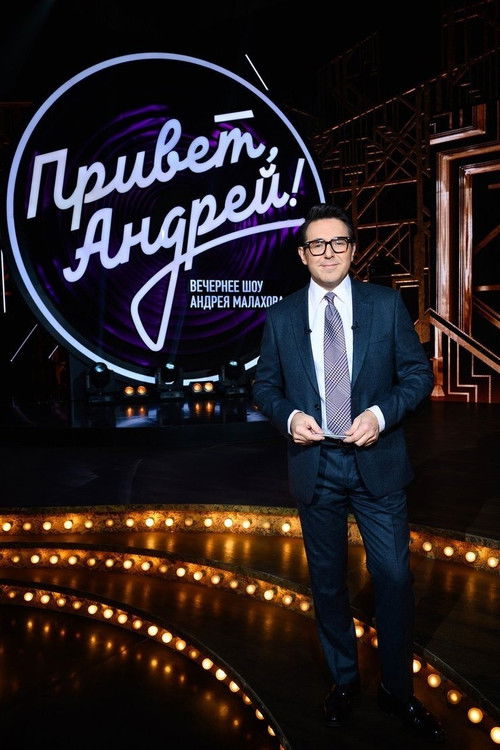
Guests are invited to the studio to have conversations with Andrey Malakhov, where they talk about their personal and professional successes, as well as anything else that interests them. Through these open discussions on air, viewers get a complete impression of the guest's life and their perspective on various issues.
Hello, Andrey!

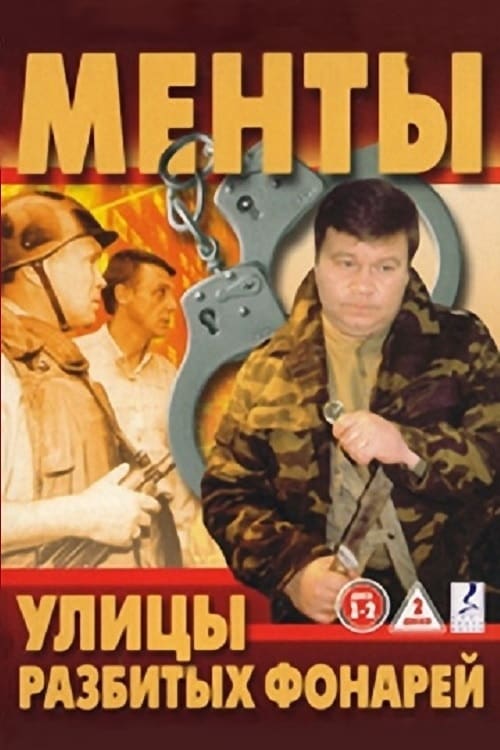
Russian detectives unwind the ball of the most intricate and cruel crimes. They are consummate professionals, the best cops in town. Even on the most dangerous missions, this quartet never loses their sense of humor. It is it that helps them find the most incredible ways out of any situation. They uphold the law and emerge victorious.
Streets of Broken Lights

The "Big Difference" is created not only for the audience, but also for those who became the hero of the parody - TV presenters and actors. A guest who comes to the studio seems to see himself through a magnifying glass, because all the details are taken into account in the parody: the character's manner of dressing, speaking, diction features, plastic, makeup, hairstyle. The uniqueness of the project is that in addition to entertainment, the program also has a developmental function. After all, our guest, who is being parodied, has a chance to look at himself from the outside, to see his shortcomings and advantages. Some people like themselves, and some don't. But the main thing is that no one remains indifferent.
Big Difference

The action takes place in Victorian England in the last quarter of the 19th century. 27-year-old amateur detective Sherlock Holmes becomes a bystander to a crime along with Dr. John Watson, a military doctor who has just returned from the war in Afghanistan. During the investigation, Watson, not yet having an apartment in London, settles with Holmes in Mrs. Hudson's «half board», and then takes part in the affairs of his new friend. Watson gives Holmes boxing lessons. Watson himself is an experienced boxer, able to deal with several opponents with his bare hands. In addition, he is an excellent marksman. Considering Holmes a genius, the doctor decides to tell the whole world about his talent and the mysteries he revealed in his stories, where he often embellishes the events («the true story» of which the series presents). Watson is taught to embellish events by the editor-in-chief of the «Morning Chronicle».
Sherlock Holmes
Fabrika Zvyozd, sometimes known internationally as Star Factory, is a popular Russian television talent show that aired on Channel One from 2002 until 2007. It was the Russian version of the Endemol format Operación Triunfo.
Star Factory

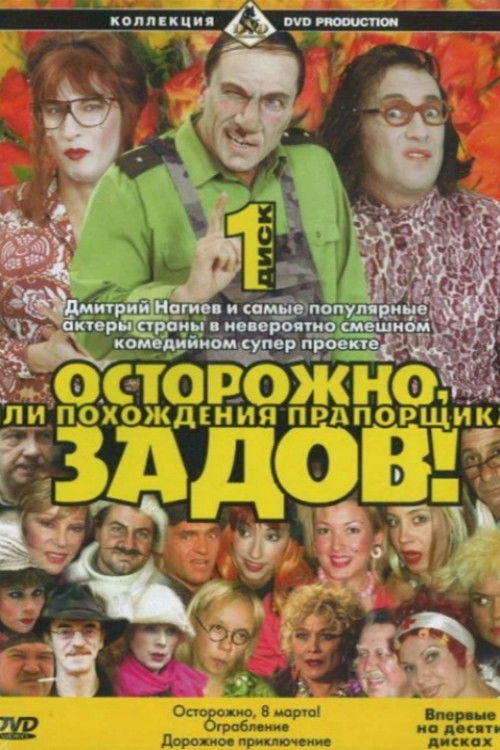
The face and habits of this very original character are well known - the unique and irresistible Ensign Zadov is one of the main characters of the comedy series "Beware, Modern!2».
Careful, Zadov!

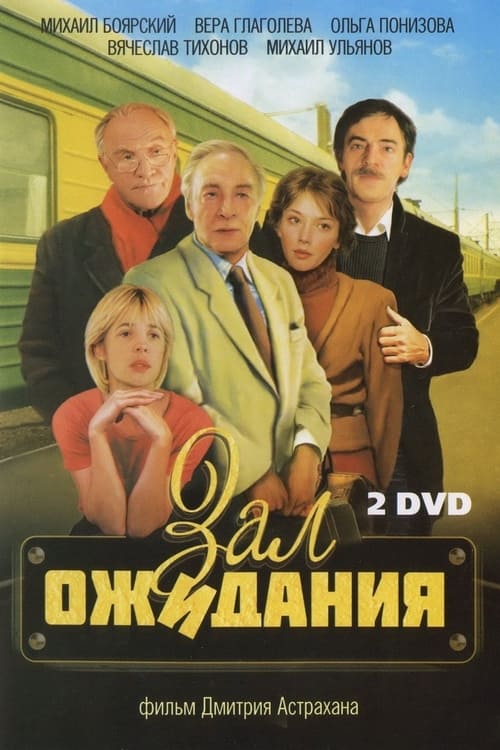
A 'runaway' homeless man, once a renowned athlete, finds himself marooned in the small, snow-covered town of Zarechensk. Victor lands a job at an orphanage, where he soon meets a young teacher who becomes both a compassionate friend and the love of his life. However, fate doesn't play out simply as good or bad; it unfolds in a way that makes the hero realize one cannot run away from oneself. Consequently, it is in Zarechensk that a train carrying a film crew from the capital, on their way back to Moscow, is compelled to delay their journey for a few days. Remarkably, Zarechensk becomes the place where a director finally discovers the perfect actress for his leading role and encounters a man who has fled from her love. Meanwhile, a producer makes the ultimate decision to select this town as the filming location for her upcoming movie.
The Waiting Room

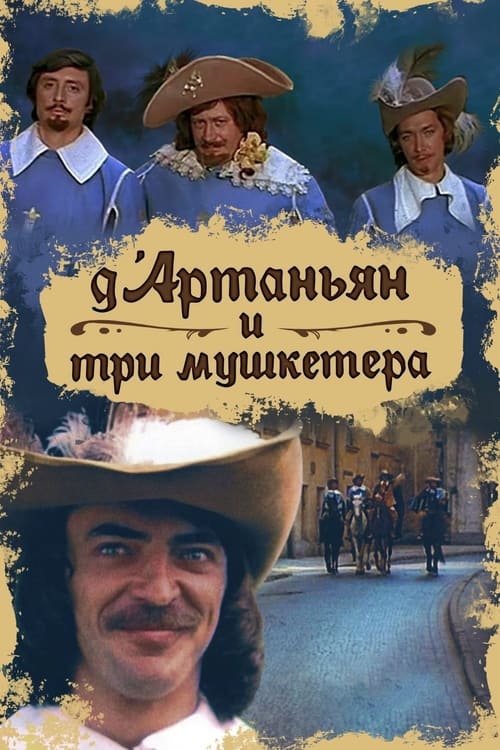
The musketeers battle against the all-powerful Cardinal Richelieu and the treacherous Milady.
D'Artagnan and Three Musketeers

XVI century. In France, there is a fierce struggle between Catholics and Huguenots. The reign of the Valois dynasty is nearing its end. Conspiracies, the elimination of rivals, the creation of secret and explicit coalitions are part of the daily life of the royal family and close associates. Love stories are woven into the canvas of palace intrigues that will affect the history of the world.
Queen Margot

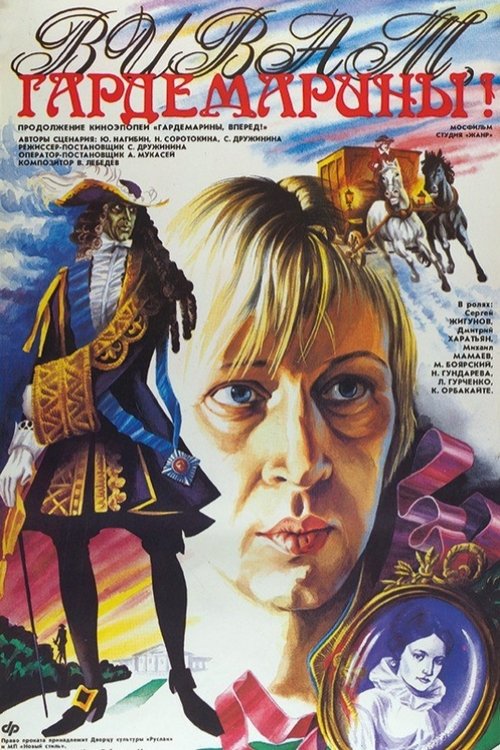
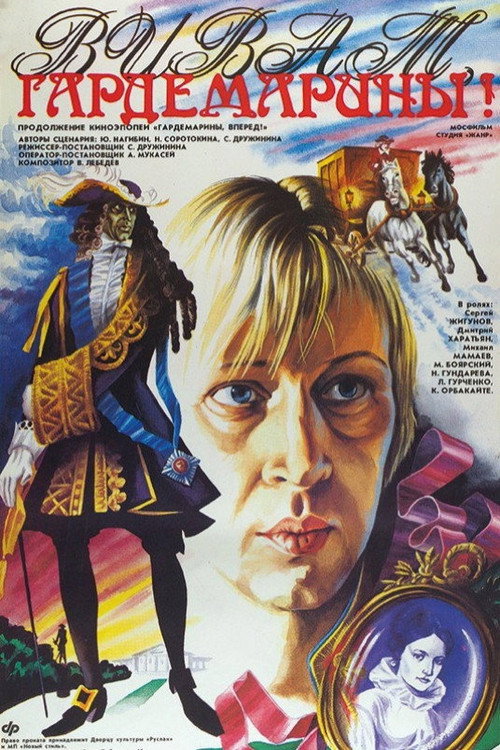
1744. Russian Empire. Being childless, but at the same time wanting to finally consolidate on the Russian throne of his - "Peter's" line of the Romanov dynasty, Empress Elizabeth Petrovna decides to marry his nephew Karl Peter Ulrich, brought from Prussia, called in Russia "Peter Fyodorovich" to some noble, but preferably not very rich and not very willful European "princess". Elizabeth is intrigued by the brave young guardsman and his intercession for Yaguzhinskaya, and she gives Belov "an assignment of national importance" - to secretly bring his important guests to Russia from Prussia. The ubiquitous vice-chancellor Bestuzhev learns about it. He summons Alexei Korsak, Belov's friend who will keep Alexander company on his trip to Prussia, and instructs him to become a spy on Belov, threatening Korsak with "exile to the galleys" and "Siberia" for his wife and young son if he refuses.
Vivat, Naval Cadets!

No description available.
The Return of Musketeers or the Treasure of Cardinal Mazarini

No description available.
Tonight

No description available.
Главная сцена

In turbulent times for France and herself, the first minister of the Kingdom of France, Cardinal Mazarin, asked Queen Anne of Austria to give him the names of four friends who successfully helped her in the fight against Cardinal Richelieu. Under pressure from Mazarin, Queen Anne calls the name D'Artagnan, lieutenant of the royal musketeers. Mazarin calls D'Artagnan and orders him to find Athos, Porthos and Aramis in order to attract them to his service...
Musketeers Twenty Years Later

Three naval cadets accidentally get possession of a secret diary that was stolen from Bestuzhev, a vice-chancellor of Russia. If this diary ever gets abroad, the consequences for the country would be grave. The cadets are trying to return the papers to their owner, but there are others who want to get the papers...
Naval Cadets, Charge!

After the deaths of d'Artagnan, Athos, Porthos and Aramis the Queen Anna of Austria has to ask for help of the heroes' sons. They, however, cannot fulfill her request on their own. The original musketeers have to literally return to live and embark on a new adventure.
The Return of Musketeers or the Treasure of Cardinal Mazarini

The 3rd part of the famous trilogy by Alexandre Dumas about d'Artagnan and his 3 friends Athos, Porthos and Aramis.
The Secret of Queen Anna or Musketeers 30 Years Later

No description available.