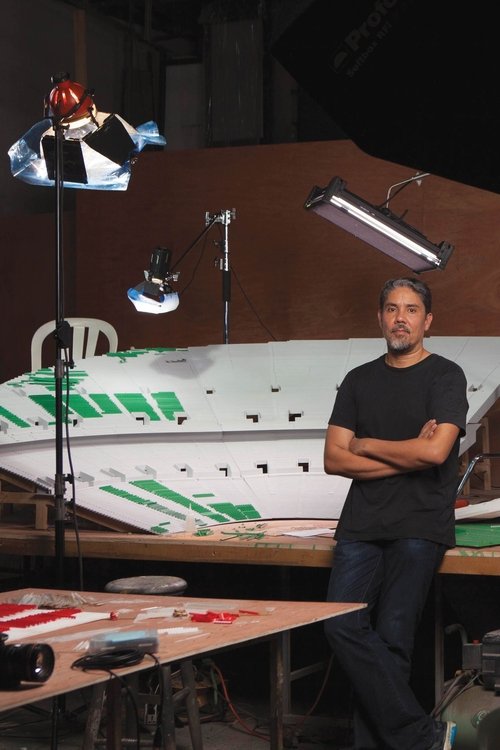
Paul Pfeiffer
Directing
Biography
Paul Pfeiffer was born in Honolulu, Hawaii, in 1966 but spent most of his childhood in the Philippines. Pfeiffer relocated to New York in 1990, where he attended Hunter College and the Whitney Independent Study Program. Pfeiffer’s groundbreaking work in video, sculpture, and photography uses recent computer technologies to dissect the role that mass media plays in shaping consciousness. Pfeiffer is the recipient of numerous awards and fellowships, and was the inaugural recipient of the Bucksbaum Award, given by the Whitney Museum of American Art (2000). In 2002, Pfeiffer was an artist-in-residence at Massachusetts Institute of Technology, and at ArtPace in San Antonio, Texas. In 2003, a traveling retrospective of his work was organized by Massachusetts Institute of Technology’s List Visual Arts Center and Museum of Contemporary Art, Chicago.
Known For

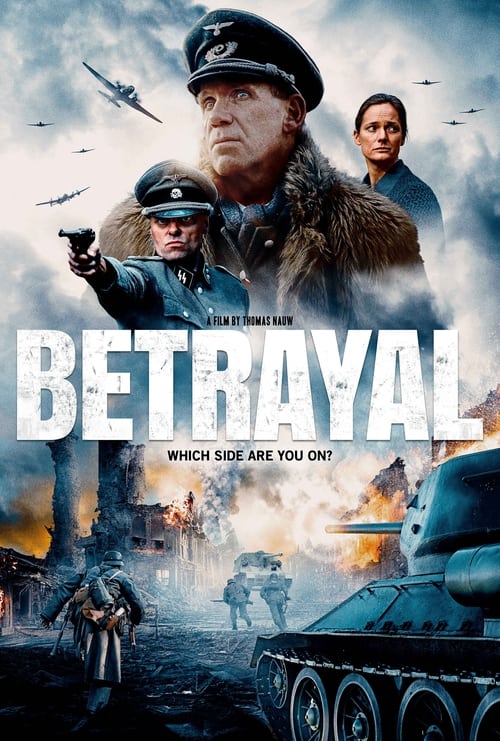
During the final months of World War II, a Nazi officer assigned to protect the war-torn frontline in the Netherlands decides to risk his life to protect a Jewish family in hiding.
Betrayal

Live From Neverland is part of my ongoing series of works with found footage, a recreation of a public statement Michael Jackson read on television around the world in 1993. I chose the footage less for the content of the speech and more for the global recognition factor. This televisual image of Jackson is also just a visually arresting image with a dream-like quality to it, thanks to the saturated colors and the shocking whiteness of his face. [...] The scene seems staged and affected. This footage is paired with a second video image showing a chorus of 80 men and women performing Jackson’s monologue in unison. [...] I slowed down the Jackson footage, synching the movement of his mouth to match the measured pace of the chorus. In the resulting slow motion image, Jackson appears to be struggling to speak, as though he’s stuck in some viscous medium and can barely move.
Live From Neverland

Morning After the Deluge is a large-scale, single-projection video installation, preferably presented in a dedicated room where the projected image is directed onto a free-standing screen. The work features two pieces of real-time footage that the artist filmed in Cape Cod, Massachusetts – one a sunset over the Atlantic Ocean and the other a sunrise on Cape Cod Bay – that are merged together and presented on a continual loop. As the sun slowly disappears into the ocean on one side, it rises out of the water on the other. In this new arrangement, the usual figure-ground relationship is upended: the sun becomes a fixed point at the centre of the image while the horizon line becomes unfixed, slowly wandering across the frame from top to bottom.
Morning After the Deluge

The Long Count III (Thrilla in Manila) is the third in a series of works based on the three best-known fights in Muhammad Ali’s career between 1964 and 1975. It addresses the last rounds of the final boxing match between longtime rivals Ali and Joe Frazier, held in Manila on October 1, 1975 and ultimately won by Ali. The subtitle - Ali’s promotional slogan - indicates the subject of this work. Pfeiffer has effaced the figures of the boxers from the ring by digitally copy-pasting sections of background over them. However, they remain as blurred contours, a ghostly presence, and the ropes surrounding the ring occasionally move as one of the invisible fighters leans against them. The soundtrack was extracted from interviews with the boxers who participated in the three fights; Pfeiffer has edited out the words, and only sounds like stammering and breathing remain.
The Long Count III (Thrilla in Manila)

In 'The Long Count (I Shook Up the World)," a tiny video monitor, which plays and replays in a continuous loop the third round of the 1964 match between Sonny Liston and Cassius Clay. Characteristically, the three-minute sequence has been Pfeifferized: the figures of Liston and Clay have been removed from the sequence as completely as current technology allows, serendipitously leaving a pair of ghostlike, barely discernible presences that flicker across the surface of the crowd like wind moving over water.
The Long Count (I Shook Up The World)

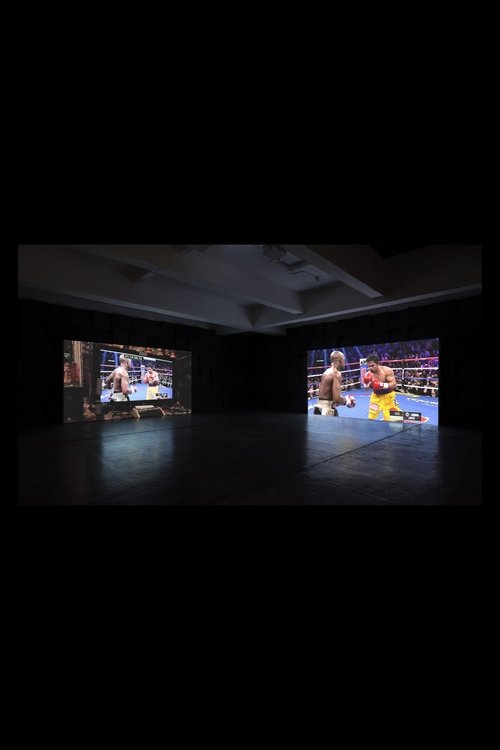
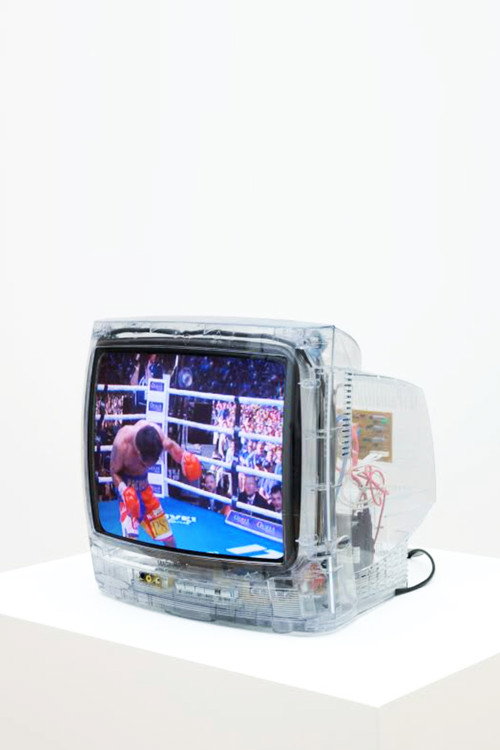
Foley artists re-record the sound of the 2015 Mayweather-Pacquiao fight. Two channel installation.
Three Figures in a Room

The Stanley Cup bobs and floats around.
Caryatid

Pfeiffer converted a moment of midgame triumph for the Knicks forward Larry Johnson into anguished isolation in a piece titled "Fragment of a Crucifixion (After Francis Bacon)." By simply eliminating the other players, the crowds, even the insignia on his uniform, Mr. Pfeiffer converted Mr. Johnson's arm pumps and energized jubilation into expressions of terror. The player seemed like a hunted animal or a martyr and, either way, a profoundly disturbing metaphor for the plight of the black man in American culture. -Roberta Smith
Fragment of a Crucifixion (after Francis Bacon)

The Long Count (Rumble In The Jungle), is the second of three works in which the artist has painstakingly removed Muhammad Ali from the boxer’s most famous bouts. This piece continues his investigation of racial identity through his use of popular iconography, namely athletes and movie stars, across various media.
The Long Count II (Rumble In The Jungle)

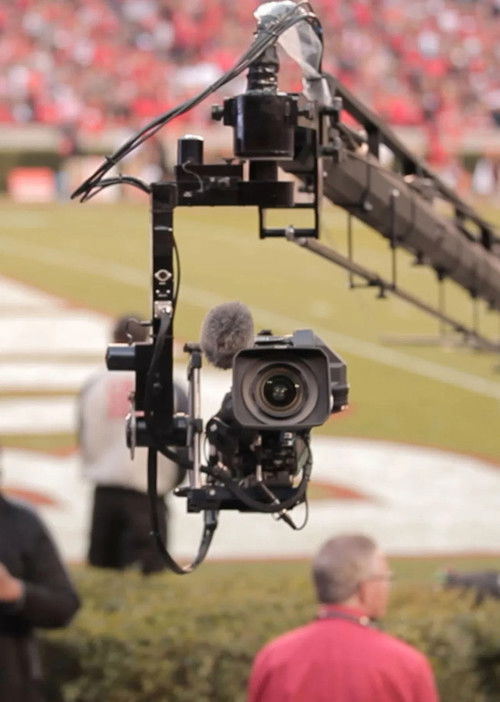
Stitches together audio and video recordings the artist made of the University of Georgia Redcoat Marching Band. Named for an image display system that responds to how the human eye perceives color, this immersive video installation layers sensory components to reproduce the experience of attending a college football game.
Red Green Blue
"In the video ‘John 3:16’...a reference to a passage so often quoted that its sort of the Biblical code for the New Testament that gives you the formula for salvation and eternal life. There’s an interesting kind of resonance that I see between this idea of a formula for salvation and eternal life and the promise of digital media that never break down and literally can live forever...that can always be copied endlessly. In a way, the medium itself represents a kind of promise that almost has spiritual overtones." - Paul Pfeiffer
John 3:16
Paul Pfeiffer’s video installation of a boxer Frank Lamar Martin being punched during a boxing match, with his opponent visually removed.
Caryatid (Martin 'The Ghost')
A short video comprised of collaged footage of the encarnadores at work, a live Justin Bieber concert in Mexico, rice paddy farmers in the Philippines, Buddhist meditation DVDs, and kids from various countries singing along to Justin’s remix of Luis Fonsi’s Despacito posted on social media. Pfieffer’s video explores mimicry–whether as popular fandom, sculpture, photography, videography, or digital image capture–as an act of devotion, and the ways by which beliefs, which control how one views oneself and the world, spread like wild-fire across an expanding mediated landscape.