Jutta Hoffmann
Acting
Biography
Jutta Hoffmann was born on March 3, 1941 in Halle, Saxony-Anhalt, Germany. She is an actress, known for Bandits (1997), Der Angriff der Gegenwart auf die übrige Zeit (1985) and Karla (1965). She is married to Nicolaus Haenel. They have one child. She was previously married to Herrmann Zschoche.

Known For

Every evening at 6:45 p.m. sharp, a prominent guest takes a seat on the red sofa—and DAS! provides daily updates on what's hot in the north.
DAS!

Polizeiruf 110 is a long-running German language detective television series. The first episode was broadcast 27 June 1971 in the German Democratic Republic, and after the dissolution of Fernsehen der DDR the series was picked up by ARD. It was originally created as a counterpart to the West German series Tatort, and quickly became a public favorite.
Polizeiruf 110

The SOKO Stuttgart team investigates analytically and with sensitivity in the likeable state capital. The exciting cases of the series lead them to bizarre crime scenes and to different milieus.
SOKO Stuttgart
No description available.
German Film Award
Annual awarding of the Grimme Awards.
Grimme Award

Bella Block is a long-running German detective television series starring Hannelore Hoger, first broadcast in 1994 on ZDF. In 2010 the 30th series was produced.
Bella Block
No description available.
Telestar

Motzki is a German television series.
Motzki

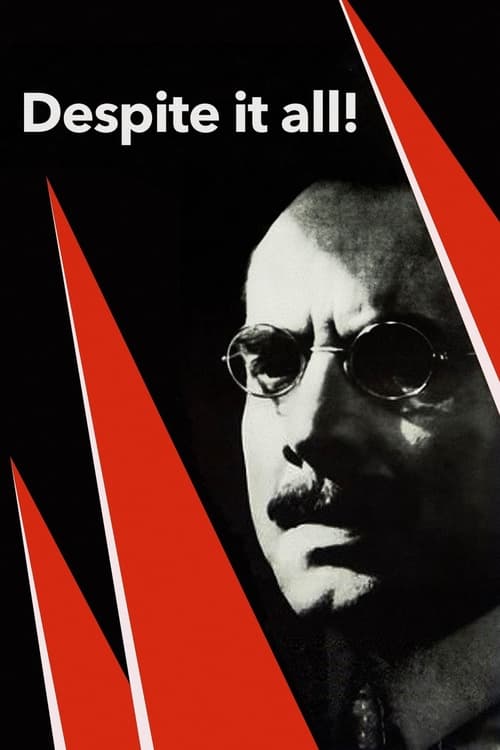
October 1918: Karl Liebknecht is released from prison and Berlin workers celebrate his release. Although WWI is almost over, the German Kaiserreich in vain sends its last reserves to the slaughter. The working class is in a rebellious mood; the uprising of Kiel’s sailors against war and militarism sets off a call for revolution led by Liebknecht. On November 9, Liebknecht declares the Free Socialist Republic of Germany. But pro-Kaiser military and right wing Social Democrats oppose him.
Despite It All!

Four female cons who have formed a band in prison get a chance to play at a police ball outside the walls. They take the chance to escape. Being on the run from the law they even make it to sell their music and become famous outlaws.
Bandits

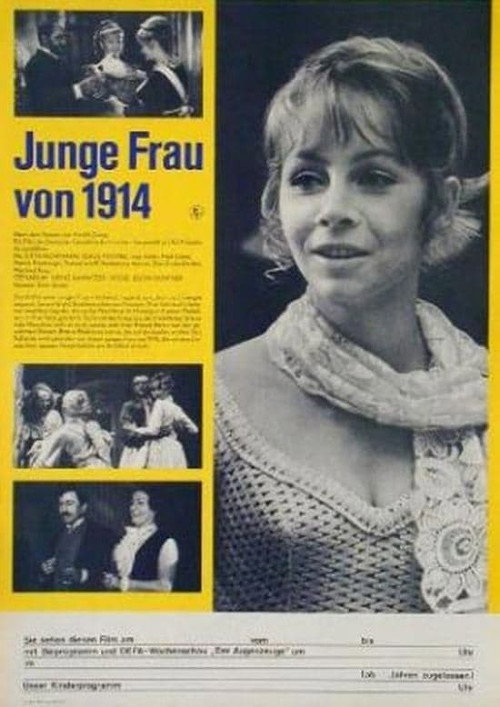
In 1914 Berlin, bank heiress Leonore Wahl and struggling Munich student Werner Bertin fall passionately in love, defying class and her parents’ expectations. Their idyll is shattered by the outbreak of WWI: Werner, swept up in patriotic fervor, is conscripted to the Western Front, while Leonore, pregnant and abandoned, faces her family’s condemnation and a clandestine abortion. Set against the tumult of war, the film explores idealism, social divides, and the personal costs of duty and desire.
Junge Frau von 1914

Three couples want to spend a short break together. Some have a traffic accident, the others are prevented professionally. So the designer Robert and the youth helper Ellen are forced to spend the days in a remote farmhouse alone with her young son. The previously suppressed marriage crisis breaks open. Allegations, confessions, charges, self-accusations are in the room. Painfully, they come to the realization that only their own happiness is responsible for their happiness. With the old landlord, each of them finds himself. In the end, Robert and Ellen want to try a new beginning.
Geschlossene Gesellschaft

Oskar Roehler's drama Der Alte Affe Angst (Angst) is about the dissolution of a couple. Robert (Andre Hennicke) and Marie (Marie Baumer) have little in common other than their sex life. Since Robert is going through a bout with impotency, they are having a very rocky time. Robert learns that his father, whom he is estranged from, has died. This disturbs Robert so much that he visits a prostitute, and is able to engage in sex with her. Marie discovers the infidelity, and the prostitute has a surprise of her own. Angst was screened at the 2003 Berlin Film Festival.
Angst

Prague 1913: The family of newspaper publisher Alexander Reither, traditionally reunited for a New Year's dinner, moves along convoluted and secretive paths in everyday life. Granddaughter Wally is impressed by the opaque businessman Marko Gelusich. Her cousin Adrienne meets the young socialist Joseph Prokop at an illegal anarchist meeting. On a business trip to Vienna, Alexander Reither falls in love with Irene v. Claudi. Adrienne wants to move completely into Joseph Prokop's proletarian world, but her mother Kalivoda makes her a painful announcement. Joseph already has a girl. Alexander finds Irene v. Claudi in Budapest. They spend happy days in Vienna. In Prague, the printing workers go on strike. Adrienne fights alongside the workers and Robert Kalivoda. She experiences class struggle with her cousin Guido Frank. Alexander tries to introduce Irene to the family.
Farewell to Peace

This is part one of a two-part biopic about Karl Liebknecht. In 1914, Germany is arming itself for war. Karl Liebknecht, left-wing revolutionary Social Democrat, workers’ leader and a virulent antimilitarist, is one among 110 SPD members of Parliament who vote against approving war loans. From then on, he is considered un-German and a traitor to the fatherland, and his own party’s leadership turns against him. Despite threats, Liebknecht speaks up against the war and writes the manifesto “The Main Enemy Is at Home.” Even when he is arrested and charged with treason, he does not surrender.
As Long as There’s Life in Me

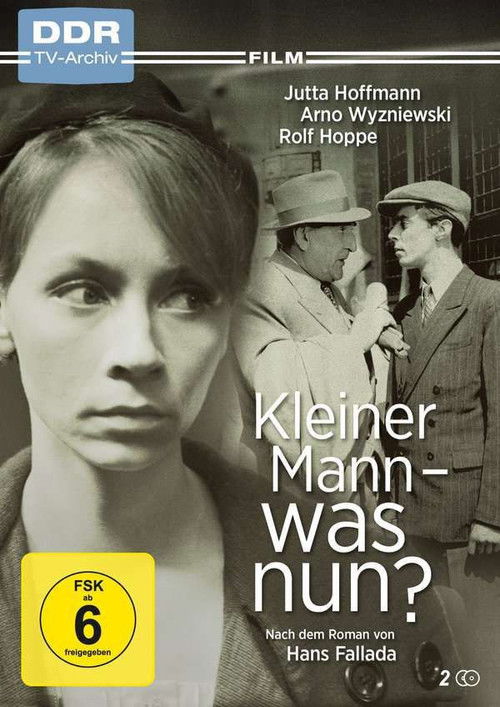
The love story of Emma and Johannes begins during the hard years of the Great Depression. Emma repeatedly tries to encourage her husband, who is suffering terribly from unemployment. However, the crisis continues to intensify and social disintegration affects millions.
Kleiner Mann – was nun?

In this East German film, the third one in The Third is Margit's third lover. After her mother's death, Margit has two affairs which don't work out, and one lesbian friendship which she retains. She is looking for a husband, though, and thinks she has spotted a candidate in her fellow factory worker. As she contemplates marrying him, her story is told in a series of flashbacks.
Her Third

An idealistic teacher is shocked to discover her pupils are already cynical and opportunistic. Her colleague soon grows resentful when she uses new and challenging techniques to help her students overcome obstacles.
Carla

19-year-old NVA soldier, Alex Karow, is sent to the West German-East German border in May 1974, shortly after Willy Brandt's resignation and during the World Cup. The army is dominated by brutal rituals, tolerated or used by the officers. Alex understands that the ideals of balance, democracy and human dignity are propaganda. The question of what happens when the other appears in the sights of the Kalashnikov occupies the soldiers day and night, interrupted almost exclusively by the games of the World Cup with the historic encounter between the GDR and the FRG. Alex draws strength from his love for Christine, a confident tractor driver who lives in the neighbouring village. Christine encourages him not to do what his father expects, but to follow his dream of becoming a photographer. But when her brother sends Alex's photo from the border fortifications to the West, everything gets out of control...
An die Grenze

Switzerland 1523. The mercenary Hansli Gyr returns with his soldiers from Italy to his home in the Oberland. They have fought for the Pope and now find a religious upheaval in Switzerland.