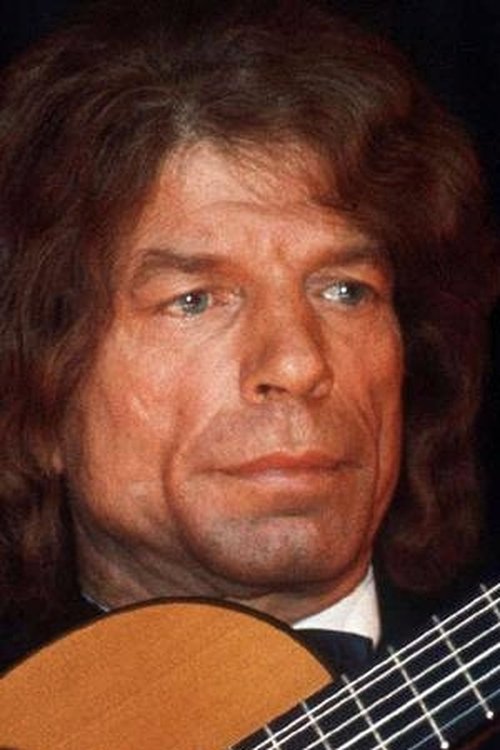
Manitas De Plata
Acting
Biography
Ricardo Baliardo (7 August 1921 – 5 November 2014), better known as Manitas de Plata ("little hands of silver"), was a French flamenco guitarist of Catalan Gitano descent, born in southern France. Baliardo was born in a gypsy caravan in Sète, southern France. Nicknamed Manitas de Plata ("little hands of silver" in Spanish), he agreed to play in public only ten years after the death of Romani-Belgian jazz guitarist and composer Django Reinhardt, in 1953. Baliardo attained fame in the United States after a photography exhibition in New York, organized by his friend Lucien Clergue. He had recorded his first official album in the chapel of Arles in France in 1963, on the Philips label. It was later re-released in 1967, on the Connoisseur Society label and sold through the Book of the Month Club. This record brought him to the attention of an American audience, where a manager obtained a booking for him to play a concert at Carnegie Hall in New York on 24 November 1965, and on The Ed Sullivan Show the same year. He went on to perform in various venues around the world. Manitas de Plata was the uncle of Diego, Paco, and Tonino Baliardo, and cousin to Pablo, François (Canut), Patchaï, Nicolas, and André Reyes (the sons of his cousin, flamenco artist José Reyes, with whom he performed as a duo in the 1970s), all current or former members of the Catalan rumba band Gipsy Kings. De Plata died on 6 November 2014, aged 93, in a retirement home in Montpellier. He had suffered a severe heart attack in April 2013. One of his recordings earned him a letter from Jean Cocteau, acclaiming him as a creator. Upon hearing him play at Arles in 1964, Pablo Picasso is said to have exclaimed, "that man is of greater worth than I am!" and proceeded to draw on Baliardo's guitar. Australian multi-instrumentalist Chris Freeman, his student in 1971, acknowledged de Plata's influence and teachings. A statue by the sculptor Jean-Loup Bouvier, depicting de Plata playing his guitar, was erected in front of Hôtel de Ville, Montpellier, in June 2017. Source: Article "Manitas de Plata" from Wikipedia in English, licensed under CC-BY-SA.
Known For

No description available.
Vivement dimanche

Midi Première is a French variety show presented by Danièle Gilbert, directed by Jacques Pierre and broadcast from January 6, 1975 until January 1, 1982 on TF1. The program was generally broadcast between 12:15 p.m. and 12:55 p.m., then giving way to the 1:00 p.m. TV news. However, the broadcast schedule could change, depending on the guests, and the setting where the recording of the program was shot. Certain performances by artists who have become cult like the one where Ringo jostles with a demonstrator in interpretation (1977), that of Dalida with the title There is always a song with the soundtrack that does not start, twice, at the right speed (1978), Claude François and his Clodettes, who, in the provinces, are unable to join "the set" in order to interpret his song, the latter being taken by the crowd of delirious fans (summer 1977) . The group Supertramp performed there with the title "Dreamer" on March 8, 1975.
Midi Première

No description available.
Sacrée soirée

A talk show presented by Michel Drucker
Les Rendez-vous du dimanche
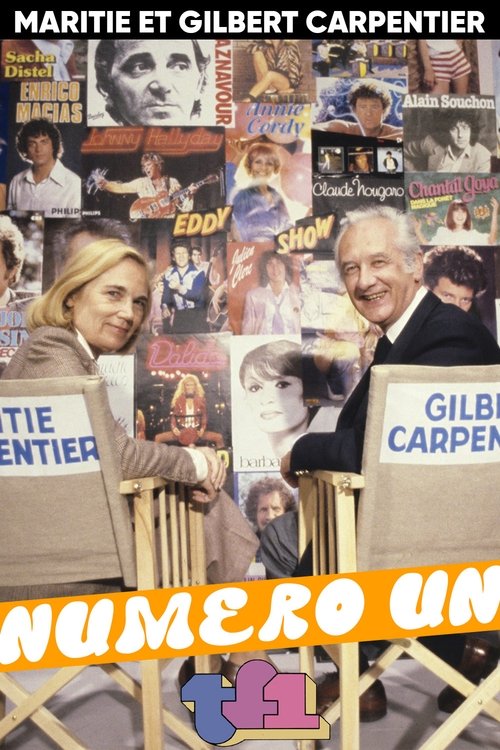
A French variety show.
Numéro un
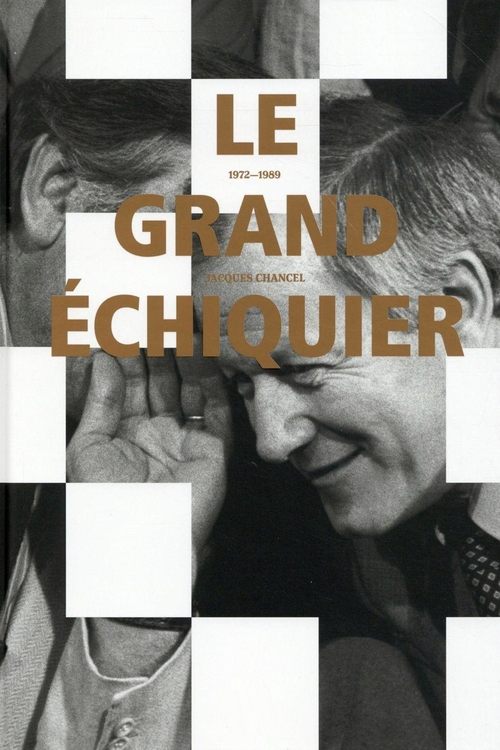
Le Grand Échiquier is a French variety television program created and presented by Jacques Chancel. It aired at 8:30 pm on the first channel of the ORTF from January 12, 1972 to July 12, 1972, then on the second color channel of the ORTF from September 1972 to December 1974, and finally on Antenne 2 from January 1975 to December 21, 1989. The program returned to France 2 on December 20, 2018 and is hosted by Anne-Sophie Lapix.
Le Grand Échiquier
No description available.
Midi trente

No description available.
Discorama
No description available.
Samedi soir

No description available.
Téléthon
No description available.
Système 2

No description available.
Dim Dam Dom
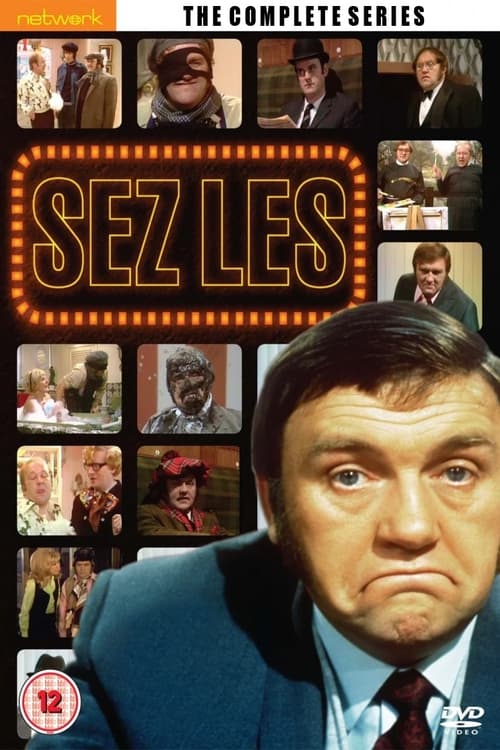
Sez Les was a British comedy sketch show that starred Les Dawson, produced by Yorkshire Television, airing on ITV from 1969 to 1976. Roy Barraclough also joined from series four and would go on to become Dawson's most recognisable sidekick. The two most notably appeared together in drag as characters Cissie and Ada. John Cleese, who had quit the Monty Python team's television series, was also present from 1974 in two complete seasons. Other cast members included Norman Chappell, Brian Glover, Brian Murphy and Kathy Staff. Music was provided by Syd Lawrence and his orchestra.
Sez Les
No description available.
Night-Club
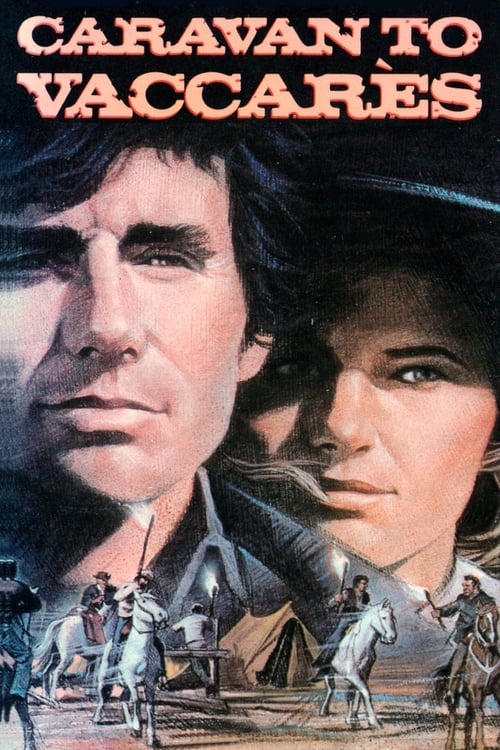
American Neil Bowman is traveling through France when he meets British photographer Lila. They are hired by French land owner Duc de Croyter to escort a Hungarian scientist to New York. But they soon realize that the job is not a cushy number, and have to deal with a gang of kidnappers who will stop at nothing to get their hands on the scientist
Caravan to Vaccarès
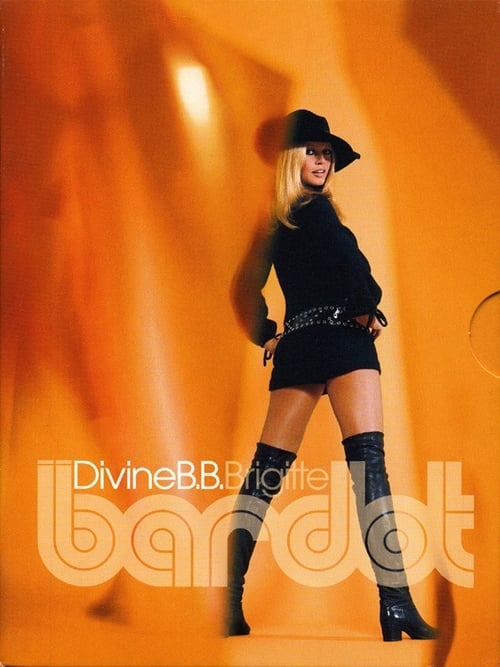
While Brigitte Bardot is best known in North America as one of the sexiest women to ever appear on a movie screen, in her native France she also enjoyed a successful career as a pop singer, and this retrospective offers a comprehensive look at the high points of her musical career, drawn from television appearances and promotional clips. Brigitte Bardot: Divine BB includes several of Bardot's collaborations with Claude Bolling and Serge Gainsbourg; selections include "Everybody Loves My Baby," " Le Belle et le Blues," " Bubblegum," " Bonnie and Clyde," " Saint-Tropez," " Comic Strip," " Harley Davidson," and many more.
Brigitte Bardot : Divine B.B.

No description available.
Bei Westwind hört man keinen Schuß
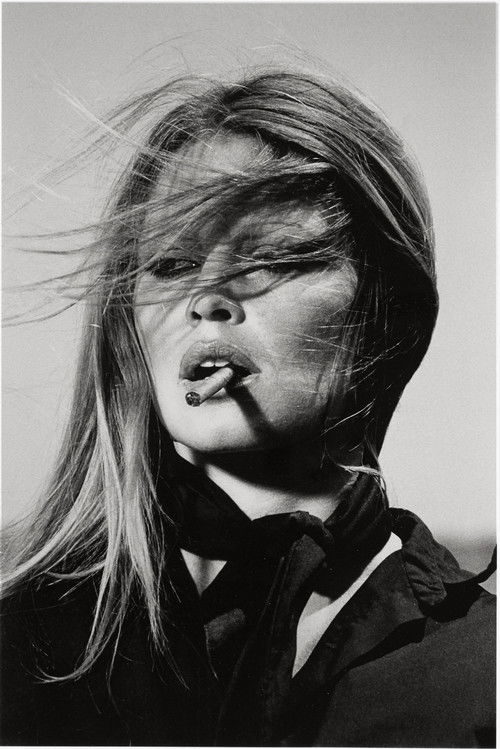
And the image created the myth... Bardot as a brunette, blonde or redhead. Bardot in thigh-high boots, mini-dress or swimsuit, Bardot in London, at La Madrague or on a Harley... In all her states, BB sings with Gainsbourg and Sacha Distel: "Bonnie and Clyde", "Comic strip", "Mister Sun"... Reichenbach's camera sublimates the icon.
Show Bardot
Jeanne, a little secretary dreaming of love, meets Alain, a reporter-photographer with a major daily newspaper. He takes her along on his professional nocturnal activities, during which she meets a host of celebrities. One evening, Alain takes photos of the kidnapping of a diplomat, and is followed by a mysterious individual who wants the film back. Alain falls in love with Jeanne. Their embrace is passionate. During the night, he manages to get rid of the follower, then receives a new assignment: to leave for Colombia as soon as possible. He sacrifices his love for Jeanne to his ambition, and she waits in vain for him before returning to her dull life.