Youssef Chahine
Directing
Biography
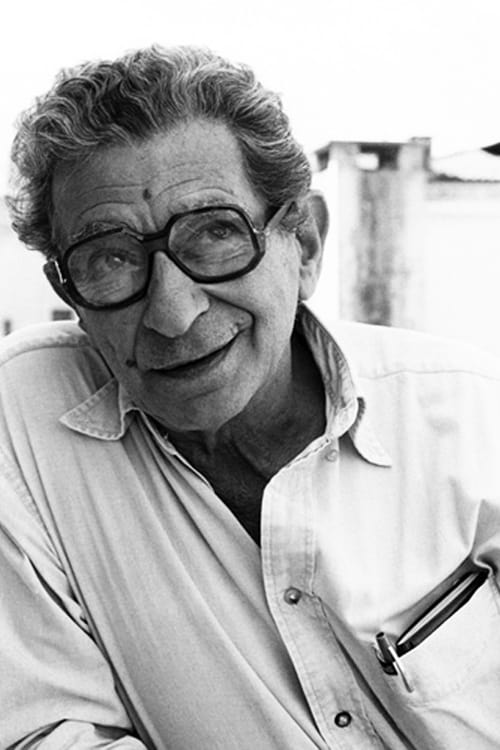
Youssef Chahine (born in Alexandria, Egypt, 1926) started studying in a friars' school and then turned to Victoria College until High School Certificate. After one year at the University of Alexandria, he moved to the U.S. and spent two years at the Pasadena Play House, taking courses on film and dramatic arts. After coming back to Egypt, cinematographer Alevise Orfanelli helped him into the film business. His film debut was Baba Amin (1950): one year later, with Son of the Nile (1951) he was first invited to the Cannes Film festival. In 1970, he was awarded a Golden Tanit at the Carthage Festival. With Le moineau (1973), he directed the first Egypt-Algeria co-production. He won a Silver Bear in Berlin for Alexandria... Why? (1979), the first installment in what proved to be an autobiographic trilogy, completed with Hadduta Masriya (1982)(An Egyptian Story (1982)) and Alexandria: Again and Forever (1989). In 1992, Jacques Lassalle proposed him to stage a piece of his choice for Comédie Française: Chahine chose to adapt Albert Camus' "Caligula," which proved hugely successful. The same year he started writing The Emigrant (1994), a story inspired by the Biblical character of Joseph, son of Jacob. This had long been a dream project, and he finally got to shoot it in 1994. In 1997, 46 years and 5 invitations later, he was again selected Hors Competition in Cannes with Destiny (1997).

Known For

Marcello Mastroianni, Isabelle Adjani, Alain Delon, Martin Scorsese, Woody Allen... the biggest stars in cinema were welcomed by Christian Defaye on his show Spécial cinéma. Between intimate confessions from actors and immersion in the world of the greatest filmmakers, Christian Defaye took viewers on a journey into the fascinating world of cinema for nearly thirty years.
Spécial cinéma

A worldwide guided tour of the greatest movies ever made and the story of international cinema through the history of cinematic innovation.
The Story of Film: An Odyssey

Commissioned to mark the 60th anniversary of the Cannes Film Festival, "To Each His Own Cinema" brought together 33 of the world's pre-eminent filmmakers to produce short pieces exploring the multifarious facets of cinema and their perspective on the state of their chosen artform in the early 21st century.
To Each His Own Cinema
No description available.
Matin Bonheur

An anthology of short films inspired by the events of the September 11 World Trade Center attacks.
September 11

The first Sultan of Egypt and Syria leads the Muslim military campaign against the invading Christians from Europe during the Third Crusade.
Saladin

A wealthy landlord floods and destroys a village on purpose to prevent the people living there from making a profit off their crops. What he doesn't know is that his own daughter, Amal, is in love with Ahmed, a young man from the village.
The Blazing Sun

Qinawi, a physically challenged peddler who makes his living selling newspapers in the central Cairo train station, is obsessed with Hanuma, an attractive young woman who sells drinks. While she jokes with him about a possible relationship, she is actually in love with Abu Siri, a strong and respected porter at the station who is struggling to unionize his fellow workers to combat their boss' exploitative and abusive treatment.
Cairo Station

40 international directors were asked to make a short film using the original Cinematographe invented by the Lumière Brothers, working under conditions similar to those of 1895. There were three rules: (1) The film could be no longer than 52 seconds, (2) no synchronized sound was permitted, and (3) no more than three takes.
Lumière & Company

Freed after spending years in prison, an activist's homecoming turns into a dark affair as his disillusion clashes with his family's expectations. Demonstrating Chahine’s eclecticism, this is an elegant melodrama, exuberant musical, layered allegory, and profound portrait of personal and political disillusionment.
Return of the Prodigal Son

In the 12th century's Andalusia lives Ibn Rushd a prominent Islamic philosopher with his wife Zeinab and daughter Salma. The principality is ruled by Khalifa ElMansour who has two sons, ElNasser, an intellectual that likes Ibn Rush and is in love with his daughter Salma. The younger son Abdallah is more into dancing and poetry, spending most of his times with the gypsy family and getting the daughter pregnant. The Khalifa is depending on the extremists to build his army granting them more power which they use to combat artists and philosophers. The extremists succeed in recruiting Abd Allah and train him to kill his father. Events go on where Marawan, the gypsy singer, is killed and Ibn Rushd's books are burnt. Adapted from the real life of Ibn Rushd AlMasir is Chahine's statement against extremism.
Destiny

Set in 1987 against the backdrop of a hunger strike by the Egyptian film industry, Chahine himself steps in to play Yehia, the famed Egyptian director whose life is chronicled in "Alexandria, Why?" and "An Egyptian Story". Obsessed with Amr, the handsome actor he discovered and cast as his alter-ego in parts one and two of The Alexandria Trilogy, Yehia pressures Amr to star in various film projects that change even as Yehia's perception of the young actor begins to change. He first casts Amr as Hamlet, which the actor deems too demanding for his talents, then as the lead in a musical biopic of demigod Alexander the Great, who founded the city of Alexandria in 332 B.C.
Alexandria Again and Forever

Amid the poverty, death, and suffering caused by World War II, 18-year-old Yehia retreats into a private world of fantasy and longing. Obsessed with Hollywood, he dreams of studying filmmaking in America but struggles to pursue his dream, given the constraints of his life in the middle class and the horrors of war.
Alexandria… Why?

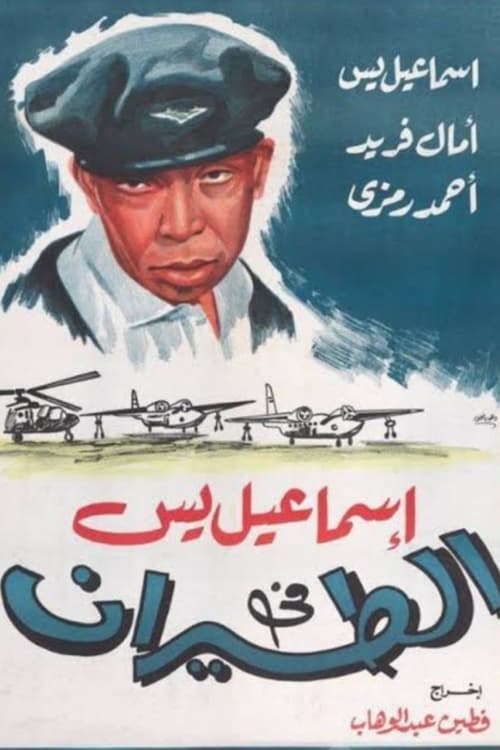
Ismail El Ghandoor works as a stuntman and a small time actor in movies. He falls in love with a young belly dancer, Soheir who dreams of being the wife of a pilot. Ismail dresses up in his brother Hussein’s clothes as a pilot in the force while his brother is away on his honeymoon. When Hussein returns the truth is revealed, and each of them goes back to his real job. Will Soheir accept the real Ismail or will she continue to pursue her dream of marrying a pilot?
Ismail Yassine in the Air Force

Two strangers try to solve a mystery that revolves around both of their tragic pasts. At the heart of the mystery lies a mystic board with an ability to kill.
Ouija

Fikria is a singer who's married to Farid ,the gambling addict. When she's traveling by train, she gets in an accident and a peasant treats her. After she returns home,her husband asks her to stay hidden to get the insurance money to pay for his gambling debts.
Lady of The Train

The construction of the Aswan dam as seen by those who took part in it: engineers, workers, Egyptians, and Soviets.
The People and the Nile

Djamila, a young Algerian woman living with her brother Hadi and her uncle Mustafa in the Casbah district of Algiers under the French occupation of Algeria, sees the full extent of injustice, tyranny and cruelty on his compatriots by French soldiers. Jamila's nationalist spirit will be strengthened when French forces invade her university to arrest her classmate Amina who commits suicide by ingesting poison. Shortly after the prominent Algerian guerrilla leader Youssef takes refuge with her, she realizes that her uncle Mustafa is part of this network of anti-colonial rebel fighters. Her uncle linked her to the National Liberation Front (FLN). A series of events illustrate Jamila's participation in resistance operations against the occupier before she was finally captured and tortured. Finally, despite the efforts of her French lawyer, Jamila is sentenced to death...
Jamila, the Algerian

This big-budget historical epic from acclaimed Egyptian director Youssef Chahine features a crazed turn by Patrice Chereau as Napoleon Bonaparte. The film, an Egyptian-French co-production, deals with Napoleon's occupation of Alexandria and its effect on a typical Egyptian family. Michel Piccoli leads the cast as a general in Napoleon's army who tentatively befriends a local poet and falls in love with two young Egyptian brothers, reflecting complex themes of colonial desire, affection, and personal connection.
Adieu Bonaparte

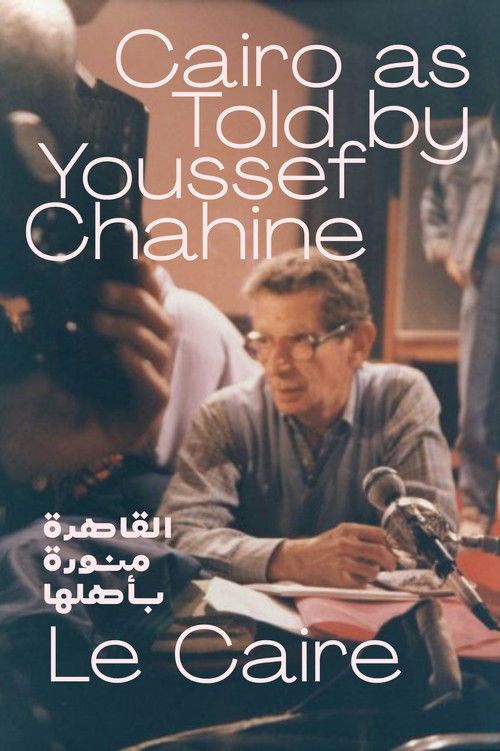
A “Cinéma, de notre temps” series episode directed by French film critic Jean-Louis Comolli on the Egyptian director Youssef Chahine.