
Yau Ching
Directing
Biography
Probing and formally innovative, the work of Hong Kong-born artist Yau Ching strategically pulls apart the conventional relationship between spectator and text. Inverting the roles of "tourist" and "native," Yau Ching rigorously interrogates the politics of representation, particularly in relation to questions of gender, exile, and cultural translation. Difference emerges as a core theme in her work, invoked and challenged by the incongruities of public and private memories. Yau Ching's imagery is complexly layered, moving from diaristic documentary video to richly processed found footage. Issues of language and the limitations of expression are foregrounded, as she draws upon diverse sources, from personal memoirs and "video letters" to historically disparate literary and theoretical works. Fragmented voices and texts point to the failure of language to fix identity, and to the meanings that can be created through silences. Through overlapping and disruptions, she creates a kind of visual and aural stuttering that echoes the counter-discourse of the outsider. The subjects of Yau Ching's video works seem perpetually caught between visibility and invisibility, and the imagined or forgotten memories of a home that no longer exists. Yau Ching was born in 1966 in Hong Kong. She gained a B.A. from the University of Hong Kong, receiving the Urban Council Literary Award (Hong Kong). She moved to New York in 1990 to study at the New School for Social Research and the Whitney Museum Independent Study Program. She has taught at the School of Visual Arts, New York; University of California, San Diego and the University of Michigan. She has received grants and awards from the Jerome Foundation, the Roothbert Fund, New York Foundation for the Arts, Hong Kong Arts Development Council; Lyn Blumenthal Fund for Independent Video; Astraea Foundation Grant; the Asian Cultural Council; and Image Forum, Japan. Yau Ching has had residencies at Video In, Vancouver, Canada; Harvestworks, New York; and Banff Centre for the Arts, Alberta, Canada. Her tapes have been screened at numerous museums, galleries, and festivals including the Hong Kong Arts Centre, Hong Kong; The Museum of Modern Art, New York; Zentrum fur Kunst und Medientechnologie, Karlsruhe, Germany; the London Film Festival; Galerie National du Jeu de Paume, Paris; the World Wide Video Festival in The Hague, The Netherlands; the Asian American International Film Festival, the New York Lesbian and Gay Film Festival, the Yamagata International Film Festival, Japan, the San Francisco International Lesbian and Gay Film Festival, and the Hong Kong International Film festival. She lives in Hong Kong and New York City.
Known For
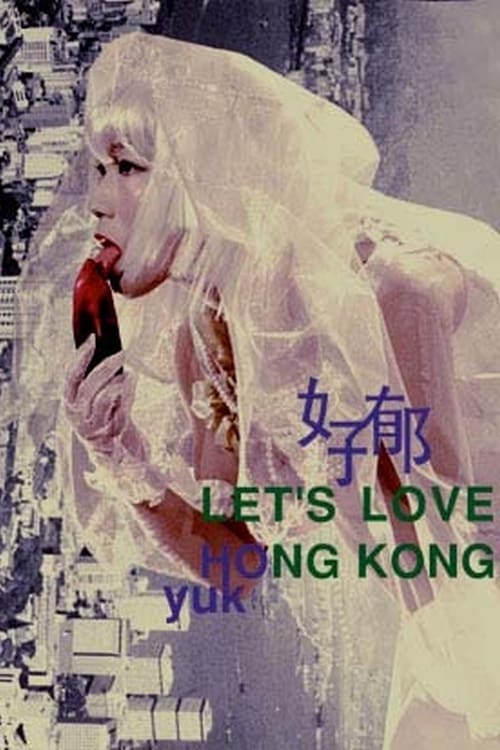
Fantasies, dreams, tears, and fears of four women chasing and watching each other in post-colonial Hong Kong. They chase, seduce, resist, and fantasize about each other. A Hong Kong that is as fake as real provides the perfect setting for their games, secrets, screams and tears. “Made-in-China Chan” (in Cantonese: Chan Kwok Chan) works as a stripper in cyberspace, but she often has headaches. Her only solace is from a Mainlander migrant who echoes what Chan does but with a better attitude. Nicole has money and power but she depends on “Made-in-China” to play with virtually at night in order to get some sleep. Zero does not have anything, but she knows what she wants and is determined to get it. Four women meet in a Hong Kong somewhere in the future. How do their desires manifest themselves in this Forbidden City? From totally different backgrounds, they look like they have very different problems, but do they?
Let's Love Hong Kong
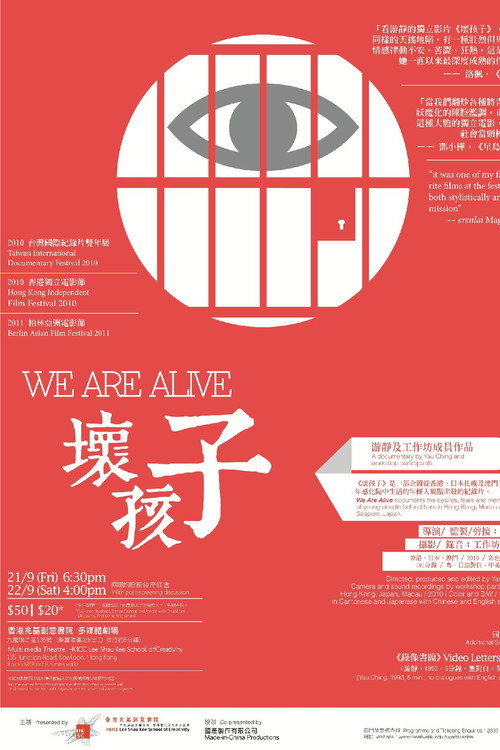
Director Yau Ching has been conducting media production workshops in juvenile reform and welfare institutes in Hong Kong, Macau and Sapporo, Japan for seven years. With simple video recording techniques, the teenagers make this video letter to talk about love, dream, idols and ups and downs in their lives. Are you sick of those pretending high school dramas? Try to take a look at this sincere documentation of youthhood. To get your taken-for-granted values reflected, to be touched by their truthful reveals without any sensational gimmick, and most importantly, to recall what we went through when we were young, and the ways we could be alive…
We Are Alive
In this music video, which operates as a meditation on contemporary Chinese history, Yau Ching combines found images and text to negotiate between idealism and propaganda and the hopes and disillusionment that they bring.
The Ideal/Na(rra)tion
It started off as personal letter I imagined a woman like me would write to, say, a lover back home. I initially had an image in mind to talk to but gradually that image fell apart, became obscure, diverse and unrecognisable. Amidst the minute, unconnected pieces I had to ‘make up’ that image myself. Making this film forced me to rethink my relationship with that image and if possible, exorcise it. – Y.C.
Is There Anything Specific You Want Me To Tell You About?
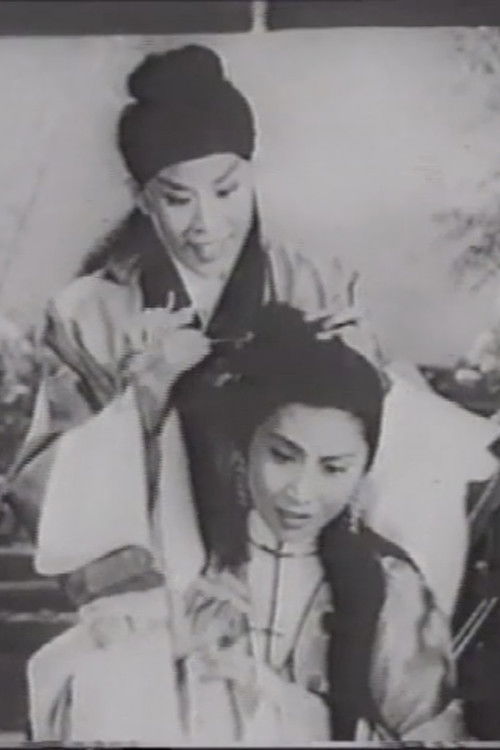
Explores issues facing Chinese women in same-sex relationships. Interviews are intercut with archival footage of a classic Cantonese opera singer known for being a "mannish" woman.
Suet-Sin's Sisters
In Flow, completed in 1991, Wenyi Hou, the Chinese woman migrant artist being interviewed, struggles with the impossibility of identity formation through speech and performs instead a documentary scene that has obviously been rehearsed in order to highlight the unhumanness of being human. She asks whether it is possible that we all originated from and could be reducible to grape, in the farm of bunches, connecting and consumable, yet all brilliant and different in their own contexts, or in her words, “in another kind of time.”
flow
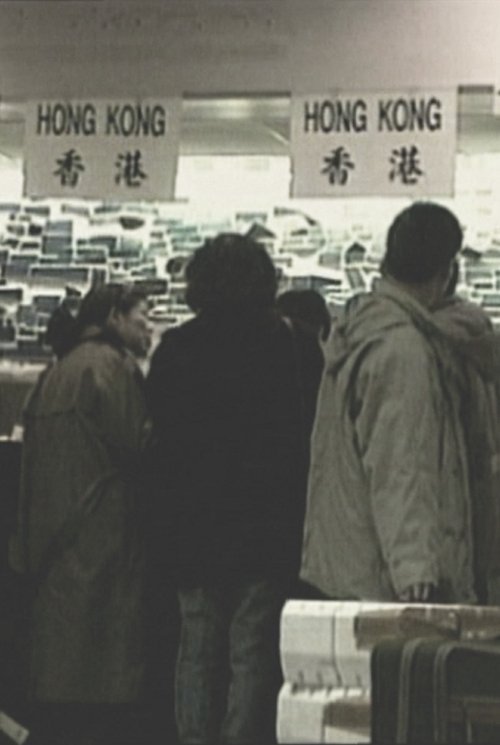
An average of 60,000 people emigrated from Hong Kong each year in early 1990s. An absolutely personal and biased sampling of this diaspora from an insider/outsider perspective just before the 1997 handover. Based on the personal experiences of individuals from Hong Kong in 1990s, Diasporama is an experimental documentary that addresses issues of the diasporic condition. In a series of intimate interviews that explore the relationship of the personal and the political, Yau Ching confronts notions of nationhood, identity, and post-colonialism. Inserting her own face and voice as a form of mediation, the artist herself becomes one of the subjects.
Diasporama: Dead Air
“Because I have always been on the move, departing a city and waking up in another country, I find myself writing letters all the time — to people I miss, people I met on the road, people I look forward to meeting… When I grew tired of words (which happened very often), I began writing them in video. Since I was traveling, writing letters in unknown lands, I also had very limited access to technology. I write my video letters with Fisher Price Pixelvision, Super-8, and Hi-8. When I could not find editing facilities I edited them with the camera. They became records of my desires desperately in need of an outlet… When shown in public, they re-invent new meanings in different contexts. They become letters to anyone who can relate to them.” — Yau Ching
Video Letters 1-3
"June 30, 1997. Hong Kong. Tourists flocked to expensive gourmet parties with a harbor view, or got drunk on the streets, embracing British or Communist flags. All media coverage described how happy the local Hong Kong people were about being taken over the next day. I was invited to a private gathering at Hong Kong Arts Centre to watch television and the fireworks together. It turned out to be a gathering of local artists singing sad songs and telling angry stories, against a room decorated in words of bright red: 'Reversion 1997: I am very happy.' Later I went to the Central part of town to find thousands of people rallying in Victoria Square. At midnight they released multi-color balloons, tied a huge yellow ribbon around the Legislative Council, where the directly elected Democratic Legislators were being kicked out, as of July 1. The action was illegal in the new Hong Kong law. The police blocked the area around the Council soon afterwards, calling it 'private property.'"