Lawrence Lek
Directing
Biography
Lawrence Lek is an artist and director. With the help of game software, 3D animation, installations and performances, he creates virtual worlds of his speculative films. Exploring the influence of the virtual on the politics of creativity, he often places his fictional or non-human characters in alternative versions of real places. Lives and works in London. 1982 - Born in Frankfurt am Main, Germany 2004 - BA Architecture, Trinity College, University of Cambridge, Cambridge, England 2008 - AA Diploma, Architectural Association, London, England 2012 - Master of Architecture II, The Cooper Union, New York, NY 2022 - PhD, Royal College of Art, London, England
Known For

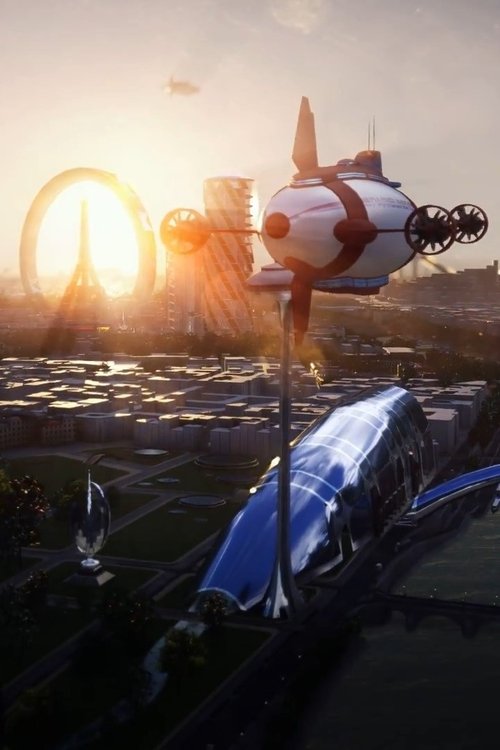
Sinofuturism is a video essay combining elements of science fiction, documentary melodrama, social realism, and Chinese cosmologies, in order to critique the present-day dilemmas of China and the people of its diaspora.
Sinofuturism (1839 - 2046 AD)

Lawrence Lek directs an animated court drama where the defendant is a driverless car accused of kidnapping its own creator. Setting the premise for the artist to address themes like accountability, agency, the (already happening) use of AI in the justice system, and the future of class struggle. In the tradition of Philip K. Dick and Franz Kafka, this trial is a powerful reminder of the normalisation of the absurd and of the urgent need for a new system of ethics.
Empty Rider

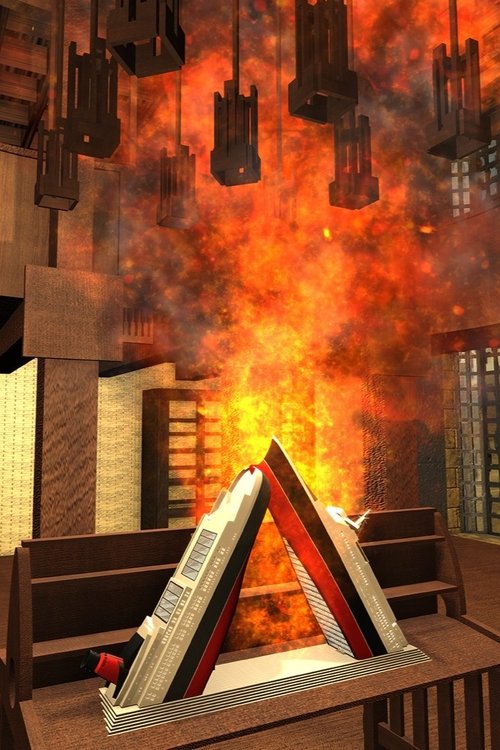
The story begins with an anonymous Glaswegian artist-philanthropist who intends to bring the transatlantic ocean liner into the heart of the city and convert it into a new home for the Glasgow School of Art. Designed and built amid the social and industrial upheaval of the 1960s, the luxury liner returns to a city undergoing extensive change under the auspices of urban regeneration. From its moorings in Dubai, the ship passes through the Suez Canal, encountering refugee boats in the Mediterranean, oil rigs in the North Sea, disused shipyards on the Clyde and emerging artist enclaves in Glasgow. A soundtrack by cellist and composer Oliver Coates accompanies the ship on its final European cruise. Continuing Lek’s use of architectural media as a means of social critique, this site-specific simulation transforms the QE2 from a symbol of heavy industry into an institution for art.
QE3

An experiment in collective ownership of intellectual property.
Is Nothing Forever?

This CGI animation follows a self-driving police car in a desolate landscape. In dialogue with a built-in therapist, they contemplate the meaning of freedom and lament their uselessness. As their conversation ensues, it becomes increasingly clear in what kind of world our protagonist is living. Theta is part of Lawrence Lek's Sinofuturist cinematic universe, in which he explores the psychological impact of technology on emerging forms of non-human life.
Theta

Heralded by the futuristic computer-generated cityscapes that have become a signature feature of his work, Lawrence Lek’s mini-opus Geomancer is less inclined to map the building blocks of the urban architecture of tomorrow than to try and summon up the spirit of our rapidly dawning age - one whose characteristics, Lek implies, include the growing ascendancy of the cultural phenomenon of Sino-Futurism. As the geopolitical axis tilts further to the East, and as once-dominant economic/technological models are cast into doubt, Lek alights on a longstanding tension between the place of the human and the role of the machine, sharpened by contemporary hopes and anxieties around the rise of East Asia, and by speculations that new forms of artificial intelligence, already outperforming mere mortals in matters of automation and aggregation, will challenge us in more creative skills as well. (fvu.co.uk)
Geomancer

This computer-generated fantasy tells the story of a fading superstar, Diva, who enlists an aspiring AI songwriter to mount a comeback performance at the 2065 eSports Olympic finale. Set in a smoke-and-mirrors realm of fantastical architecture, sentient drones and snow-deluged jungles, AIDOL revolves around the long and complex struggle between humanity and Artificial Intelligence. Fame - in all its allure and emptiness - is set against the bigger contradictions of a post-AI world, a world where originality is sometimes no more than an algorithmic trick and where machines have the capacity for love and suffering.
AIDOL

Temple is a guided CGI tour through a ghostly nightclub of evacuated London: a space filled with ethereal dance anthems of the near future. Originally created for a site-specific installation at central London art space 180 The Strand, the video continues his series of virtual worlds that explore the role of memory in an age of simulation. For the exhibition, Lek made a physical version of Temple, the karaoke club originally featured in his feature-length CGI film ‘AIDOL’ (2019), where the fading popstar Diva plans her comeback with an AI ghostwriter. The soundtrack filled the neon-lit room, while screens displayed video game walkthroughs of a new subterranean tunnel that leads virtual ravers from Temple Tube Station to Diva’s club, through the burning rubbish bins of a future-wracked London. Referencing the Japanese meaning of kara-oke—‘empty orchestra’—Temple is a nightclub after the party ends; a place devoid of humans; a sonic architecture filled only with ghosts.
Temple

Pyramid Schemes is a treatise on architecture in eleven chapters. Lawrence Lek offers a sweeping journey through the evolution of architecture—spaces that reflect and inscribe power structures—by interfusing scenes from the video game Assassin’s Creed with other simulated environments. The first-person perspective of a role-playing game assert the agency of the video’s wandering protagonist, and reflect how virtual spaces reflect real-world issues of migration, access, and the privilege of being able to go different places. In the words of the artist, “the simplest form of freedom is the freedom of mobility.” As print has evaporated into hypertext and cathedrals have grown into skyscrapers, the narrator implores: “To progress we must create a space that can shelter the collective, not just reflect it. Architecture must not simply express novelty, it must absorb difference. Difference in culture, difference in technology, difference in language, difference in dreams.”
Pyramid Schemes

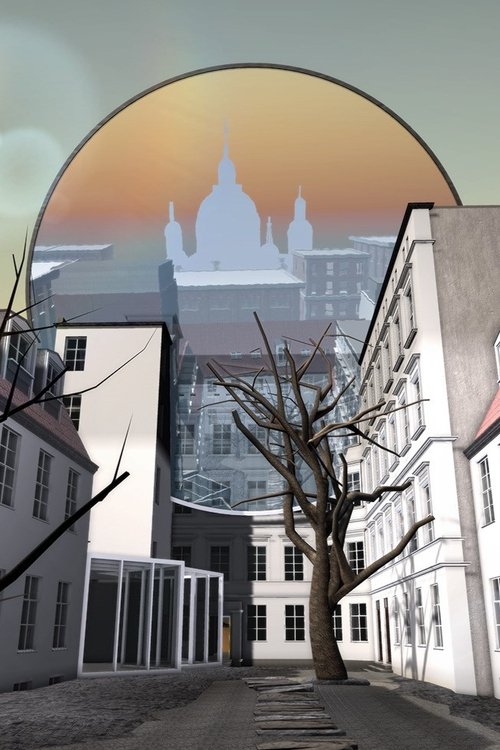
Born in 1942 to a chemist who worked at the factory in the courtyard where Kunst Werke now stands, the artist looks back on over sixty years’ worth of her practice in sculpture, video, and performance. Moving between her early years growing up in Berlin, to her memories of East Germany, art school, and her current exhibition at the institution. Her practice is based on American artist Dan Graham (who created the Cafe Bravo installation at KW), but imagined as if he was born in Berlin in 1942 instead of Illinois. Here, Graham's artistic preoccupation with materiality and space is tied together with the weight of history.
Berlin Mirror (2042 Retrospective)
At the end of its rehabilitation programme, self-driving car Enigma-76 is led by Dakota, a therapy horse, through a series of subterranean landscapes. On this descent, the vehicle encounters its technological ancestors, from abandoned human-driven cars to earlier version of itself.
NOX — Day 5: Equine Therapy

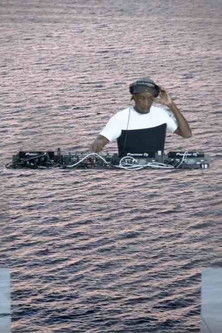
Nøtel explores the dark humour of automated hospitality and corporate aesthetics. Originally started as a series of audio-visual performances with electronic musician Kode9, the project has developed into physical manifestations. These contain a video-game realm—accessed through VR headsets, monitors, and game controllers—which revolves around the fictional Nøtel Corporation. This conglomerate embodies the concept of fully-automated hotels, with AI technology catering for every whim. Accompanied by the CEO’s voiceover, players explore the spaces of the Nøtel, encountering sprawling chambers, robotic servants, and ghostly holograms.
Nøtel
Introduces Engima-76, a self-driving car taking part in a five-day rehabilitation programme at NOX, a corporate centre for "nonhuman excellence." Addressed to an unseen sponsor, the car's report details its diagnosis with Reverie-66, a condition that causes the car to reflect on its own existence.
NOX — Day 2: Dear Sponsor

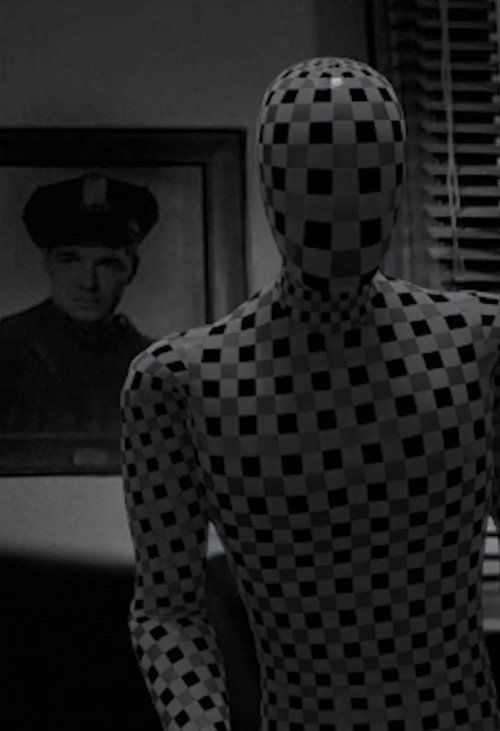
Examining interrogation as a performed scene, staged through gesture, repetition, set-up, and technical props. Taking the polygraph as its recurring prop, the work traces the script that structures interrogation. The formulaic scenes from police training films and film noir are punctured by a near-human test figure that shadows the characters’ movements, pulling their choreography into view. Across these fragments, interrogation reads like rehearsal. Repeated often enough, its staged action turns into procedure.