FEEL IT.STREAM
?

Gary Hill

Directing

Biography

Gary Hill (b. 1951, Santa Monica, CA) has worked with a broad range of media – including sculpture, sound, video, installation and performance – since the early 1970’s, producing a large body of single-channel videos, mixed-media installations, and performance work. His longtime work with intermedia continues to explore an array of issues ranging from the physicality of language, synesthesia and perceptual conundrums to ontological space and viewer interactivity. (Vimeo)
Known For

No image
N/A

No description available.

Live

1990
Skaterdater
6.3

The film tells a story with no dialogue. The group of boy skaters are suddenly at a point when one of the boys sees a young girl, and becomes interested in her. This causes a rift with the other boys, who challenges him to a skating duel that goes down a hilly street. The young boy loses. However, he gets the girl, and shortly, a few other girls are seen and become interested in the boys, too. The film was nominated for an Oscar for Best Live Action Short Film. Preserved by the Academy Film Archive in 2010.

Skaterdater

1965
Incidence of Catastrophe
N/A

In the video, Thomas the protagonist is played by Hill which confounds the self-reflexive nature of the book’s relationships all the more, making the video something of a “transcreation.” The “reader” begins in the liquidity of the text almost as if he were waking from drowning. Images of the sea ravishing the shore – small cliffs of sand eroding and collapsing – are inter-cut with extreme close-ups of text and the texture of the page and book itself being flooded with ocean waves. In scene after scene the reader attempts to re-enter the book only to find himself a part of intense dreams and hallucinations.

Incidence of Catastrophe

1988
Pacifier
N/A

No description available.

Pacifier

No image
N/A

This rarely screened film was used to raise funds for the making of Energy and How to Get It. High-energy physicist Robert Golka was granted a lease on an airplane hangar once used to build B-29 bombers to further his experiments on ball lightning and free energy distribution. By the time Robert Frank and his crew arrived, Golka, his frisky older love interest Agnes Moon, and his dogs Nitro and Proton were facing eviction. — Museum of Modern Art

Project Tesla

1980
No image
N/A

This tape is the first of Hill’s works for which he deliberately wrote a screenplay. The title defines the piece’s starting point: Alice in Wonderland asks her omniscient father why things get in a muddle. They then talk on a metalinguistic level. A glimpse through the looking glass reveals an inversion of the customary order of things. The father ingests the smoke from his pipe, Alice does not so much blink her eyelids momentarily open as stare wide-eyed, and the playing cards fall out of the air in an orderly manner into the girl’s hand. (Gary Hill: Selected Works and catalogue raisonné, edited by Holger Broeker)

Why Do Things Get in a Muddle? (Come On Petunia)

1984
No image
N/A

Blind Spot constructs a space of living portraiture by “focusing time” on an exchange between the artist (the camera) and a man on the street in the small Algerian neighborhood of Belsunce in Marseille, France. As the camera zooms in slowly on its subject, the imagery is interrupted by longer and longer segments of black/silence, in essence slowing the scene down so that it almost reaches the photographic.

Blind Spot

2003
Mouthpiece
N/A

Dave Jones prototype modules (keyers, color field generators, output amplifier), black-and-white camera, microphone and Serge audio modules (voltage controlled oscillators, filters, sequencer)

Mouthpiece

1978
Mediations (towards a remake of Soundings)
N/A

“The beginning of a remake of an earlier work [Soundings, 1979] in which I wanted to extend the reflexivity of each text in relation to the interaction between different physical substances—in this case, sand—and the speaker cone. A loudspeaker fills the screen and I begin to speak, referring to the speaker itself. This is followed by more declarations of what I am doing, ‘…a hand enters the picture….’ A hand filled with sand enters the picture and slowly releases it into the loudspeaker’s cone. Every nuance of speech vibrates the speaker’s cone (or membrane), bouncing the grains of sand into the air. The more I speak about what is happening, the more it changes—or feeds back into—the movement and patterns of the sand."

Mediations (towards a remake of Soundings)

1986
No image
N/A

“I was thinking of the camera as a kind of archeological tool that I could use to dig into or slice through the landscape —one among many studies toward using the camera in a highly physical way.”

AXIS

1975
Windows
N/A

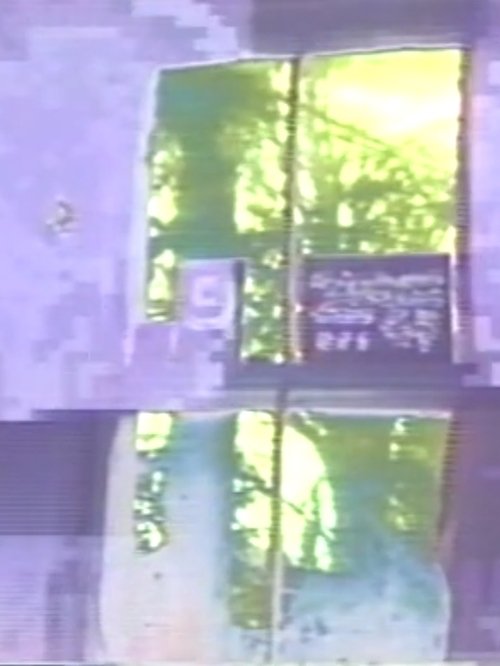
Silent or with minimal sound, Hill's early formalist works explore the manipulation of electronic color and image density through the camera obscura and image processing devices. Of these tapes, Hill has written that "much of the subject matter and the expressionistic method of working underline and in some sense parody the traditional medium of painting." In Windows, the image of windows in a darkened room is digitized, densely layered, and otherwise abstracted in a series of graphic compositions.

Windows

1978
No image
N/A

Recorded in Woodstock, New York, Rock City Road incorporates multiple levels of rescanned images of walking on different surfaces, including pavement and snow-covered terrain. The images have been rescanned and manipulated using reel-to-reel videotape recorders. Editing actions—fast forward, reverse, pause, as well as “scratching” through and between frames—remain present as the sounds they make. Noises inherent to the medium, they function as metaphoric links between the texture/materiality of the world and that of electronic media.

Rock City Road

1974
No image
N/A

Observaciones Sobre los Colores consists of a single video projection in which a boy reads a Spanish translation of Wittgenstein's Remarks on Color, Part 1 (1951), consisting of 88 segments, in real time over a period of 78 minutes. Hill provided a modified version of the book with all proper names, philosophical terms and scientific language replaced with phonetically spelled versions.

Observaciones Sobre los Colores

2008
Elements
N/A

One of the earlier works Hill produced on the Rutt/Etra video synthesizer, Elements combines abstract “landscapes” with fragmented syllabic language. Undulating topological forms superimpose themselves on one another, changing their shape and direction of movement.

Elements

1978
No image
N/A

Our visual field is dominated by gossamer layers that become distorted in fluid motion, break off, begin anew and continually change color. As we continue looking, they break down into seemingly amorphous constructions. We see details, textures and patterns from curtains, whose form responds to air movements and whose color alters through manipulation. Through or behind the veil-like fabric we can make out plants. As our gaze is increasingly directed outwards, we momentarily discern trees, branches, twigs and undergrowth before they vanish into electronic interferences. Hill uses video shots of these motifs as a basis for his artistic experiments in electronic alienation, overriding the colors and tone values to such an extent that the recorded structures become distorted and dissolve beyond the limits of their identifiability.

Bits

1977
Commentary
N/A

“Made just before Around & About, this work is something of a ‘manifesto in jest’ against television…. I’m a sit-in viewer looking slightly up at the screen making simple gestures into the camera. The mood is ambiguous as I seem to be watching a mirror, covering my face, reaching out to the camera, obstructing my head with a harsh (interrogator’s) lamp, and maybe more. The image, distorted through a fisheye lens, gives the impression of a concave monitor, as if the whole act were seen through a peephole or pinhole camera. In some sense I ‘play’ both sides of the screen—performer and viewer attempting to ‘connect’ either way. As ‘commentary’ it’s two-way, making it also a commentary on commentary.”

Commentary

1980
No image
N/A

The basis of this “sound/image construct,” recorded in real time, are three black-and-white still images: a keyboard, a flute, and an African drum. These motifs are altered through digitalization, solarization, and interframe switching. As they alternate, the images are accompanied acoustically by simple tonal routines of the instruments shown – little sequences of sound on the keyboard, some drum beats, a brief trill of the flute. The solarization effect of the images changes with the sounds. The work intensifies as it progresses, and images and sounds succeed one another ever more rapidly until a melody of the three instruments emerges. The frequency of the video images continues to increase, with the result that the images pulsate ever more quickly until they gradually overlay one another, producing a cinematographic effect through interferences. Parallel to this, the audio frequency of the melody rises until fundamental tones form, lasting several seconds.

Sums & Differences

1978
No image
N/A

Disturbance (among the jars) is a multi-lingual adaptation of selected Gnostic texts from the Nag Hammadi library discovered in 1945/46. The structure of the piece is based around the metaphor of fragmentation, more specifically, that of a broken sentence reflecting the original condition of many of the texts. In a completely white room lit with several thousand watts of light, a veranda with seven straight-back wooden chairs faces a low pedestal of the same height on which seven 27-inch bare cathode ray tubes (display bulbs of video monitors) are positioned to form a fragmented line. The positions of the monitors can be seen in a multiplicity of ways.

Disturbance (among the jars)

1988
Gary Hill: I Believe It Is an Image
N/A

In this program video artist Gary Hill uses a number of his pieces to investigate otherness and ambiguity, dislocation of the senses, the boundary between words and comprehension, the physicality of text, and figurative interactivity.

Gary Hill: I Believe It Is an Image

2004
Cutting Corners Creates More Sides
N/A

Two channel video installation. A spoken text …rummages through piles of surplus; boxed accouterments and that unaccounted for miscellanea… and the uneasiness of language itself as it grapples with the whereabouts of the necessary words. The narrative debris morphs through manifolds of optical glass with each utterance marking points along the way. On a long, black tableaux two cameras with little or no depth of field, sentence by sentence cut through a mysterious world of a seemingly inconsequential lineup of objects, tools, parts, bits and the unidentifiable forgotten --whatever might have been close at hand becomes enfolded in a richly colored crystalline doppelgänger image. For each sentence and “drilling” through the objects, the cameras’ parallaxes have been adjusted for a different cross section—the point where momentarily a continuous horizontal view is possible only to then quickly deconstruct as quickly as it formed.

Cutting Corners Creates More Sides

2012