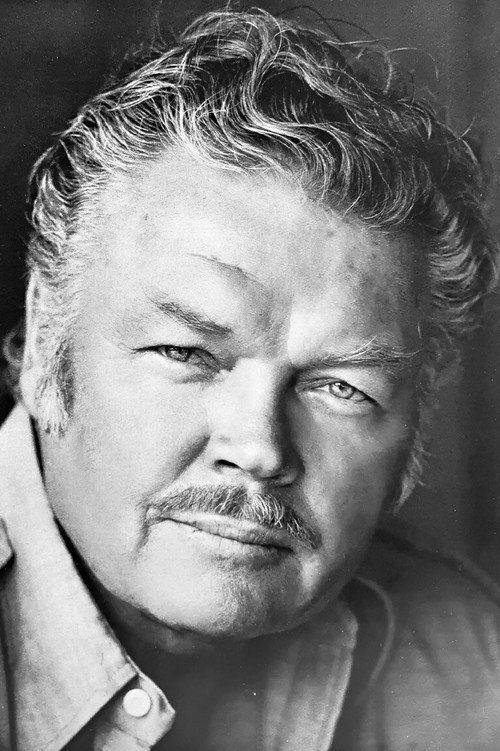
Hal Baylor
Acting
Biography
From Wikipedia, the free encyclopedia Hal Harvey Fieberling (born Hal David Britton; December 10, 1918 – January 15, 1998) known by his stage name Hal Baylor, was an American boxer and screen character actor. He had a professional boxing record of 16–8–3, and later appeared in 76 films and over 500 episodes of various television shows. Early years Born in San Antonio, Texas, to David Locke Britton and Thelma Hallie Bowles, he grew up in Oakland, California when his mother remarried to Walter H. Fieberling during January 1925. After Oakland High School, he attended Chico State College where he played on the football team. He transferred to Washington State College in the Fall of 1938, where he pledged Phi Delta Theta. But by December 1939 he was working as an apprentice butcher in a meat market on 14th Street in Oakland. Boxing Fieberling had his first amateur fight in San Francisco, during June 1938, while still a college student. Representing the Athens Athletic Club of Oakland, he won the California Amateur Athletic Union (AAU) novice heavyweight title in a single bout on points. A newspaper report on his first boxing match mentioned he was left-handed. He repeated the triumph in August 1939, this time taking the State AAU heavyweight title by knocking out 6' 6" 225 lb. Jack Hillman of the San Francisco Olympic Club. However, the following month he lost a rematch on points to Hillman, his first amateur defeat. After just five amateur fights, Fieberling signed a professional contract with manager Ray Carlen in May 1940. He scored a technical knockout over Phil Latonia in the third round for his first professional win, and three weeks later did the same to Bob Schaunbelt. Sportswriters labeled him "the butcher boy" and printed photos of him at his daytime job. Columnists also called him "Handsome Hal" and "Prince Hal" for his good looks. Military service Fieberling was a private at a US Marine Corps recruit depot during January 1943, making the rank of sergeant by November 1943. He was assigned stateside through April 1944, enabling him to continue boxing. He took part in the landings on Saipan and Tinian, finishing the war as a Staff Sergeant with the 18th Anti-Aircraft Artillery Battalion. Personal life Fieberling married Jacqueline Anstey, whom he had known at Oakland High School, on February 3, 1940, in Reno, Nevada. They had a son Michael, born in late 1941, before separating on May 15, 1942. She filed for divorce and was granted preliminary alimony and child support on May 27, 1942. While a sergeant in the USMC, stationed in San Diego, Fieberling married Margaret Jeanne MacLean in Los Angeles, on November 27, 1943. They had a daughter Paula in August 1955. Hal Baylor and Shirley Hickey (née Croose), were married on August 14, 1965. Years active 1940–1947 (boxer) 1948–1978 (actor) Spouses Jacqueline Anstey (m. 1940; div. 1942) Margaret MacClean (m. 1943; div. 1964) Shirley Hickey (m.1965) Children 2 CLR