Zacharias Werner
Writing
Biography
From Wikipedia, the free encyclopedia - https://en.wikipedia.org/wiki/Zacharias_Werner. Friedrich Ludwig Zacharias Werner (November 18, 1768 – January 17, 1823) was a German poet, dramatist, and preacher. As a dramatist, he is known mainly for inaugurating the era of the so-called “tragedies of fate.” Werner was born at Königsberg in East Prussia. At the University of Königsberg, he studied law and attended Kant's lectures. Jean-Jacques Rousseau and Rousseau's German disciples were also influences that shaped his view of life. He lived an irregular life and entered a series of unsuccessful marriages. However his talent was soon recognized, and in 1793 he became chamber secretary in the Prussian service in Warsaw. In 1805 he obtained a government post in Berlin, but two years later he retired from the public service in order to travel. In the course of his travels, and by correspondence, Werner became acquainted with many eminent literary figures of the time, for example Goethe at Weimar and Madame de Staël at Coppet. At Rome, he joined the Roman Catholic Church in 1811. He was consecrated a priest in 1814 at Aschaffenburg, and, exchanging the pen for the pulpit, became a popular preacher in Vienna, where, during a congress in 1814, his eloquent sermons were listened to by crowded congregations. He was later appointed head of the chapter of the cathedral of Kaminiec. Werner died in Vienna.
Known For
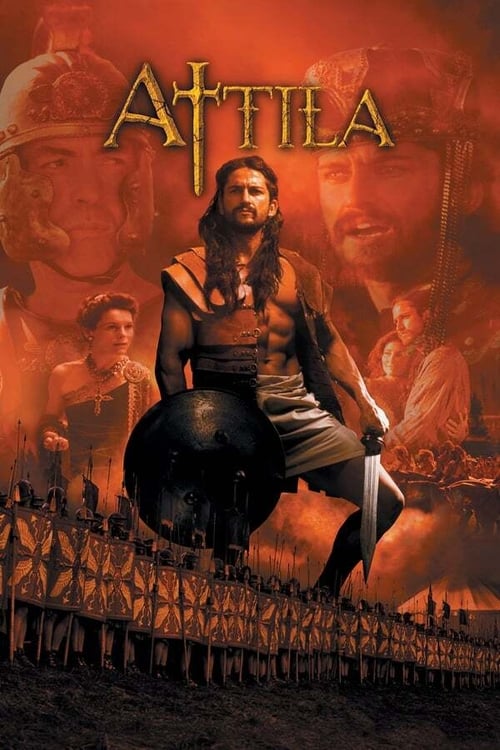
A vengeful beauty foils the plans of the bloodthirsty Hun warrior to conquer Rome.
Attila
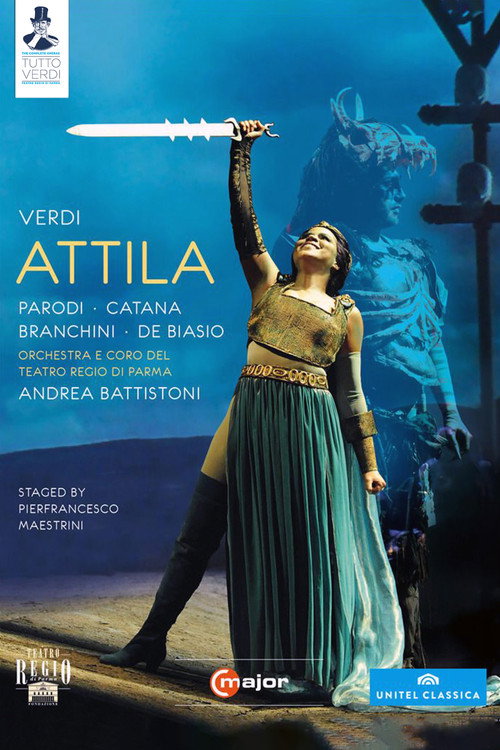
In Aquileia, around the middle of the 5th century. Odabella, daughter of the city’s lord, lost her family during the sacking carried out by Attila and intends to take revenge by killing him (Santo di patria indefinito amor). She herself was spared by Uldino, one of Attila’s slaves. Impressed by her courage, Attila gives her his sword. General Ezio, sent from Rome, proposes to Attila a deal to divide the Empire (Avrai tu l'universo, resti l'Italia a me!). But Attila denounces him as a traitor and refuses. Attila is an opera in a prologue and three acts by Giuseppe Verdi, with a libretto by Temistocle Solera based on Zacharias Werner’s tragedy, Attila, König der Hunnen, and premiered at the Teatro la Fenice in Venice on March 17, 1846. From the box set of 27 Verdi operas, “Tutto Verdi.” Recorded live at the Teatro Verdi in Busseto on October 21 and 25, 2010.