
Tony Wu Chun-Hui
Directing
Biography
Tony Wu Chun-Hui (吳俊輝) is a Taiwanese filmmaker born in Taitung in 1966. He holds a BFA in Filmmaking from San Francisco Art Institute and a MFA in Film/Video from Milton Avery Graduate School of the Arts, Bard College, New York. He is a co-founder and curator of Image–Movement Cinematheque. He lives and works in Taipei, Taiwan.
Known For
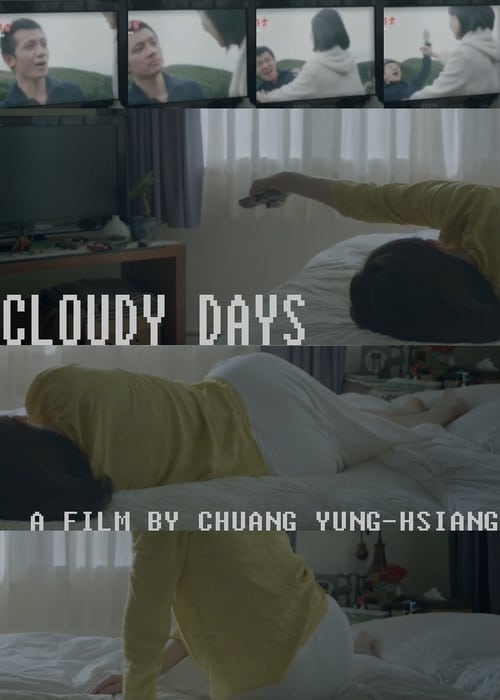
A-Yun, a middle-aged woman from Vietnam, remarries an old man in Taiwan, bringing along her little son from her first marriage. Devoted as she is to her new husband, she is not treated as a family member. In their suffocating marriage, there is no love, but rather daily routine. Repressed desire makes her turn to her stepchild, a considerate and amiable young man.
Cloudy Days
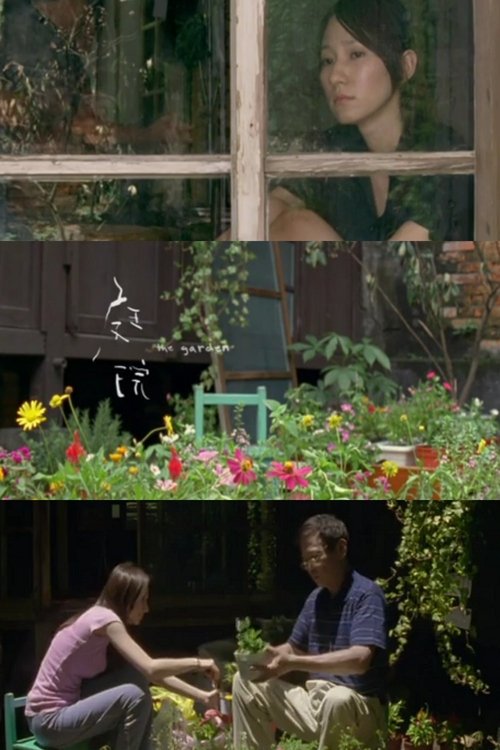
Living together with her father, Yao Shan has to readjust her life after her mother's death. Misunderstanding and tension between she and her dad builds up to an extent that her father wanted to move out of the house. After attending an overseas gardening course, her father steps into her mother's garden again. And this move seems to have changed everything between YaoHsuan and her father...
The Garden
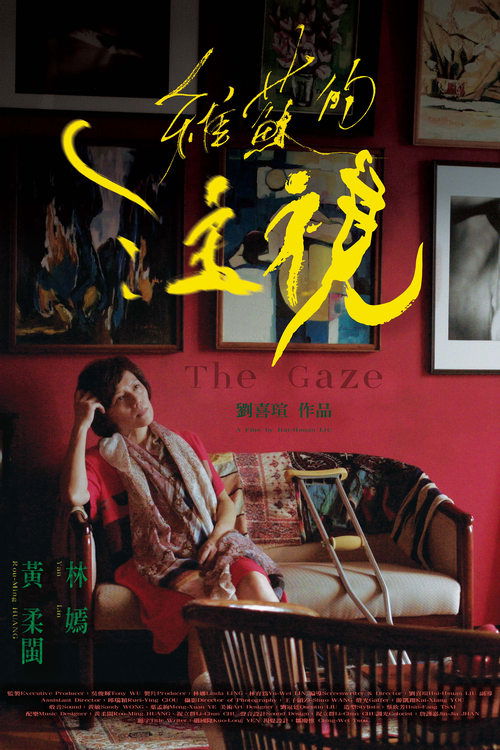
Wei-su gets injured. Her daughter rushes to the hospital. While looking after her, her daughter realizes how distant they are from each other, but they both long to be understood.
The Gaze
Taipei 4-Way is a film on Taipei and the people of Taipei directed by four artists working in various art fields such as animation, installation documentary and experimental film. The film looks at Taipei as a whole through four sections titled' enTAIPEItrance,"traTAIPEIverse','adTAIPEIhere', and 'exTAIPEIit'.
Taipei 4 Way
A boy comes to a garden and is seduced by a man transformed by a strange flower. The strange flower man leads the boy to the entrance of a forest that appears mysterious and unknown, waiting for the boy to explore.
The Chronicles of a Garden
Bathing but no murder! Chun-Hui Wu deconstructs Marion Crane's motel room ablutions in Htichcock's classic "Psycho", reframing and reanimating the famous shower scene into a whole other narrative of frustrated suspense with erotic overtones.
Psycho Shower
A super-8mm Maya Deren-inspired queer experimental film shot in San Francisco, exploring queer desire through surrealism.
Castro
Integrating home movies shot over six years of traveling with friends and lovers with postcards and flyers collected during past travels, Wu Chun-Hui takes us on a journey without end, a voyage searching for the origin of memory and infinite desire. Noah, Noah deals with relationships, distance, and memories, and turns the needs and desires that evolve from them into a cinematic experience. Trains departing, back roads roamed, navigating by water or air. It’s also about distance in filming, a distance from one image to another film roll, from one frame to another perforation, the distance from the real to the faded memory.
Noah, Noah
This is a 3-part love story. One girl is talking a story of her ex-boyfriend. He went aboard to chase for homosexual love. Although she stayed home, both of them are experiencing almost simultaneously unbounded sexual exploring journey in each end. The traditional narrative monologue is manipulated as a link to all the experimental segments. As the story goes on, the emotion of those original extremely abstract experimental footages are becoming touchable and understandable.
Sentimental Journey

Incarnation (Boy) Negative & Positive evokes the ghosts from Stan Brakhage’s Mothlight. Boy images incarnate from found-footage film corpse. Boys and incarnation (boys) gaze at each other. Wu’s hand-processed 16 mm double projection employs negative and positive prints of the same snippet from appropriated porn film to summon an eerie doppelganger of erotic obsession.
Incarnation (Boy)
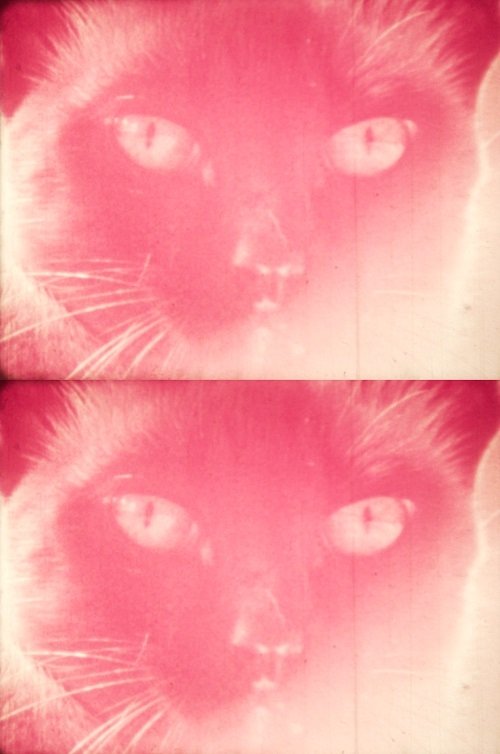
PRISCILLA'S DREAM is a film about a cat's dream journey. The original film footage comes from the American director Carroll Ballard's 1969 film THE PERILS OF PRISCILLA. In PRISCILLA'S DREAM, real danger turns into an adventure in a dream. In the original film, Priscilla shuttles through the human home environment, and in PRISCILLA'S DREAM, she dreams of breaking away from human society, into the dream, into the state of flight in the dream, and finally out of the dream and into nature, and gaining complete freedom. This film removes the dangerous encounters and restrictions in the original film, changing the situation in which cats cannot escape from the human living environment.