Andrea Maffei
Writing
Biography
From Wikipedia, the free encyclopedia Andrea Maffei (1798 – 1885) was an Italian poet, translator and librettist. He was born in Molina di Ledro, Trentino. A follower of Vincenzo Monti, he formed part of the 19th-century Italian classicist literary culture. Gaining laurea in jurisprudence, he moved for some years to Verona, then to Venice and finally to Milan, where in 1831 he married contessa Clara Spinelli. They separated by mutual consent on 15 June 1846. As well as Verdi, Maffei also built up close relationships with others in the Italian cultural scene of the time, including Vincenzo Monti, Antonio Rosmini, Gino Capponi, Mario Rapisardi, Carlo Tenca, the painter Francesco Hayez, and the sculptors Vincenzo Vela and Giovanni Duprè. Key cultural figures from the rest of Europe also passed through the lounge of his house in Milan, including Liszt and Stendhal. In 1879 Andrea Maffei was made a senator of the Kingdom of Italy and participated in Italian political life. In the mid-19th century he frequently lived at Riva del Garda, where he organised his rich art collection and where, in 1935, the town's Liceo classico was named after him. He died in Milan in 1885.
Known For

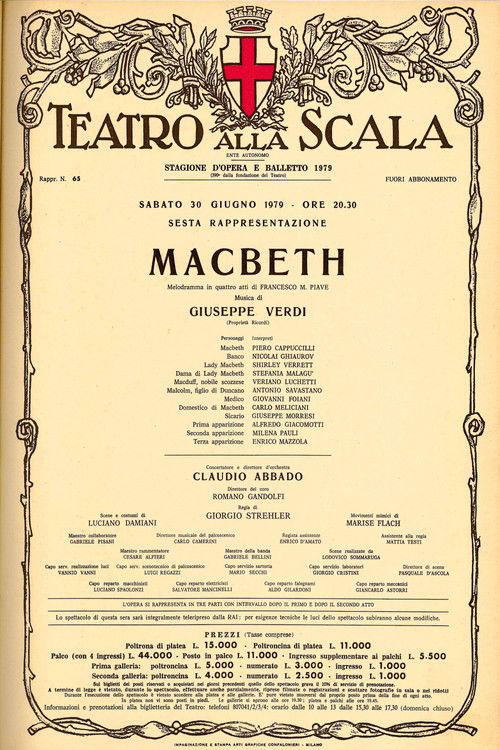
Piero Cappuccilli and Shirley Verrett lead Verdi’s sombre masterpiece, drawn from one of Shakespeare’s most celebrated tragedies. Filmed for television at Teatro alla Scala in 1979, Claudio Abbado conductes a night to remember.
Macbeth

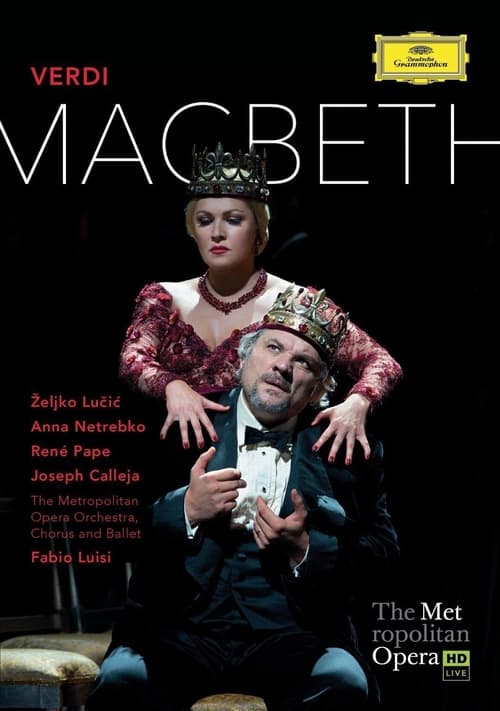
Star soprano Anna Netrebko created a sensation with her riveting performance as the malevolent Lady Macbeth, the central character in Verdi's retelling of Shakespeare's tragedy. She is joined by Željko Lučić, who brings dramatic intensity and vocal authority to the title role of the honest general driven to murder and deceit by his ambitious wife. The great René Pape is Banquo and Joseph Calleja gives a moving performance as Macduff. Adrian Noble's powerful production provides an ideal setting for this dark drama, which is masterfully presided over by Met Principal Conductor Fabio Luisi.
The Metropolitan Opera - Verdi: Macbeth

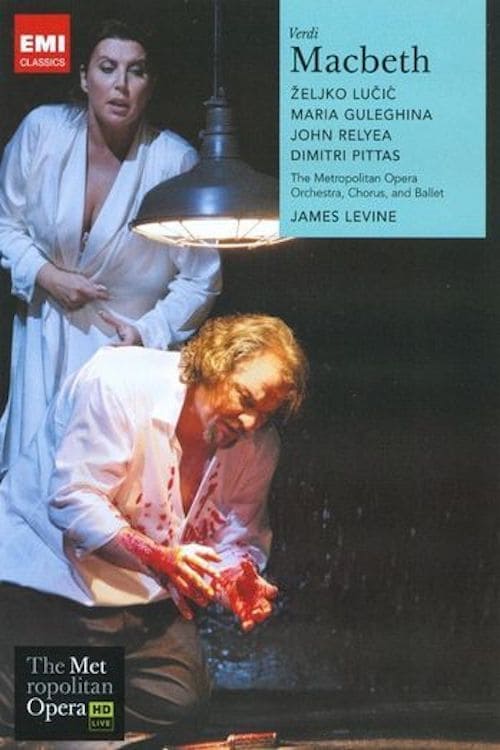
Verdi’s admiration for Shakespeare led to such masterpieces as Othello and Falstaff, and if the earlier Macbeth isn’t on their exalted level it’s still a powerfully dramatic opera that hews closely to the original’s story line. The MET’s production retains the dark aura of the opera while updating it to a vaguely post-modern context. So the witches are bag ladies in various stages of decrepitude, with children in tow. The Banquet Scene features lowered chandeliers, a plethora of chairs, and a slew of extras dressed in tuxedos and party gowns. Macbeth sports a leather coat, the soldiers are in drab brown uniforms and seem to have fingers on their triggers even when they’re supposed to be in non-threatening situations. Director Adrian Noble also has Lady Macbeth do an inordinate amount of writhing around and singing from a lying-down position, adding to the feeling that a less interventionist directorial hand might have generated more impact.
The Metropolitan Opera – Verdi: Macbeth

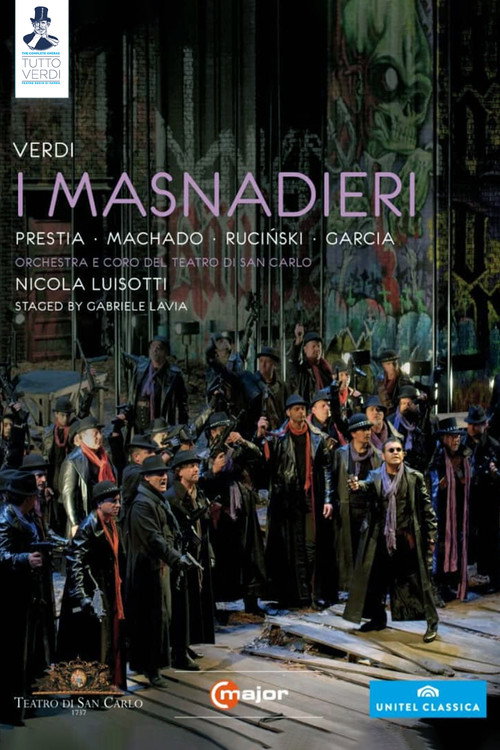
In Milan and Como during the month of May 1176. Milanese soldiers defend the city under the command of Rolando. He is reunited with Arrigo, his friend from Verona, who had been presumed dead in battle. Arrigo also meets Lida, his former fiancée, who, at her father’s behest, has married Rolando. Meanwhile, Rolando, who is preparing to leave for battle, is approached by Marcovaldo, a German prisoner of war, who hands him a letter from Lida for Arrigo. Rolando’s anger turns to a desire for revenge. Catching Lida and Arrigo in the middle of a conversation, he has his “rival” imprisoned in a tower. “La battaglia di Legnano” (The Battle of Legnano) is a four-act opera by Giuseppe Verdi with a libretto by Salvatore Cammarano, premiered at the Teatro Argentina in Rome on January 27, 1849. From the “Tutto Verdi” box set of 27 Verdi operas. Recorded live at the Teatro Lirico “Giuseppe Verdi” in Trieste on February 23 and 29 and March 2, 2012.
Verdi: I masnadieri

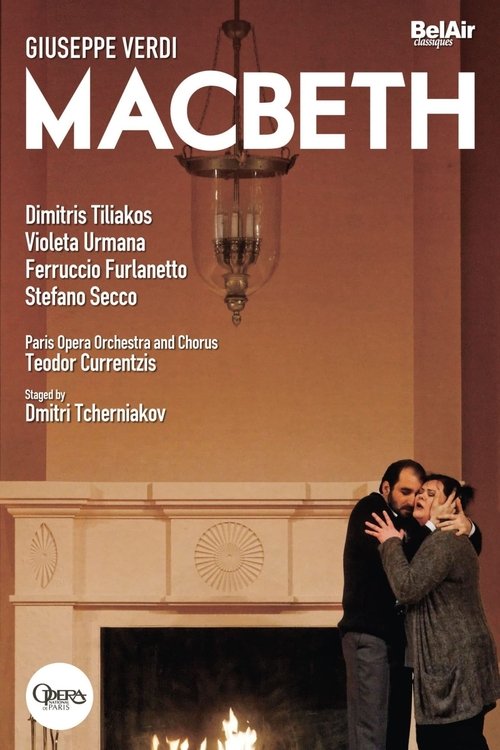
Coproduced with Siberia’s Novosibirsk Opera, this new Macbeth uses cutting-edge multimedia technology to give the viewer a fresh perspective on the work. Google Earth satellite images plunge us into the heart of the action: a gloomy square surrounded by soulless buildings, and the interior of an aristocratic residence. Witches are no more a part of Tcherniakov’s Macbeth that the duel was of Onegin, but once again the atmosphere is one of brooding claustrophobia. Tcherniakov has chosen a great cast, beginning with the marvellous Lithuanian soprano Violeta Urmana as Lady Macbeth. Greek baritone Dimitris Tiliakos is a powerful presence as Macbeth, while the Italians Ferruccio Furlanetto (bass) and Stefano Secco (tenor) are sumptuous as, respectively, Banquo and Macduff. In this, his second production at the Paris Opera, Teodor Currentzis, music director of the Novosibirsk Opera and Ballet Theatre conducts with verve and a splendid theatrical sense.
Macbeth: Opéra National de Paris

After winning in battle, Commander Macbeth receives a prophesy that he will one day become King of Scotland. Influenced by the whisperings of his wife, he literally stops at nothing to fulfil the prophesy. But racked by guilt, the Macbeths soon sink into delusions and become victims of their own thirst for power. Anna Netrebko reprises her electrifying portrayal of Lady Macbeth opposite Plácido Domingo at the Berlin State Opera. Maestro Daniel Barenboim leads the opera icons along with the Staatsopernchor and Staatskapelle Berlin.