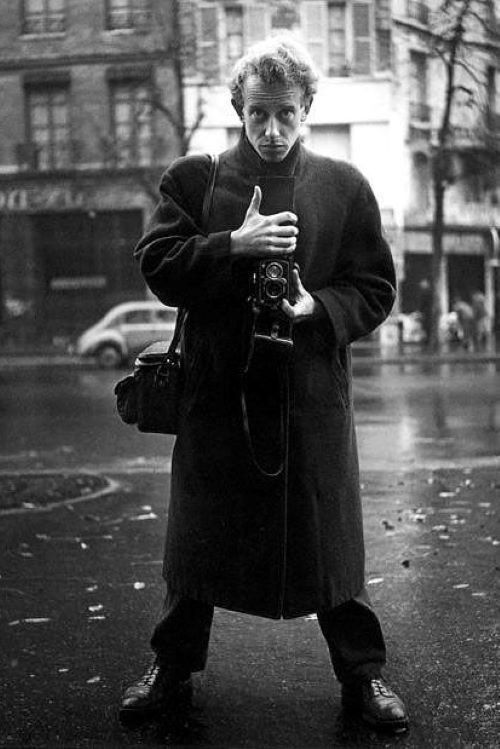
Ed van der Elsken
Directing
Biography
Ed van der Elsken (1925-1990) - the enfant terrible of Dutch photography - was a talented photographer and filmmaker who expressed his meetings with people in photos, photo books and films for more than 40 years. Strolling through cities such as Paris, Tokyo, Hong Kong and Amsterdam or travelling through Africa and Japan, he preferably took photographs of striking individuals with character. His first photo book Love on the left bank was published in 1956 and instantly made him world-famous. Some twenty photo books followed. He also made several television films, mostly about subjects regarding his own life. Ed van der Elsken was born in Amsterdam in 1925. He lives and works in Paris from 1950 to 1954. In this period, he lives with Ata Kando and her 3 children. He moves back to Amsterdam and lives there from 1954 to 1971. He travels a lot for his work, for instance to Bagara, Central Africa in 1957, and makes a long world trip in 1959 and 1960 with Gerda van der Veen, his second wife. Shortly after, their children Tinelou and Daan are born. During his many travels, Ed van der Elsken makes reports in colour for the monthly magazine Avenue. From 1971, he lives in the countryside near Edam. In this period, he often travels to Japan and also works in Amsterdam. He is living with Anneke Hilhorst and they have a son named John. In 1988 he is diagnosed with cancer. He dies in 1990.
Known For

The fainthearted cigar trader Ducker keeps himself quiet during World War II. That changes when parachutist Dorbeck lands in his backyard. It turns out the parachutist bears a remarkable resemblance to Ducker. Ducker follows Dorbeck blindly, becomes involved in the Dutch resistance and soon starts killing people. When he escapes through German lines to the freed South Netherlands, no one has ever heard of Dorbeck.
Like Two Drops of Water

BEPPIE is a moving and disarming portrait of an Amsterdam street urchin. Van der Keuken once described her as follows: 'She was ten years old and the joy of the Achtergracht, where I was living at the time. An Amsterdam child, sweet and crooked as a corkscrew.' He films her while she skims the city with some friends and knocks at strangers' doors. Her family has nine children and is not well off. In those days, a visit to the De Miranda swimming pool cost a quarter, but only ten cents if the weather was bad. At school, Beppie gets a poor mark because she is too boisterous, but when the whole class rattles off the multiplication tables, she joins in at the top of her voice. All of TV-watching Holland was wildly enthusiastic about this portrait, with which Van der Keuken even made the front page of the national newspaper De Telegraaf.
Beppie

For the exhibition Dylaby, the museum’s director Willem Sandberg and artist Jean Tinguely transformed the Stedelijk into a huge labyrinth. The film follows a tour of the exhibition in which the viewers have to actively participate in this DYnamisch LABYrint. Van der Elsken walks through the exhibition; looks, sees and hears what is happening, and also records viewers’ responses.
Dylaby

As part of the celebrations for 100 years of Amsterdam’s Vondelpark in 1965, the Vondelpark was transformed into a massive sculpture garden under the direction of Stedelijk Museum director Sandberg. 25 epic artworks by well-known artists such as Pablo Picasso, Alexander Calder, Henry Moore, Shinkichi Tajiri and Jean Tinguely were placed in the park. Karel Appel was also represented, by a gigantic elm tree trunk brightly painted in Appel’s characteristic manner.
De Appel-iep

A collage of autobiography, reflections on previous work and the photographer in action. Van der Elsken tells us that he’s working on a photo book about life, from the cradle to the grave, about how people are: physical, sensuous, naked. He takes the time to show us a selection from the thousands of slides he has made during his wide-ranging travels as a photo reporter.
Camera in Love

Handen (Hands) is an experimental documentary film by Dutch photographer and filmmaker Ed van der Elsken. the film is a moving and poetic observation of how hands play an integral part in human life, from birth to death.
Hands

In 1960, Utrecht University took over the Studio for Electronic Music from Philips. In this studio in Utrecht, composers and artists worked on their own compositions. In 1961, Jan Vrijman made a film about Karel Appel, De werkelijkheid van Karel Appel, and Appel himself made a musical composition for this film in the studio in Utrecht. Van der Elsken films and photographs Appel during the composition of his Musique Barbare, as well as recording conversations on tape; the film is in fact a kind of collage of film, photographs and sound. As well as an exceptional record of Karel Appel’s working process, this film is a unique documentation of the studio and therefore a significant piece of Dutch musical history.
Karel Appel, Composer

Rhythmic composition of moving photographs of cyclists in Amsterdam, ‘set’ to Vivaldi’s The Four Seasons.
Bicycle

In the seventies, Waterlooplein square and the Nieuwmarkt neighbourhood faced a great deal of demolition in relation to the construction of Amsterdam’s new opera house, the ‘Stopera’, and the metro system. Van der Elsken did a lot of filming in and around Waterlooplein and its centrepiece, the legendary flea market which faced closure.
Het Waterlooplein verdwijnt
Short film about the mare of Ed van der Elsken who is covered by a stallion from the neighborhood. The horse is getting thicker and brings a foal into the world. The foal soon runs through the meadow. A few recordings have been made with a 'fish eye' lens, so that the image is distorted (source: Eye Catalogue).
Paardeleven

Famed Dutch photographer Ed van der Elsken documents the natural world as well as the local people in and around his hometown of Edam, the Netherlands.
Avonturen op het land

Poverty, Demolition and Waterlooplein 1962/1964
Found footage

A self-portrait of the Van der Elsken family, with his heavily pregnant wife Gerda in the lead role. She is expecting their second child, and Van der Elsken portrays her in a kind of free cinema style in her everyday surroundings, in the living room of their house in Amsterdam’s Nieuwmarkt neighbourhood. The film is also a portrait of the energetic life of this neighbourhood, of which the Van der Elskens are an integral part.
Welcome to Life, Little Love

Famous Dutch photographer Ed van der Elsken, suffering from prostate cancer, shares his thoughts predominantly on his illness, but also on his life and work.
Bye

An impression of schoolkids in Amsterdam: in the canal boat, in Artis Zoo at the monkeys and swimming in the canal.
Lieverdjes

A filmic portrait of the Australian visual artist Vali Myers, whom Dutch photographer and filmmaker Ed van der Elksen got to know in post-war Paris. With Myers, Van der Elsken shot his photo story LOVE ON THE LEFT BANK.
Death in the Port Jackson Hotel

An entire summer, van der Elsken walked through Amsterdam an filmed in the same manner as he used to shoot his photos, strolling through the city centre and making contact with people that fascinated him. It became hís portrait of the city and its inhabitants.
Een fotograaf filmt Amsterdam

Report of the last market day on the old Waterlooplein in Amsterdam. Traders and visitors are interviewed and van der Elsken provides the commentary to the events.