Writing
Who remembers that unlikely handful of marchers—campaigning "for equality and against racism"—who set out on the roads of France in October 1983 in obscurity, only to culminate in a triumphant finale in Paris, with nearly 100,000 people at the Bastille and the Élysée Palace as the finish line? "Put your guns away, we’re coming—hunting season is over," proclaimed the March, a response to the police violence and numerous racist crimes that had marked the early 1980s. A novel of the "Beur generation," Les Marcheurs revisits this little-known story.
In the early 20th century, one of the biggest stars of the Parisian stage was a Black artist who has since been forgotten: the clown Chocolat. This film by Samia Chala and Thierry Leclère tells the extraordinary story of this former Cuban slave who captivated the Lumière brothers, inspired the painter Toulouse-Lautrec, and later influenced writers such as Jean Cocteau. The meteoric rise of Chocolat—who was physically struck and mocked on stage by the "white clown" Footit—reflects the French public's discovery of the "Black man" during the era of colonial exhibitions and the Third Republic. It is a story that still resonates today. Drawing on exceptional archival footage, Chocolat’s epic life story is recounted by historian Gérard Noiriel and actor Marcel Bozonnet, both of whom brought the clown back to life on stage.
The Saint-Denis Canal cuts through the landscape on the outskirts of Saint-Denis and Aubervilliers, connecting both the towns and the people. Its banks invite one to take a detour and stray from the beaten path. This film takes us on a cross-cutting journey—a visual and sensory experience that immerses us in places whose boundaries remain ill-defined on today’s city map. It presents a strange tableau revealed in sequences: worn, dilapidated "no-man’s-lands" bordering neighborhoods and concrete plants. Further along, we encounter structured, developed spaces—areas already integrated into the contemporary city or currently under construction. It is a layering of human stories—tales of exile that have shaped the identity of these neighborhoods. This film is the first installment of the documentary series *Canal Saint-Denis, la bascule d’un paysage* (Canal Saint-Denis: A Landscape in Transition), in production since 2018.
"Ma ville en jeu" was made in 2024, featuring two young residents of Saint-Denis and an unaccompanied young migrant experiencing the Olympic Games in their city. This film is the fourth installment in the documentary series "Canal Saint-Denis, la bascule d’un paysage," which has been in production since 2018.
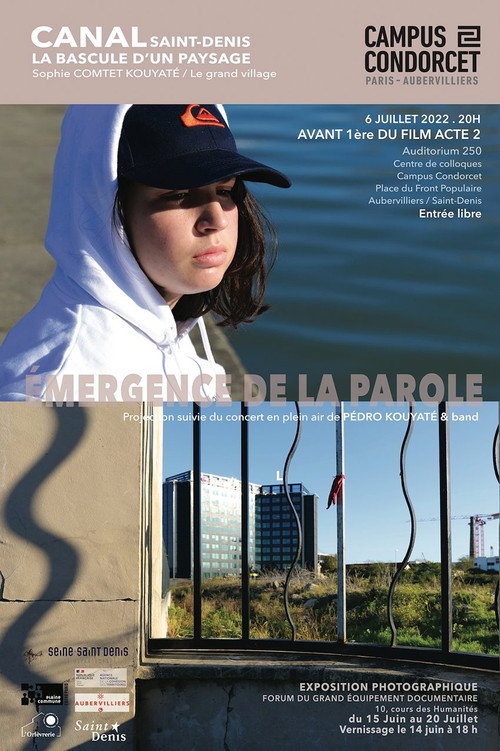
Set against the backdrop of the transformation of the Canal Saint-Denis, this film focuses on the people who inhabit its banks: displaced families, solitary workers, students, entrepreneurs, and residents who left Paris—as well as those who grew up here, who have lived through its history and continue to shape it. Each person holds a unique view of the landscape, the neighborhood, and the construction sites, weaving their own narrative around them. The film explores how this environmental shift resonates with them—deep within their inner selves and sensibilities—and what they expect from it. It follows those who daily traverse these varied paths: riverbanks, crumbling sandpits, stairways, footbridges, public squares, broad avenues, and bike lanes, alongside elements of street furniture that are aging, ephemeral, or newly built. This film is the second installment in the documentary series Canal Saint-Denis, la bascule d’un paysage, in production since 2018.
This film explores the neighborhoods along the canal alongside local residents, an architect, and a student of architecture and urban planning. It offers an intimate look at the evolution of these areas with the 2024 Olympic Games on the horizon. The film reveals the scale of the construction projects and the inner workings of creating a new neighborhood and urban layout, while highlighting the stakes involved in upcoming events—and, above all, the impact on the residents who engaged directly with the architects, urban planners, and organizers behind these major developments. It is the third installment in the documentary series Canal Saint-Denis, la bascule d’un paysage (Canal Saint-Denis: A Landscape in Transition), in production since 2018.
One morning in Paris, rue de la Sante, Pierre, thirty-five years old, gets out of prison after five years of refusing any contact with his past. After a day of sleep in one of the rooms of his old friend's hotel, he is going to live his first night of freedom in solitary wanderings in the streets of Paris. He then decides to read the letters of his friend Sylvana. They will reveal past events that will influence his itinerary, his encounters, his moods.