Directing
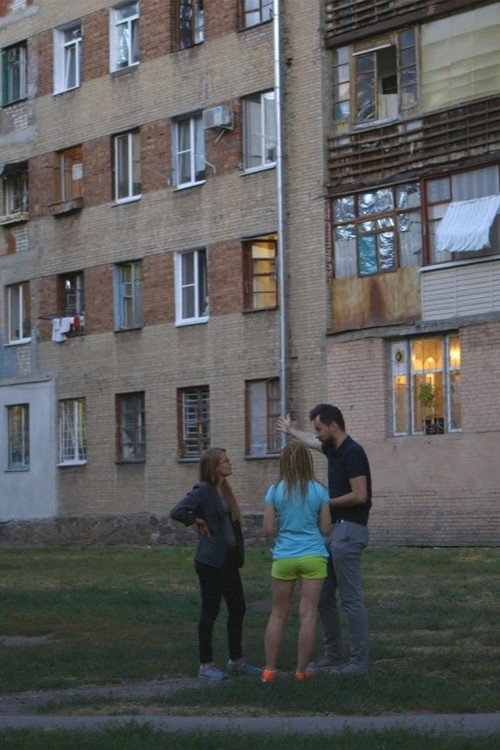
Let’s embark upon a journey to discover two collective housing projects. One in Kharkiv, Ukraine, from the early days of the Soviet era in 1930; the other, in the suburbs of Rotterdam, in the 1950s. Their connection? Lotte Stam-Beese, the first woman to train as an architect at the Bauhaus, who took part in both ventures. Two political and social spaces for two different architectural utopias. The film unfolds stories and expands them with well-informed, militant explanations, as we go back and forth, sometimes imperceptibly, from one city to another, from past to present, in a delicate weaving operation. As a game of transfer and echoes, of viewpoints opening up a counter-History, in reverse, as suggested by the superimpositions the film is peppered with. A journey through the bends of places, History, words, punctuated by the apparitions of an interpreter who translates as much as she comments, in a whispering voice, as a ghostly narrator.
No description available.
OBSADA means “film crew” in Polish, but can also mean “task force”. The crew here is dual purpose. First the film crew, in front of and behind the camera, who are all women – art and film students brought together for the occasion at the Sztuki Museum in Lodz.
Presented at the Dutch Pavilion at the 57th Venice Biennale.
Wendelien van Oldenborgh uses architecture both as a setting and as an investigative tool to question politics and its history.
Instruction interrogates the agency of the individual in conditions of war. The work revolves around an unresolved episode of military history: the Dutch intervention in Indonesia’s struggle for independence in 1947-49. Van Oldenborgh asked a group of cadets from the Royal Netherlands Military Academy to read out and discuss a script composed of documents related to the conflict. Performing the script becomes a means to enact diverging historical subject positions, as well as to negotiate positions and responsibilities in the present.
Van Oldenborgh's practice explores social relations through an investigation of gesture in the public sphere. Bete & Deise brings about a meeting between veteran telenovela actress and political activist Bete Mendes and Deise Tigrona, one of the most powerful voices in Baile funk, whose song Injeção was the basis for M.I.A.'s Bucky Done Gun.
Shot in Japan, the film brings together the voices of today’s women with the lives and texts of Fumiko Hayashi and Yuriko Miyamoto, focusing on gender, politics and love.
Shot in a single uncut sequence, Cinema Olanda Film connects an architectural location, a number of individuals, and past and present events through a momentary filmic reality.
A documentary by Wendelien van Oldenborgh.
A short documentary by Wendelien van Oldenborgh.
From Left to Night is an experimental film production through which a number of seemingly unconnected players, places, events, subjects and histories, drawn from the Church Street area in London NW8, meet. It involves five people, three locations, and the different subjects and forms of knowledge that they bring with them. These range from urban tensions – such as unresolved histories of the 2011 London riots – to music and the personal ways in which each of the protagonists relate to ideas of the political. Material gathered in a concentrated two-day shoot has been brought together in a film installation specially conceived for The Showroom, London NW8.