Alvin Lucier
Acting
Biography
Alvin Lucier (born May 14, 1931) is an American composer of experimental music and sound installations that explore acoustic phenomena and auditory perception. A long-time music professor at Wesleyan University, Lucier was a member of the influential Sonic Arts Union, which included Robert Ashley, David Behrman, and Gordon Mumma. Much of his work is influenced by science and explores the physical properties of sound itself: resonance of spaces, phase interference between closely tuned pitches, and the transmission of sound through physical media. (Source: Wikipedia)
Known For

I am sitting in a room is a sound art piece by American composer and sound artist Alvin Lucier composed in 1969. The first performance of the work was in 1970 at the Guggenheim Museum in New York. In collaboration with his partner Mary Lucier. The piece features Lucier recording himself narrating a text, and then playing the tape recording back into the room while re-recording it. The new recording is then played back and re-recorded, and this process is repeated. Due to the room's particular size and geometry, certain resonant frequencies are emphasized while others are attenuated. Eventually the words become unintelligible, replaced by the characteristic resonance of the room.
I Am Sitting in a Room

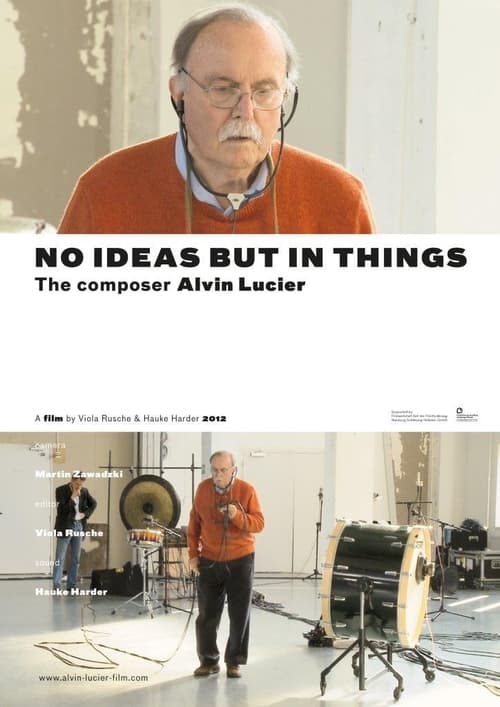
“Don’t ask me what I mean, ask me what I’ve made” – inspired by this motto, the documentary accompanies the American composer Alvin Lucier (1931 - 2021) on concert travels to The Hague (Netherlands) and Zug (Switzerland). Lucier explains and comments on his œuvre – from his early live electronics performances (MUSIC FOR SOLO PERFORMER,1965 and BIRD AND PERSON DYNING, 1975) up to the premiere of his ensemble piece PANORAMA 2 in 2011. One of Lucier’s key works, I AM SITTING IN A ROOM (1969), is introduced as a central structuring device in the film. At home in Middletown, Connecticut, Lucier offers rare insights into the beginnings of his pioneering works, his time as a member of the Sonic Arts Union, his relations with John Cage and David Tudor, as well as his teaching practice at Wesleyan University.
No Ideas But in Things - the composer Alvin Lucier
In 1975 the composer Robert Ashley embarked on an ambitious work titled Music With Roots in the Aether. He called it an Opera (or piece of theater depending on the case) for television. The work is comprised of seven, two hours sections. Each “episode” is dedicated to investigations, interviews, and performances of his one of his peers – David Behrman, Philip Glass, Alvin Lucier, Gordon Mumma, Pauline Oliveros, and Terry Riley respectively, with the final reserved for himself.
Music with Roots in the Aether: Opera for Television by Robert Ashley

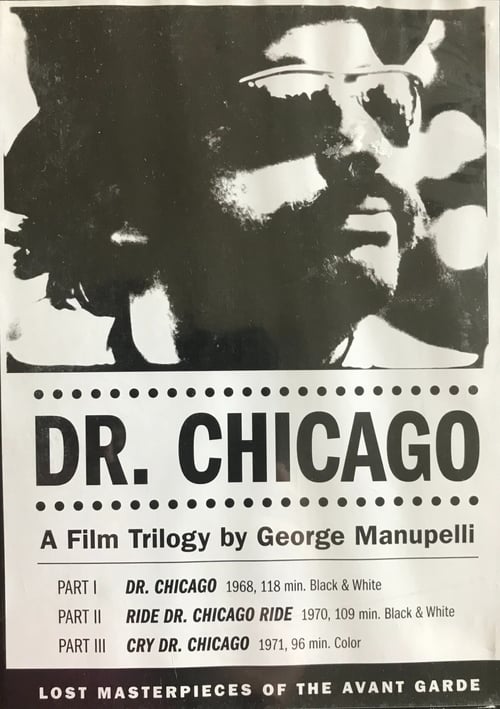
From George Manupelli's Doctor Chicago trilogy, starring Alvin Lucier as the evil (and politically incorrect) surgeon on the lam, Dr. Alvin Chicago with his sidekicks Sheila Marie (Mary Ashley) and Steve (Steve Paxton, who dies, dancingly, in each episode).
Ride Dr. Chicago Ride

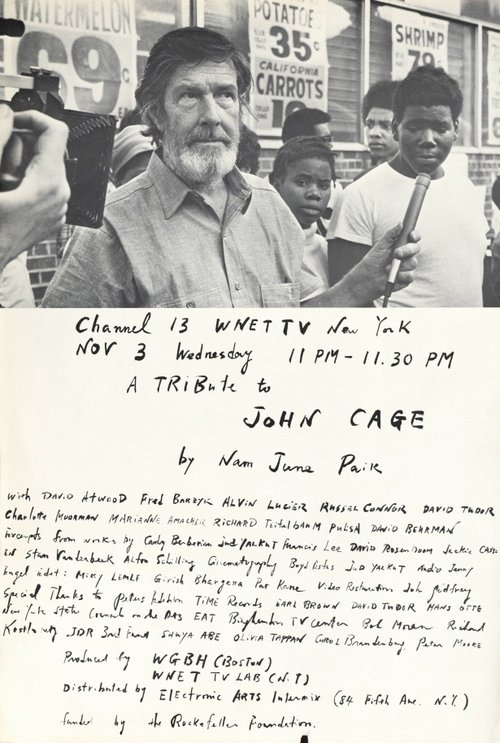
A Tribute to John Cage is Paik's homage to avant-garde composer John Cage. A major figure in contemporary art and music, Cage was one of the primary influences on Paik's work, as well as his friend and frequent collaborator. In this multifaceted portrait, Paik creates a pastiche of Cage's performances and anecdotes, interviews with friends and colleagues, and examples of Paik's participatory music and television works that parallel Cage's strategies and concerns. The methodology and philosophies that inform Cage's radical musical aesthetic — chance, randomness, the democratization of sounds — are evident as he performs such seminal pieces as 4'33" (of complete silence) in Harvard Square, or throws the I Ching to determine performance sites. Among the collage of elements included in this work are segments from Paik's Zen for TV; Paik and Charlotte Moorman in early performances, including the TV Bra; and anecdotes from composer Alvin Lucier.
A Tribute to John Cage

A silent fisherman in Texas, a blazing oil field in North Dakota, a mysterious community in Virginia, a women’s prison in Oregon, and a modernist home in California are the ostensible subjects of Austin Lynch and Matthew Booth’s new feature, GRAY HOUSE. But as meditations upon nature, isolation, decadence, and destitution, they are flawless conduits for seamless blends of documentary and narrative form, and stunning explorations of sound, image, and cinematic time. Mysterious and elusive, yet possessing an aesthetic and sensory unity (appearances by Denis Lavant, Aurore Clément, and Dianna Molzan mix with direct addresses from real-life laborers and inmates), GRAY HOUSE quietly recalibrates one’s sense of the world and our place within it.
Gray House

The premise of the Dr. Chicago feature film trilogy is that Dr. Chicago (Alvin Lucier), a sex-change surgeon, is perpetually on the lam, fleeing the Feds and, in Cry Dr. Chicago, hotly pursued by his nemesis, a French gangster–cum–business tycoon (Claude Kipnis).
Cry Dr. Chicago

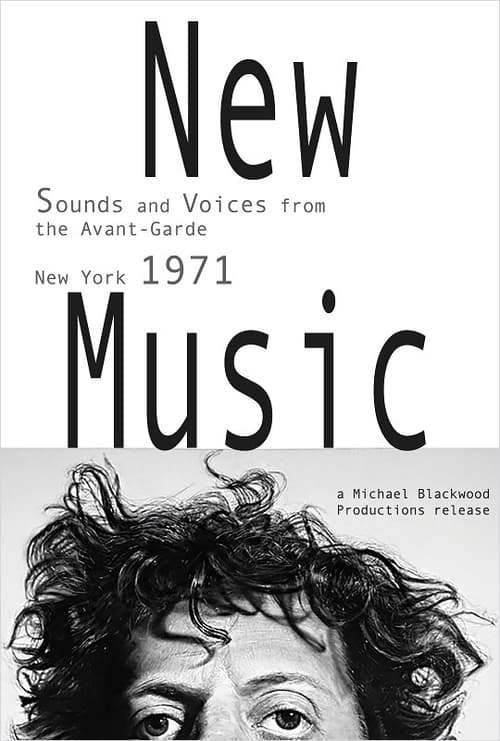
With participation of John Cage, Earle Brown, David Tudor, Gordon Mumma, David Behrman, Max Neuhaus, Morton Subotnik, Phil Corner, Joe Jones, Alvin Lucier, Steve Reich, Philip Glass, Ben Patterson, Wolf Rosenberg In 1971 we produced, in association with West German Television, a documentation on New York’s musical avant-garde. It was broadcast only in Germany at the time. By 2010, after nearly 40 years, it seemed desirable to recycle the performances and interviews with the composers and to create a revealing look back to those years for English-speaking New Music fans. The film offers valuable insights into the nature and issues of advanced composition at the beginning of the 1970s.
New Music: Sounds and Voices from the Avant-Garde New York 1971

A surgeon is on the run from the police for unacknowledged reasons.