Acting
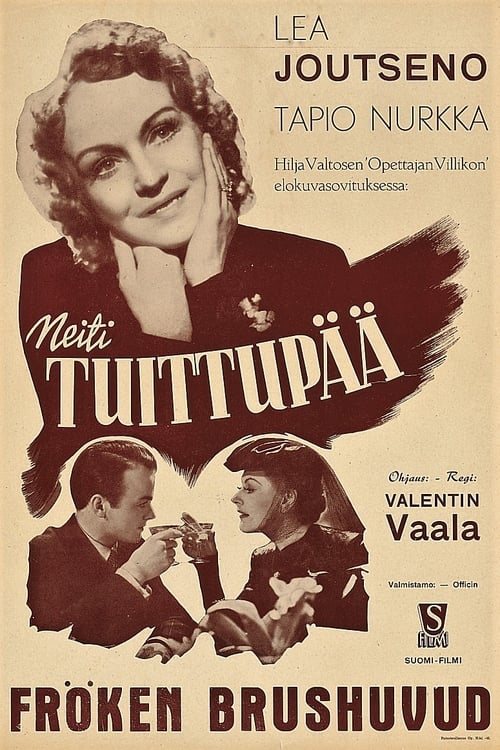
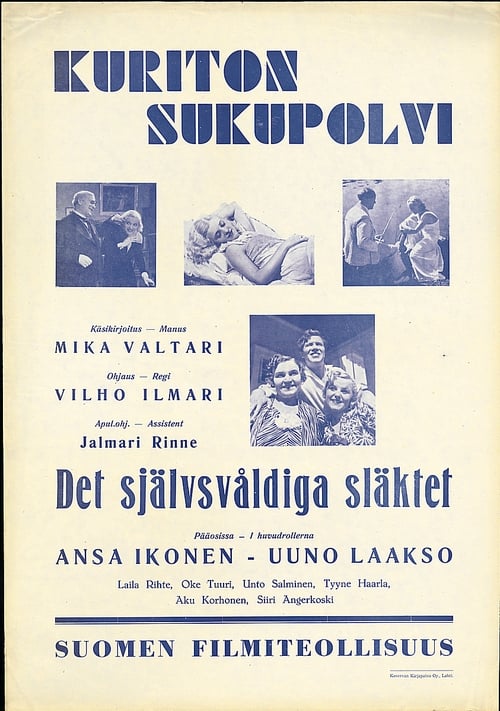
Teacher's daughter Anna cannot enter the music college because of her family's opposition. At the request of her relatives she goes to Helsinki to study administrative sciences, but nasty fellow students make the girl leave the university and apply to become a nurse.
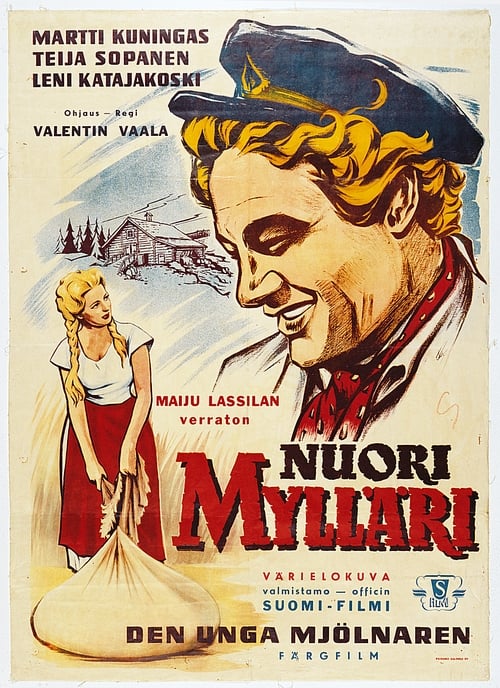
A young man arrives in the village. He becomes a miller and delights the girls in the village, which evokes bitterness in others. He is subject to moralistic criticism, even though he is in fact only in love with the tailor's daughter.
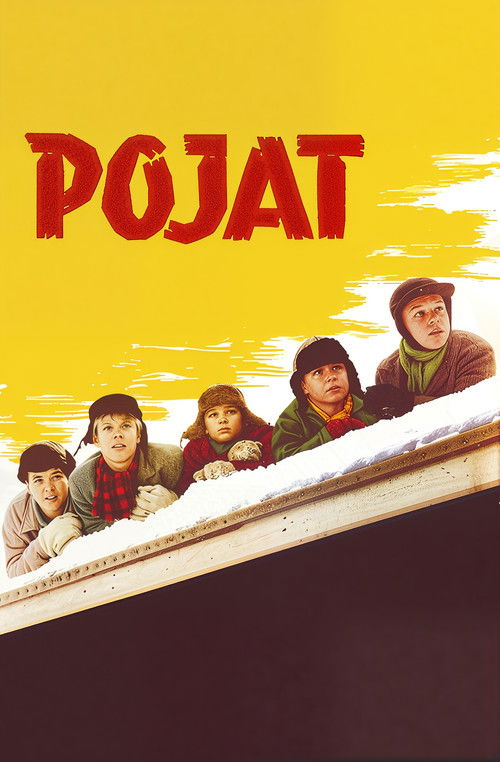
When Continuation War started in Summer 1941, German soldiers arrived to Oulu. With their charm they conquered women and town boys. Finnish boys communicated with them on many levels: had trades, worked as interpreters, rotated business, spied on German love adventures and fought with each other about the favor of soldiers. In autumn 1944, the war was ending. Germans left Oulu by leaving behind fragile relationships, bastard kids and unfinished businesses. The most shocking of all was the faith of young Jake...
Immersed in his research work, professor Reinhold Varavaara realizes that he has neglected his children's upbringing. He falls in love with his son Pelle's girlfriend Marja and becomes a laughing stock in the eyes of his family. The offended father sets out to discipline his ill-behaved children.
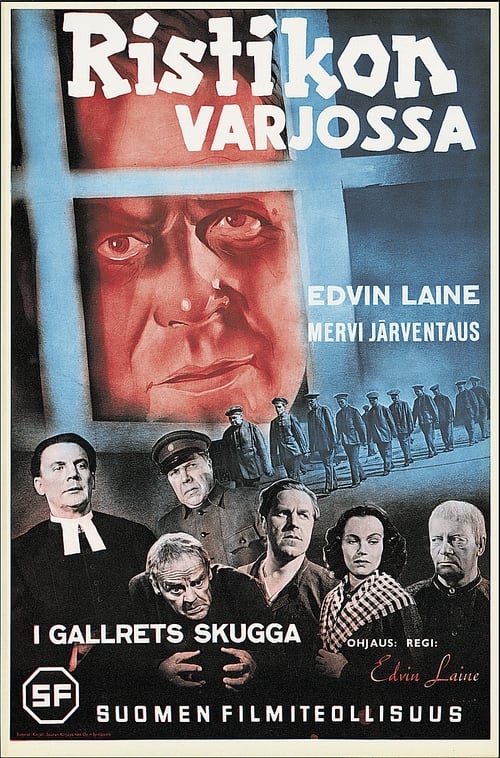
Lauri and Anna are released from prison. They run into trouble when they cannot find work because of their past. Lauri obtains false identity papers, which enable him to get a job at a factory. A dangerous criminal named Asseri begins blackmailing Lauri, who is using the alias "Pentti Tahvana." Lauri's true identity is revealed in connection with the murder of Kaalep, the factory's night watchman.
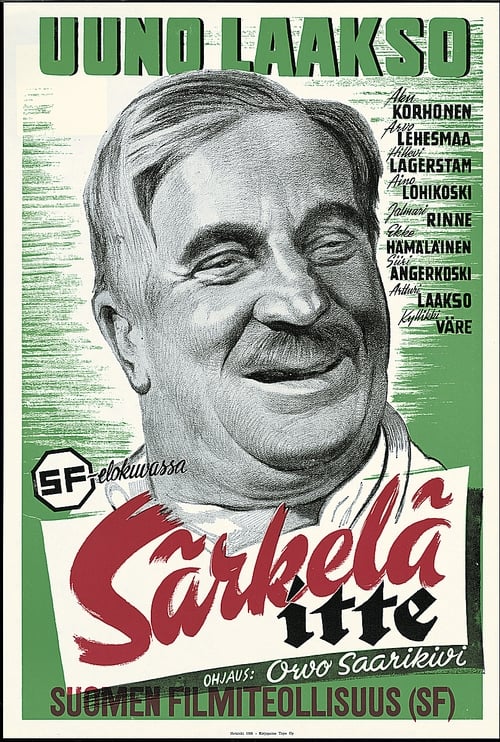
The self-assured manager Julius Särkelä maintains strict discipline in his office and at home, which is experienced by his daughter Saara and her suitor Martti, as well as the landlord Heroja, who is chasing his debts, and even the cat belonging to the patron Fallsten. Dr. Kosonen softens the stern leader by giving a speech at a party, which ultimately revolutionizes Särkelä's worldview.
Traveler Severi travels to Helsinki to enjoy some culture, where he meets Sinikka and Simo, who run a buying and selling business. At a customs auction, he buys a painting that businessman Kehveli and his assistants also have their eyes on.
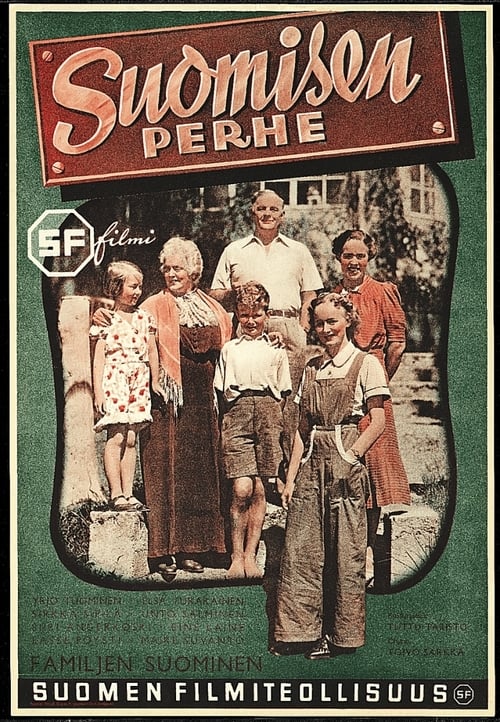
The film takes place in the summer and spring of 1940. Isä, the father, gets involved in the stock market and threatens the livelihood of the family.
A melodrama based on Aino Räsänen's novel of the same name, continuing the story of the Junkker family.
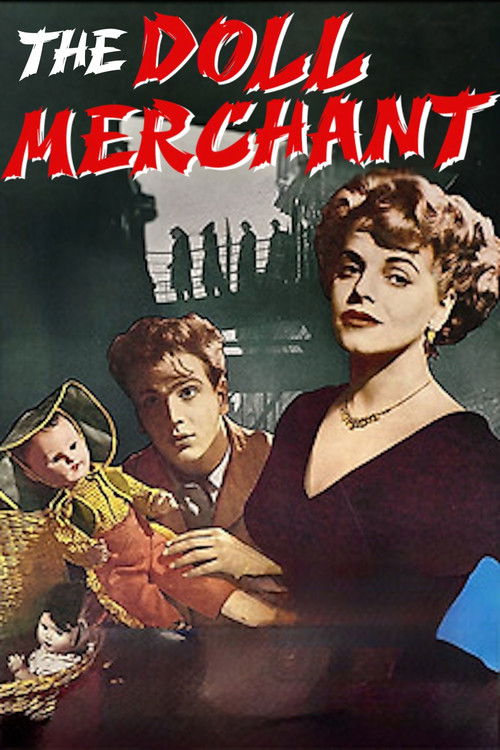
A wide-eyed doll salesman is mistaken for a bomb-wielding anarchist by the oppressive forces of the totalitarian state.
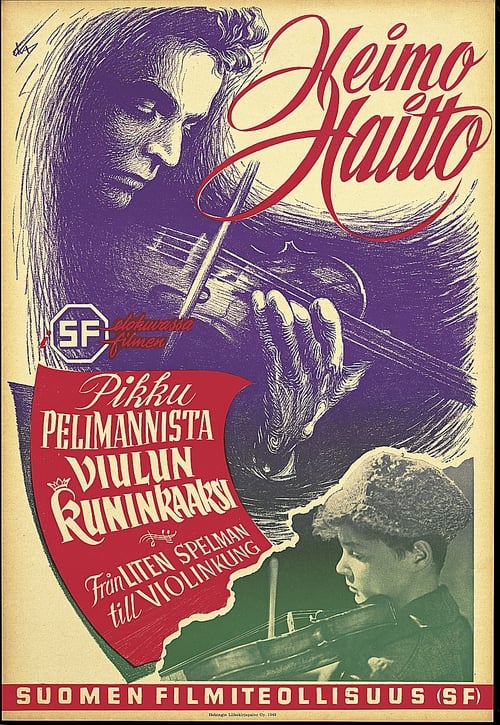
After ending up in an orphanage, Olavi sets out to find his mother. While playing the violin on the street, his exceptional talent catches the attention of a music school professor, who takes him under his wing.
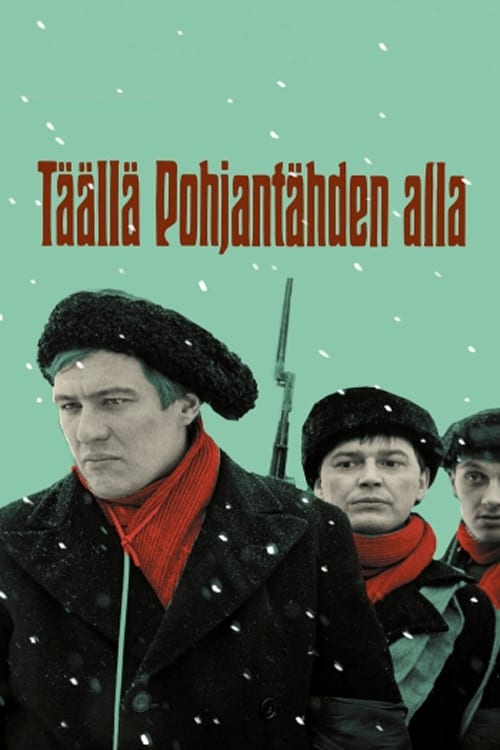
Täällä Pohjantähden alla is based on the book with the same title. It is a story of the little village. The movie starts in the 1890's and it ends to the Finnish civil war in 1918. Story concentrates around a tenant farmer family, although it gives us a good look at the society at whole. While the class struggle depends, people of the village are driven to bloody civil war.
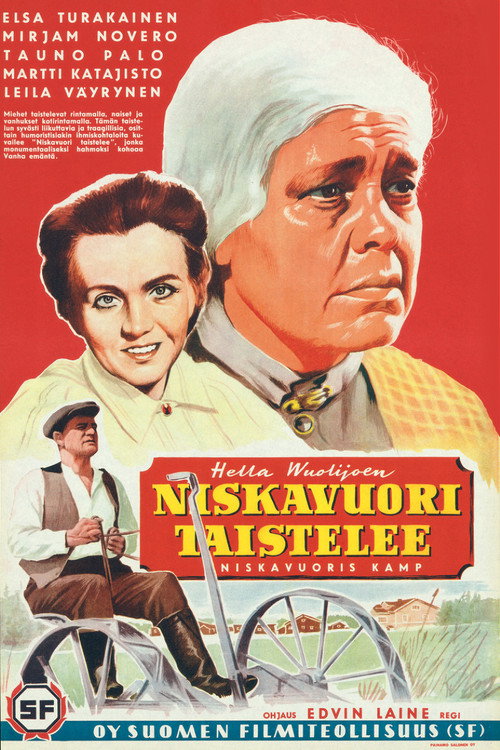
The last black-and-white film in the Niskavuori series of movies.
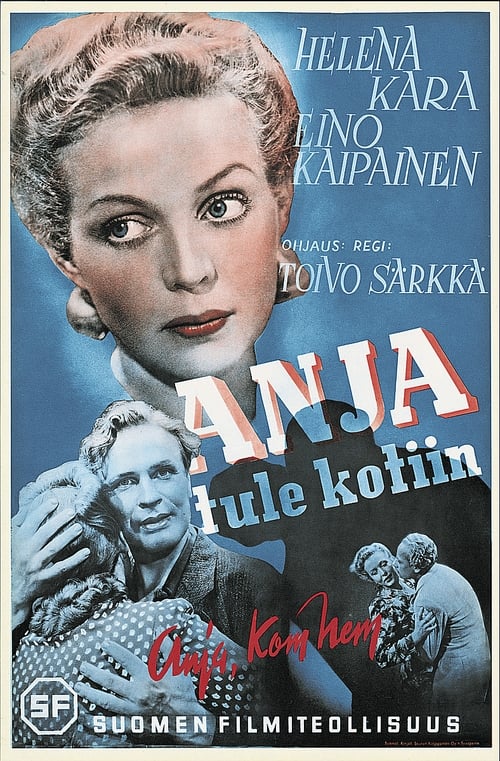
Mauri Miettinen and his wife Anja are living in a happy marriage. Everything changes when Mauri's old acquaintance comes to visit and threatens to reveal Anja's dark past.
Wholesaler Paavo Markkanen faces a month in prison for drunk driving. Accustomed to an easy life, he avoids prison by switching places with his doppelgänger, the vagrant Knip, but ends up having to do strenuous physical training in his place. Meanwhile, Markkanen's new housekeeper Kaisa Kankkunen spends her days enjoying herself with her male friends.
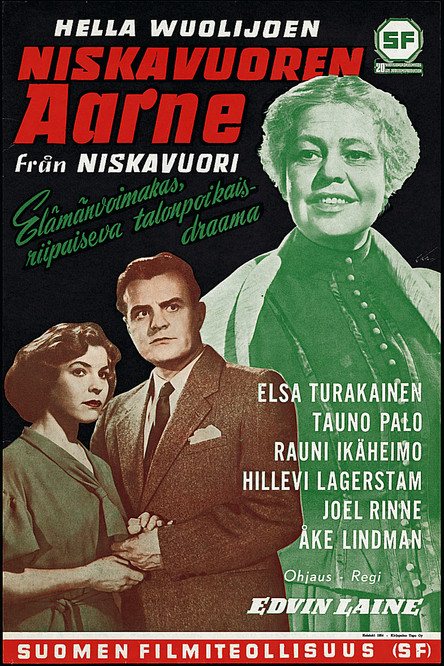
Niskavuori's Aarne (Arne från Niskavuori) is a Finnish drama film from 1954. It is based on Hella Wuolijoki's play Niskavuori's Bread. In chronological order of the Niskavuori series, the film is the fourth. Aarne has married Ilona and left the house in Niskavuori, which he hosts, where his former wife Martta still lives, while the old mistress is holding the reins. Aarne and Ilona live in Helsinki, but Aarne has not been able to completely break away from Niskavuori, but keeps secretly in touch with the headmaster and gives instructions on the farm management.
Justina urges Pete and Runt to get a job. As a result they meet an orphan boy named Otto while working as a park nannies. They offer to shelter the boy, but at the same time the father Antti, who has returned from the sea, is looking for his son together with Miss Raikas.
Police chief Olavi, health nurse Liisa Niemi and photo reporter Takola are investigating the disappearance of a local girl.
The story of the first elections in Finland. Farmer Topi Romppainen lives a modest life with his family in Kainuu in the early 20th century. While shopping in the village, Topi hears about the upcoming parliamentary elections. His wife Riikka decides to find out more and ends up at a meeting of the Social Democrats.
It is a time of extreme housing shortage in Helsinki. People with room in their flats are required either to find subtenants or to lodge anyone sent by the housing commission. Abel and Jussi Siimes, two devoted haters of women, find themselves in this predicament. They need to find a subtenant quickly to avoid the possibility of the housing commission sending a woman, God forbid it, to live with them. Abel's acquaintance, an assessor, recommends his nephew Kaino as the perfect choice.