Francesco Maria Piave
Writing
Biography
From Wikipedia, the free encyclopedia - https://en.wikipedia.org/wiki/Francesco_Maria_Piave. Francesco Maria Piave (18 May 1810 – 5 March 1876) was an Italian opera librettist who was born in Murano in the lagoon of Venice, during the brief Napoleonic Kingdom of Italy. His career spanned over twenty years working with many of the significant composers of his day, including Giovanni Pacini (four librettos), Saverio Mercadante (at least one), Federico Ricci, and even one for Michael Balfe. He is most well known as Giuseppe Verdi's librettist, for whom he was to write 10 librettos, the most well-known being those for Rigoletto and La traviata. But Piave was not only a librettist: he was a journalist and translator in addition to being the resident poet and stage manager at La Fenice in Venice where he first encountered Verdi. Later, Verdi was helpful in securing him the same position at La Scala in Milan. His expertise as a stage manager and his tact as a negotiator served Verdi very well, but the composer bullied him mercilessly for his pains over many years. Like Verdi, Piave was an ardent Italian patriot, and in 1848, during Milan's "Cinque Giornate," when Radetzky's Austrian troops retreated from the city, Verdi wrote to Piave in Venice addressing him as "Citizen Piave." Together, they worked on ten operas between 1844 and 1862, and Piave would have also prepared the libretto for Aida when Verdi accepted the commission for it in 1870, had he not suffered a stroke which left him paralyzed and unable to speak. Verdi helped to support his wife and daughter, proposing that "an album of pieces by famous composers be compiled and sold for Piave's benefit". The composer paid for his funeral when he died nine years later in Milan aged 65 and arranged for his burial at the Monumental Cemetery.
Known For

The corsair Corrado, having taken refuge on an island in the Aegean Sea, decides to launch an expedition against the Muslims, during which he is taken prisoner. Gulnara, the favorite of Pasha Seïd, falls in love with Corrado and helps him escape after murdering Seïd herself. Meanwhile, Medora, Corrado’s beloved, has poisoned herself upon hearing the false news of her lover’s death. She dies in the arms of her lover, who has returned too late. Corrado, in despair, throws himself into the sea, while Gulnara collapses, overcome by grief. “Il corsaro” is a lyric drama (“melodramma tragico”) in three acts by Giuseppe Verdi, with a libretto by Francesco Maria Piave, based on Lord Byron’s poem “The Corsair.” It premiered on October 25, 1848, at the Grand Theatre in Trieste. The opera was taken off the bill after three performances and replaced by “Macbeth.” From the “Tutto Verdi” box set of 27 Verdi operas. Recorded live at the Teatro Regio in Parma on October 19 and 21, 2008.
Verdi: Il corsaro
Live from the Metropolitan Opera: Simon Boccanegra
Simon Boccanegra

One of the lesser known works by Giuseppe Verdi, Simon Boccanegra is regarded by most opera lovers as one of his finest. The action takes place in the 14th century and deals with the political and personal rivalry between the corsair Simon Boccanegra, who has been elected Doge of Genoa with the help of the plebeian vote, and the local nobleman, Jacopo Fiesco. Arthaus presents a visually alert, musically sensitive and disturbingly coherent (Der Standard) production of the piece on DVD. The staging was directed by one of the giants of the European theatre, Peter Stein. His fondness for atmospherically dense spaces in which the characters can fully develop is particularly well brought out in his Vienna production, not least because he had at his disposal two remarkable singing actors for the principal male roles, Thomas Hampson and Ferruccio Furlanetto.
Simon Boccanegra

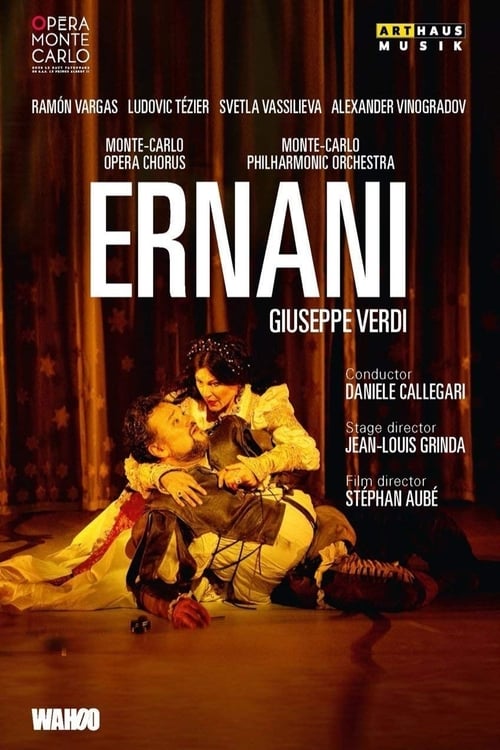
Stage director Jean-Louis Grinda and the Opéra de Monte-Carlo present Verdi’s early smash hit opera Ernani. Ramon Vargas heads up an incredible cast in the heroic title role and maestro Daniele Callegari leads the Monte Carlo Philharmonic Orchestra in the sumptuous melodies of Verdi’s score.
Ernani

A taxi driver travels to Venice and poses as a gondolier to land a radio singing job.
Broadway Gondolier

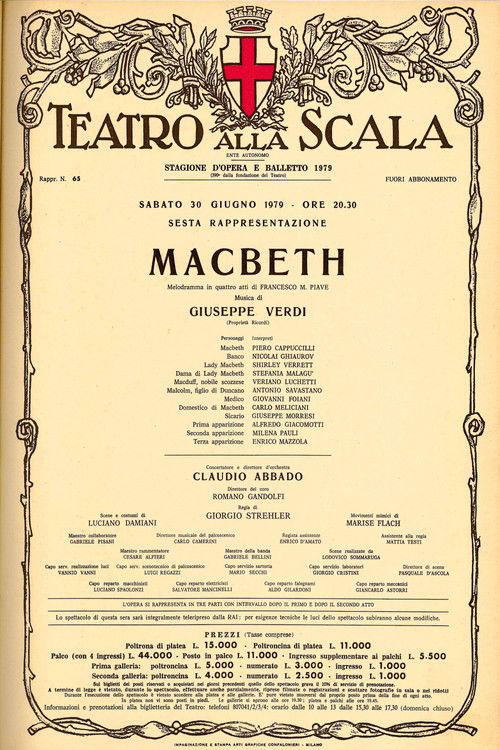
Claude D'Anna's film of Verdi's Macbeth is a gloomy affair, stressing the descent into madness of the principal villains. It's acted by the singers of the Decca recording of the opera (with two substitutions of actors standing in for singers) and the lip-synching is generally unobtrusive. The musical performance is superb, conducted by Riccardo Chailly with admirable fire, and sung by some of the leading lights of the opera stages of the 1980s. Shirley Verrett virtually owned the role of Lady Macbeth at the time, and she delivers a terrific performance, the voice equal to the role's wide register leaps and it's suffused with emotion, whether urging her husband on to murder or maddened by guilt in the Sleepwalking Scene. Leo Nucci's resonant Macbeth may lack the ultimate in vocal color and steadiness (his last notes of the great aria Pietà, rispetto, amore are wobbly) but he compensates with intensity in both singing and acting.
Verdi Macbeth Chailly

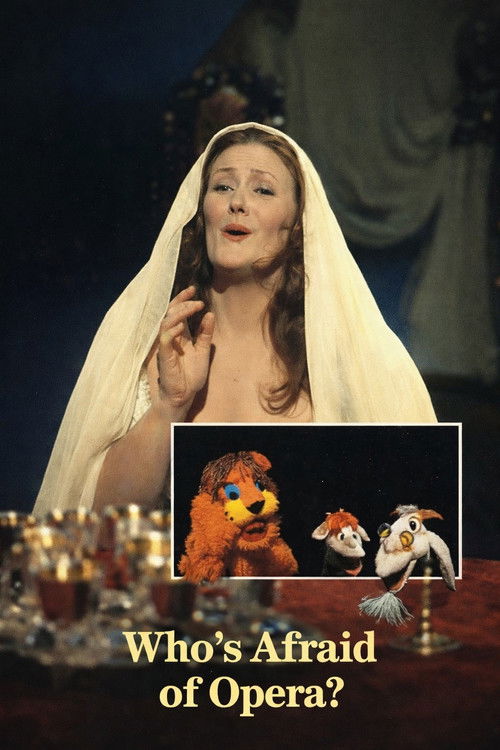
Three zany puppets bring to life our greatest opera treasures, as Joan Sutherland, the world’s most famous soprano, performs their highlights. The puppets make up the audience: Sir William, a wise old goat; Little Billy, his nephew; and Rudi, a rather boisterous lion. Sutherland first introduces them to the story of each opera. Then, backed by the London Symphony Orchestra and a first-rate cast, she moves onto the opera stage, complete with elaborate sets and elegant costumes. After each exquisite aria, the diva comes back to her inquisitive friends and unfolds the plot.
Who's Afraid of Opera?

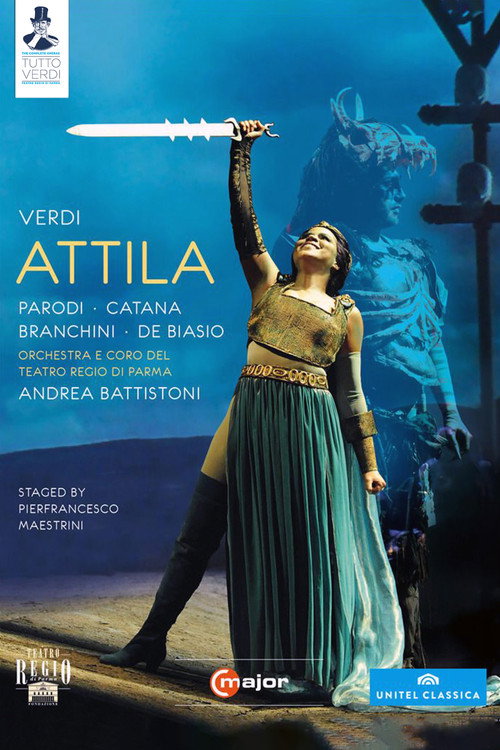
In Aquileia, around the middle of the 5th century. Odabella, daughter of the city’s lord, lost her family during the sacking carried out by Attila and intends to take revenge by killing him (Santo di patria indefinito amor). She herself was spared by Uldino, one of Attila’s slaves. Impressed by her courage, Attila gives her his sword. General Ezio, sent from Rome, proposes to Attila a deal to divide the Empire (Avrai tu l'universo, resti l'Italia a me!). But Attila denounces him as a traitor and refuses. Attila is an opera in a prologue and three acts by Giuseppe Verdi, with a libretto by Temistocle Solera based on Zacharias Werner’s tragedy, Attila, König der Hunnen, and premiered at the Teatro la Fenice in Venice on March 17, 1846. From the box set of 27 Verdi operas, “Tutto Verdi.” Recorded live at the Teatro Verdi in Busseto on October 21 and 25, 2010.
Verdi: Attila
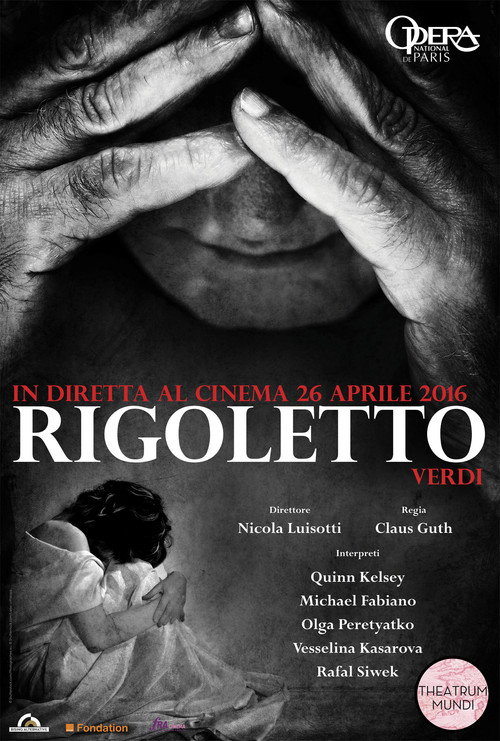
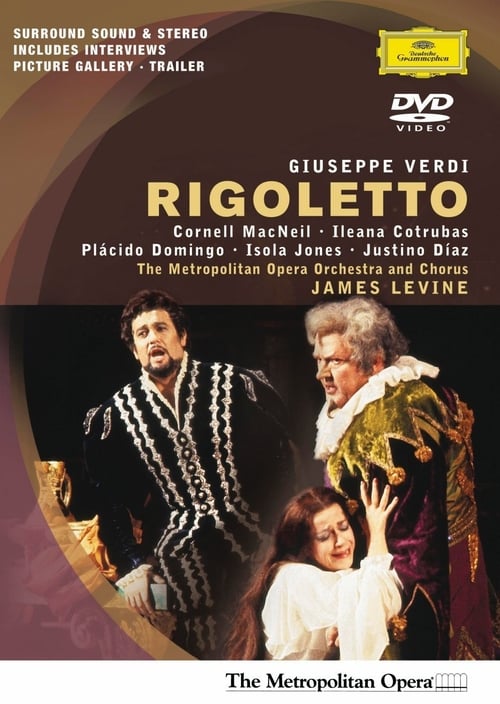
Rigoletto is an opera in three acts by Giuseppe Verdi. The Italian libretto was written by Francesco Maria Piave based on the play Le roi s'amuse by Victor Hugo. Despite serious initial problems with the Austrian censors who had control over northern Italian theatres at the time, the opera had a triumphant premiere at La Fenice in Venice on 11 March 1851. This 1994 recording, directed by Riccardo Muti, stars Roberto Alagna, Renato Bruson and Andrea Rost.
Rigoletto

Paris Opera, October 1996. New production Jérôme Savary
Rigoletto

St. Margarethen is a magnificent structure and a grand setting for Nabucco. This venue, along with the gorgeous costumes, spectacular lighting, lasers and pyrotechnics made for one grand, five star production! This is reason enough to see it and it must be an advantage to view it on DVD.--It would probably be harder to digest the whole spectacle if you were actually sitting in the audience, as there is so much to take in. The whole cast was in great form, both in singing and acting. Simon Yang as Zaccaria and Igor Morosow as Nabucco were excellent. Gabriella Morigi was a convincing Abigail who got better and better. Bruno Ribeiro as Ismaele and Elisabeth Kulman as Fenena were great, too.
Nabucco

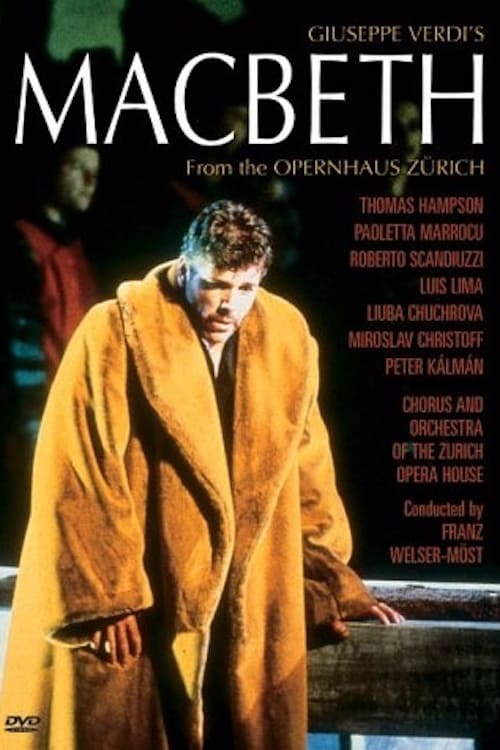
This hard-edged postmodern production of Giuseppe Verdi's haunting masterpiece brings the story of Shakespeare's bloody tragedy to vivid life, characterized by spine-tingling atmospherics and a triumphant debut by American baritone Thomas Hampson in the title role. This Zurich Opera House production also features a mesmerizing turn by Paoletta Marrocu as the beautiful, power-hungry Lady Macbeth, while striking sets and costumes further enhance the duality of the main character whose rise and fall mirror the darkest impulses of man. Replete with supernatural mystery, sexual tension, and violent power plays, this timeless story remains gripping and chilling for today's audiences and boasts some of the most astonishing music of Verdi's legendary body of work.
Macbeth

In celebration of Verdi's anniversary year, the Mariinsky label presents a high-definition video recording of Verdi's Attila, led by maestro Valery Gergiev, produced by Arturo Gama and featuring acclaimed Russian bass Ildar Abdrazakov in the title role. A two-time GRAMMY Award winner for his Verdi readings, Abdrazakov has quickly established himself as one of opera's most sought-after basses. Since making his La Scala debut in 2001 at only 25, the Russian singer has become a mainstay at leading houses worldwide. Filmed in the Mariinsky Opera House, the DVD includes a stunning picture gallery of scenes from the performance. As is the case with many of Verdi's operas, Attila is imbued with the spirit of Risorgimento, the national liberation movement of the Italian people against foreign rule and for the unification of Italy. Looking ahead, Atilla is the first of four opera DVDs that are planned for release on the Mariinsky label in 2013.
Attila

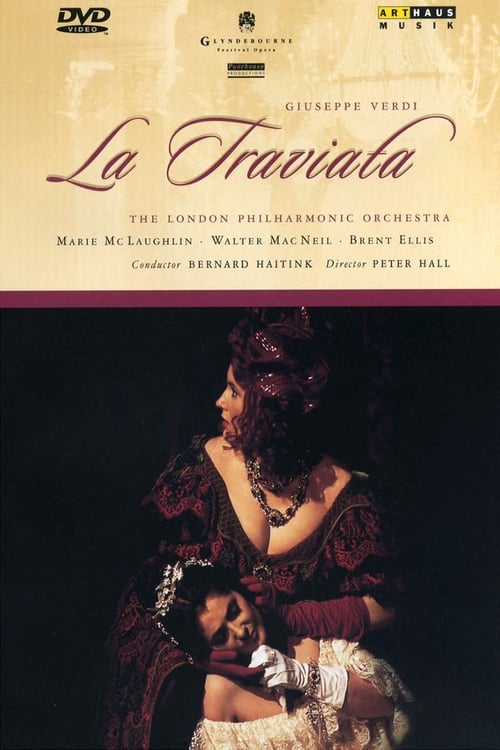
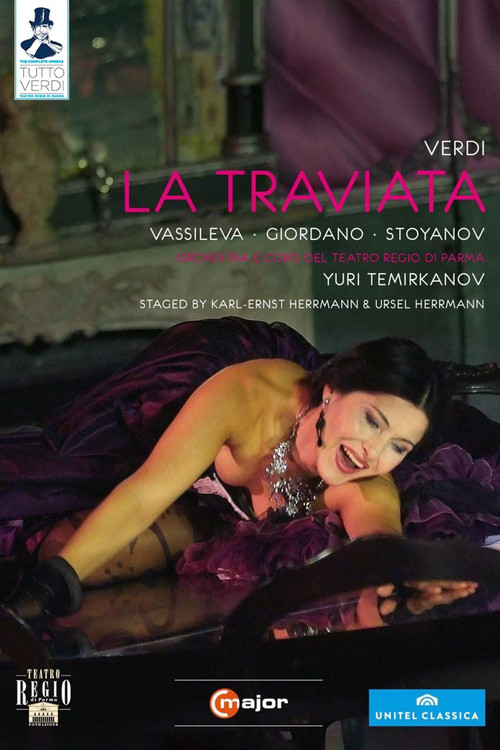
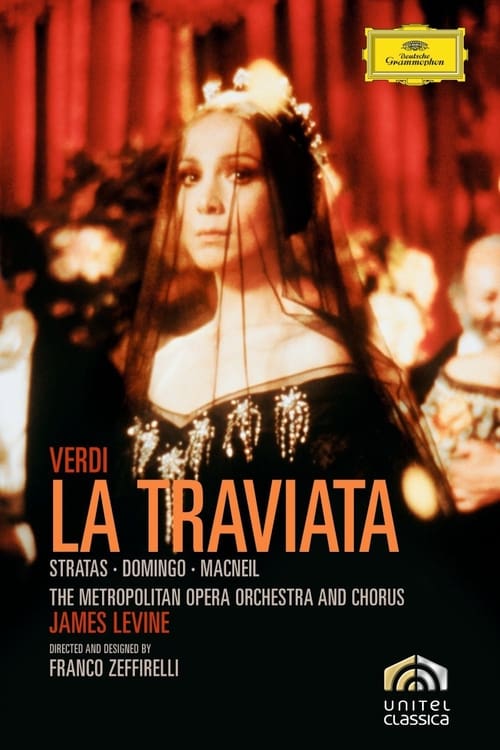
Around 1850, in Paris. At a soirée, Alfredo Germont, a young man from a respectable Provençal family, falls in love with Violetta Valéry, a courtesan. Deeply in love, Violetta gives up her profession and devotes herself entirely to Alfredo. However, Mr Germont senior, in the name of bourgeois respectability, persuades her to break up with his son. Violetta then writes a letter of separation to Alfredo without revealing the real reason for her decision. The fatal illness from which she was already suffering then flares up once more. A month later, Alfredo learns from his father that Violetta never stopped loving him... ‘La traviata’ is a 3 act opera by Giuseppe Verdi, with a libretto by Francesco Maria Piave based on the novel ‘The Lady of the Camellias’ by Alexandre Dumas, fils (1848) and its stage adaptation (1852). Premiered on 6 March 1853 at La Fenice in Venice. From the 27-opera Verdi box set “Tutto Verdi”. Recorded live at the Teatro Regio in Parma on 4 April 2012.
Verdi: La Traviata

The tragic story revolves around the licentious Duke of Mantua, his hunch-backed court jester Rigoletto, and Rigoletto's beautiful daughter Gilda. The opera's original title, La maledizione (The Curse), refers to a curse placed on both the Duke and Rigoletto by a courtier whose daughter the Duke has seduced with Rigoletto's encouragement. The curse comes to fruition when Gilda falls in love with the Duke and sacrifices her life to save him from assassins hired by her father.
Rigoletto a Mantova
![Simon Boccanegra [The Metropolitan Opera]](https://image.tmdb.org/t/p/w500/wG8lsDbBYqpj7j3rmge1aBIKDEk.jpg)
When this sumptuous production by Giancarlo del Monaco opened in 1995, legendary tenor Plácido Domingo gave a riveting performance as the fiery revolutionary Gabriele Adorno, a tenor part. In the 2010 revival, he made history by taking on the baritone title role, one of Verdi’s most fascinating characters, and thrilling audiences with his multifaceted and gripping portrayal. Boccanegra is beset on all sides, juggling political adversaries bent on murder with his love for his long-lost daughter Amelia (Adrianne Pieczonka). James Levine’s conducting brings out all the color and surging emotion of Verdi’s magnificent score.
Simon Boccanegra [The Metropolitan Opera]

Soprano Anna Moffo stars as winsome courtesan Violetta Valery -- who tries to protect her rash lover, Alfredo, even if it means lying and breaking his heart -- in this 1968 version of composer Giuseppe Verdi's masterpiece. Recorded at the Rome Opera House with renowned conductor Giuseppe Patanè leading the orchestra and chorus, the production also stars Gino Bechi as Alfredo's angst-ridden father.
La traviata

This “Traviata” became one of the most succesful of all opera films, especially in France, where 800,000 Parisian cinemagoers flocked to it in the first six week. It was nominated for two Oscars (for production and costume design) and won BAFTAs in those two categories, as well as receiving BAFTA and Golden Globe nominations as 1983’s Best Foreign-Language Film.
La traviata

Both Florez and Diana Damrau brought their bel canto expertise and superb vocalism to the service of Verdi's music. The Rigoletto, Zeljko Lucic, ran the gamut from tenderness with his Gilda to thundering fury with everyone else. I also liked the production. At first, when Rigoletto was putting on his grease paint during the overture, I was afraid that it might be a typical "Euro-trash" production, with a bit of warmed over I Pagliacci. But the sets and dramatic action really served the music and libretto. I would have to say that I came to a deeper understanding and appreciation of the story and characters as a result of seeing this performance.
Rigoletto - Semperoper Dresden

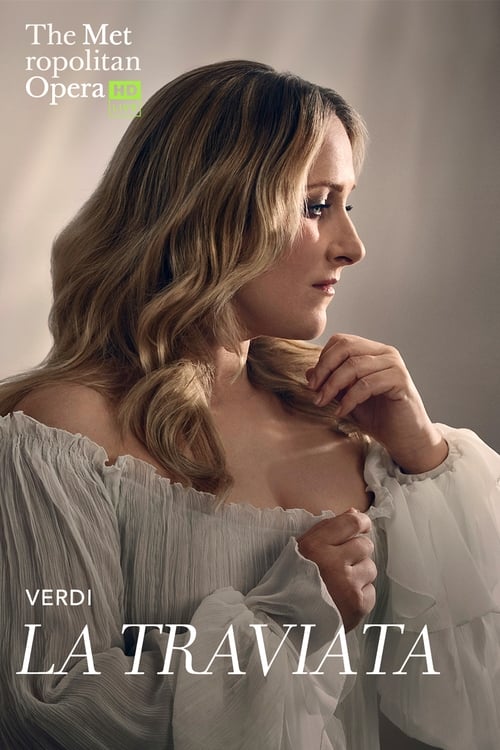
Soprano Nadine Sierra stars as the self-sacrificing courtesan Violetta—one of opera’s ultimate heroines—in Michael Mayer’s vibrant production of Verdi’s beloved tragedy. Tenor Stephen Costello is her lover Alfredo, alongside baritone Luca Salsi as his disapproving father and Maestro Daniele Callegari on the podium.