Abigail Child
Directing
Biography
Abigail Child has been at the forefront of experimental writing and media since the 1980s, having completed more than thirty film and video works and installations, and six books. An acknowledged pioneer in montage, Child’s early film work addressed the interplay be- tween sound and image in the context of resh aping narrative tropes, in a manner that prefigured many contemporary and future media concerns. Her major projects include Is This What You Were Born For?: a 9 year, 7-part work; B/Side: a film that negotiates the politics of internal colonialism in New York City; 8 Million: a collaboration with avant-percussionist Ikue Mori that re- defines the “music video”; The Suburban Trilogy: a modular digi-film that prismatically examines a politics of place and identity; and MirrorWorlds: a multi-screen installation that incorporates parts of Child’s “foreign film” series to explore narrative excess. A new film, A Shape of Error, is constructed as an imaginary ‘home movie’ of the life of Mary Shelley. Child has exhibited worldwide, with retrospectives at Anthology Film Archives (NY), the San Francisco Cinematheque, Sala Trevi in Rome, Exis (Korea), and Harvard Cinematheque, and in important showcases such as The Whitney Biennale, the Viennale and MoMA’s Millenium show. Her work is featured at numerous international film festivals, including the New York Film Festival, Rotterdam, Locarno and London Festivals, among others and is in the permanent collections of MOMA, NY, Centre Pompidou, and Arsenal Berlin. Child has received numerous awards and accolades, including the Rome Prize, a Radcliffe Institute Fellowship, Guggenheim Fellow, Fulbright Award and the Stan Brakhage Award. Harvard University Cinematheque has created an Abigail Child Collection dedicated to preserving and exhibiting her work. As a teacher at the School of the Museum of Fine Arts, Boston, Child has been instrumental in building an expansive media and film art program; she has influenced a generation of younger artists. Child is also the author of five books of poetry (A Motive for Mayhem, Scatter Matrix and Artificial Memory among them) and a book of critical writings: THIS IS CALLED MOVING: A Critical Poetics of Film from University of Alabama Press (2005).
Known For

Swamp uses the soap opera format to play with the structure and expectations of the family melodrama. Following the melodramatic format that "if it can happen, it will happen," coincidence and unlikely events abound in a gleeful send-up of lurid intrigue, threatened morality, and endless double-crosses. With looped and repeated edits, fast-paced action, and aggressively funky video effects, Child layers on artifice and excess in an overdone remake of the TV serial.
Swamp

What do construction workers do in their well-earned breaks? How might Angelina Jolie's and Brad Pitt's relationship have ended? And what really happened between Marilyn Monroe and Joan Crawford during the summer of 1959? The answers to these and many other interesting questions are provided by twelve queer New York filmmakers. Their films also scrutinize such topics as the difference between the way men and women dream, and how erotic tying a necktie or having a manicure can be.
Fucking Different New York

The condensed filmic work of Abigail Child, borrowing strategies from found footage, Appropriation Art, Language Poetry and experimental music, stands a a landmark in the experimental cinema of the 1980's. The processing of interruption and fragmentation inform the series IS THIS WHAT YOU WERE BORN FOR?, reactivating the stakes of montage applied in different artistic practices.
Perils

In 1983, filmmaker and poet Abigail Child cut up old footage from Between Times, a documentary profile of high school girls in Minneapolis which she had produced for WNET/PBS back in 1975. That footage would then be integrated into work of a drastically different kind: The film was called Mutiny which, by its very name, signaled her abandonment of the humanist documentary tradition to which Between Times belonged, to become, in her words, “a prismatic rhythmic pinwheel” born of the artistic and political necessity to radically rethink form. Mutiny, in turn, stood as one of the most densely woven in a series of bold experiments that came to be known as Is This What You Were Born For?
Mayhem
"Abigail and Jonathan Child's 20‐minute exploration of the new Lower East Side. At one point in the Child's film, an old man with an East European accent surveys his neighborhood, which has been invaded by the blacks, the hippies, the ex‐ Urban poor and the (now‐ defunct) Fillmore East. He announces that he's satis fied with the conditions in this country 'except for the people.' ;Except for the People,; the title of the Child's film, is the rather terrifying theme of the entire program." - Vincent Canby, New York Times, Nov. 19th 1971
Except for the People

A fictional story composed from an anonymous family archive of 1930s Europe with two sisters who play, race, fight, kiss, and grow up together under the shadow of oncoming history. There are at least three levels of research: 1) the home movie in which a family poses for the camera, preternaturally happy; 2) the historical moment which remains as text trace, undermining the image and serving as covert motive; 3) the development of gender identities—the innocent freedom of the elder transformed into socially bruised ‘bride,’ the irrepressibility of the younger moving from tomboy to awkward, diffident adult. At once biography and fiction, history and psychology, The Future is Behind You excavates gestures to get at the heart of narrative; it seeks a bridge between private and public histories. Music by John Zorn, arranged and performed for the movie by Sylvie Courvoisier and Mark Feldman.
The Future is Behind You

Words taken from lines of Nada Gordon's unrequited love poems, whose sentences are taken, in their turn, from anonymous web poems, reveal a history of sexuality.
(If I Can Sing a Song About) Ligatures

Experimental music and eroticism swirl about each other in Shiver, the second of the 8 Million stories which can be found in this lively and continuing collaborative ‘album’. In Kiss of Fire , Child reworks images from her squisy TV soap Swamp (1991), to punctuate romantic cliche.” Selected for New York Film Festival Video Visions (1993) Short songs chart erotic tales in an urban topology. Includes FISHTANK, SHIVER, KISS OF FIRE, 8 MILLION WAYS TO DIE, and FAINT CLUE. The myths of popular culture—romance and TV soaps— provide the motifs for the work which restructures memory-image-fragment to foreground the body against a mechanized landscape. In the shape of small stories, 8 Million rewrites women's drama.. And on occasion to be the basis of the score: image as conductor, the music performed to the video.
8 Million
No description available.
Cinexpérimentaux 14 : Rencontre avec Abigail Child

B/Side is a poignant and intelligent exploration of the urban homeless, combining sensitive footage of their exterior situation and entering imaginatively into interior deliriums. Framed by footage of the encampment locally known as Dinkinsville on New York's Lower East Side, where some of the homeless of Thompkins Square Park settled after the riots of June 1991, the movie begins with the encampment's first night and ends with the fire and subsequent destruction of the lot in October of the same year. Applying rhythmic construction, poetic license and a generous eye to bodies in poverty, B/side documents beautifully a gritty vision of late 20th century urban life. —Kurzfilmtage - international short film festival Oberhausen
B/Side

In collaboration with Adeena Karasick & Charles Bryant's Salome (1923) Child has layered and processed the images, recomposed the strains of music, and selected words and phrases to create a "succulent nexus" - fluid and strange.
Salomé

Prefaces is composed of wild sounds constructed along entropic lines, placed tensely beside bebop rhythms, and a resurfacing narrative cut from a dialogue with poet Hannah Weiner. Child tells us, "The tracks are placed in precise and asynchronous relation to images of workers, the gestures of the marketplace, colonial Africa, and abstractions, to pose questions of social force, gender relations and subordination." This tape serves as a pre-conscious preface to the parts that follow, whose scope and image bank are more narrowly defined.
Prefaces
In Rome for a year at the American Academy, I created imaginary home movies of scenes from the life of Mary and Percy Shelley. I was attracted to these authors — their life of poetry, politics and sexual invention—and inspired by my previous fictionalizing of home movies in Covert Action and The Future is Behind You. I worked with non-actors, the seasons and the extraordinary architecture and landscapes of Italy where the Shelleys were in exile for six of their eight years together. The result was a feature film A Shape of Error, gorgeous, emotional and harnessed to the narrative. I wanted to go further and abetted by digital technology, I have ‘exploded’ the film. The result is UNBOUND, digressive, looped, unpredictable, symphonic, spontaneous, messy—like life and memory.
Unbound

Mutiny employs a panoply of expression, gesture, and repeated movement. Its central images are of women: at home, on the street, at the workplace, at school, talking, singing, jumping on trampolines, playing the violin. The syntax of the film reflects the possibilities and limitations of speech, while “politically, physically, and realistically” flirting with the language of opposition.
Mutiny

A beautifully ambiguous study of the nude in light and movement, this short silent film focuses on the dimly lit bodies of two women shot from Child’s distinctly non-male perspective.
Both

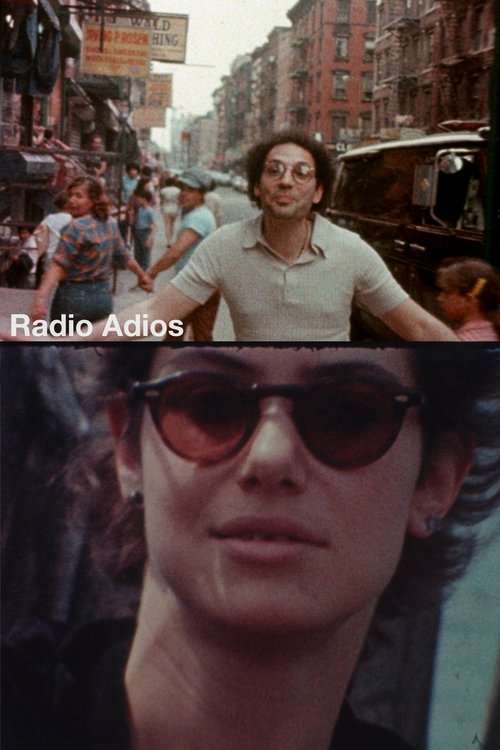
A superabundance of useless information effectively subdues freedom of speech. Condense and survive!
Radio Adios

In Ornamentals (1979), Abigail Child explores rhythm and the poetry of the repetitive image form.
Ornamentals

A second landscape film, in this case urban. The work constructed from materials gathered over two years looking out at downtown San Francisco from a loft on Folsom Street. The elements are “folded” and mixed, Time redefines Space: the erector and helicopter appear as toys within a schizy motor-oil-ized ballet mechanique.
Pacific Far East Line

A feature-length experimental video based on a 6-week stay in Mainland China in October-November 2006. The result is an intimate and critical look at China today featuring Beijing's workers, streets, stores, and parks, as well as closeup portraits of a number of characters.
Riding the Tiger: Letters from Capitalist China

Found footage exploring public and private space, organized formally as a sonata, centered around work and issues of class: the divisions between home and public, owners and workers, saturation and flow, structure and improvisation.