Johannes Beringer
Writing
Known For
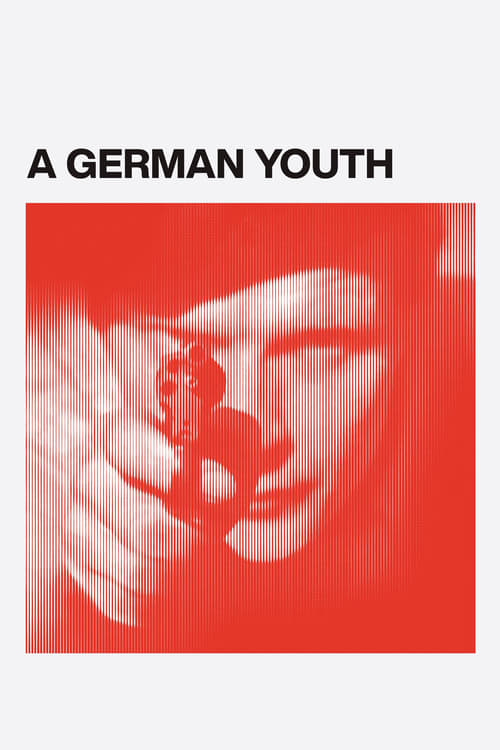
At the end of the 1960s the post-war generation began to revolt against their parents. This was a generation disillusioned by anti-communist capitalism and a state apparatus in which they believed they saw fascist tendencies. This generation included journalist Ulrike Meinhof, lawyer Horst Mahler, filmmaker Holger Meins as well as students Gudrun Ensslin and Andreas Baader.
A German Youth
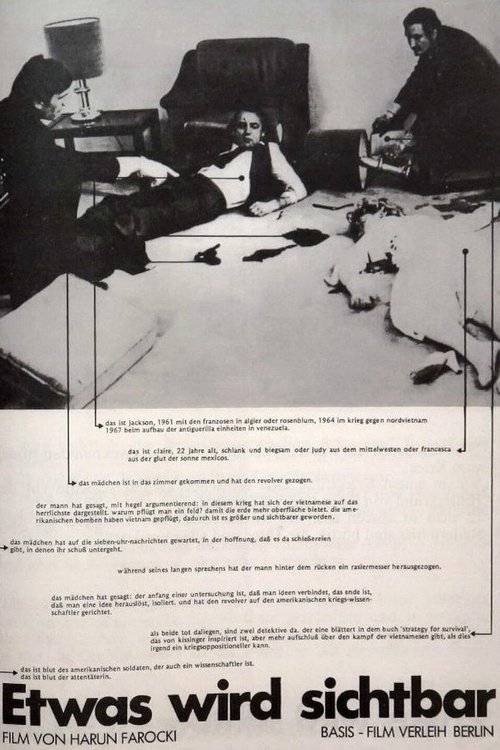
An unconventional essay film that interrogates the visual and ideological legacy of the Vietnam War. Blending staged scenes, archival footage, photographs, and philosophical dialogue, the film follows various characters — including an American soldier captured by North Vietnamese villagers — as they reflect on violence, memory, and image-making. Set partly in West Berlin and partly in reconstructed spaces representing Vietnam, the film avoids traditional dramatic narrative in favor of a fragmented montage of voices, documents, and reenactments. Interweaving love stories, political debate, and historical commentary, Farocki creates a critical reflection on how war is represented, seen, and imagined, both in cinema and in public consciousness. The result is a complex meditation on images as weapons and instruments of perception.
Before Your Eyes - Vietnam
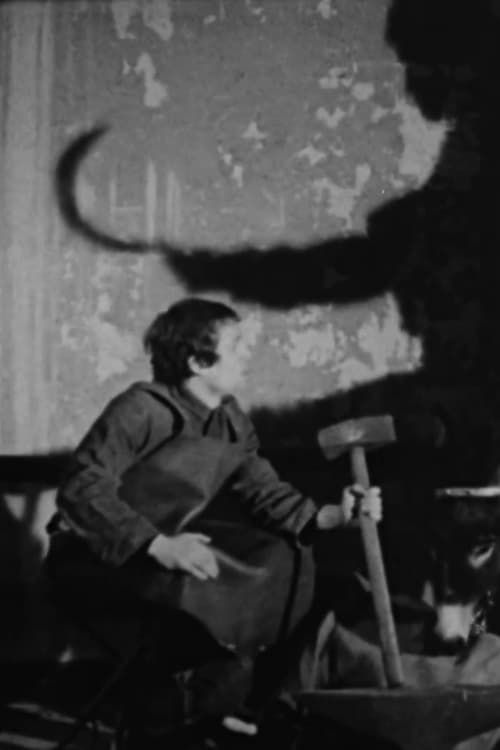
An educational film about an aspect of political economy. The concepts of use value, barter value and labor as a commodity are the subjects; they are intended to introduce the process of understanding the theory of value of work and the law of values, alienation and fetish.
Something Self Explanatory (15x)
Scenes from Berlin: Kids playing football, a man tries to light a fire in his stove, a film team sets up a shot in a park, students discuss politics.
Situationen

Western for the SDS portrays the development of the left as a learning process among women who sharpen their awareness in the movement but continue to have no say. The controversy surrounding the film is shown in the DFFB weekly newsreel Requiem for a Company. The Western was confiscated by the administration, and eighteen students who sided with Straschek were expelled from the academy. The film was considered lost until its rediscovery in 2018.
Western for the SDS
Straschek's film points to the gap between workers and intellectuals and describes the "difficulties of the revolution" in a biting and witty way.
Zum Begriff des 'kritischen Kommunismus' bei Antonio Labriola (1843-1904)

This Harun Farocki film shows the creation of a picture on which the artist worked for nine weeks. Sarah Schumann lives in Berlin and is a pioneer of the feminist scene. 1977 together with several other artists she organized the first large exhibition in which only work by women was shown. Sarah Schumann paints figuratively, that is to say she has developed a technique using layers of collage and painting worked on top of and into one another. Regarding a picture becomes an adventure. (harunfarocki.de)
A Picture of Sarah Schumann

A cinematic interpretation and literary adaptation of a text by Charles Baudelaire. "I had intended that each of the roughly 60 shots would be static, without even the imperceptible correction pans normally used in such cases. Every shot was to be a tangent, of which one must put an infinite number around a circle if it is to be calculated incrementally. One cannot represent a circle with straight shots, the most one can do is make it imaginable – this could be a righteous insight into the limitations of our means, although hopefully not self-righteously presented."
Brunner ist dran
An Arab immigrant, living in Berlin.