Patrice Barrat
Writing
Known For

Once upon a time... consumer goods were built to last. Then, in the 1920’s, a group of businessmen realized that the longer their product lasted, the less money they made, thus Planned Obsolescence was born, and manufacturers have been engineering products to fail ever since. Combining investigative research and rare archive footage with analysis by those working on ways to save both the economy and the environment, this documentary charts the creation of ‘engineering to fail’, its rise to prominence and its recent fall from grace.
The Light Bulb Conspiracy
A compilation of vignettes of daily life in Sarajevo and the people who fight to survive the war that tears the city apart. In November 1993 BBC2 TV began to broadcast 'Sarajevo: A Street Under Siege', a 2-minute film shown every night before the 22.30 Newsnight programme. It was bringing a day-by-day account of how the siege was affecting a group of ordinary citizens. The authors were Ademir Kenovic, a graduate of the Sarajevo Film and Theater Academy, and Patrice Barrat, a director from an independent French production company. The full version of the film was broadcast on BBC2 on 20 March 1994. Later on in 1994 the film 'Sarajevo: A Street Under Siege', ('Chaque jour pour Sarajevo') received a BAFTA (British Academy Award of Film & TV Arts) award and the Jury Award at the Locarno Film Festival.
Sarajevo: A Street Under Siege
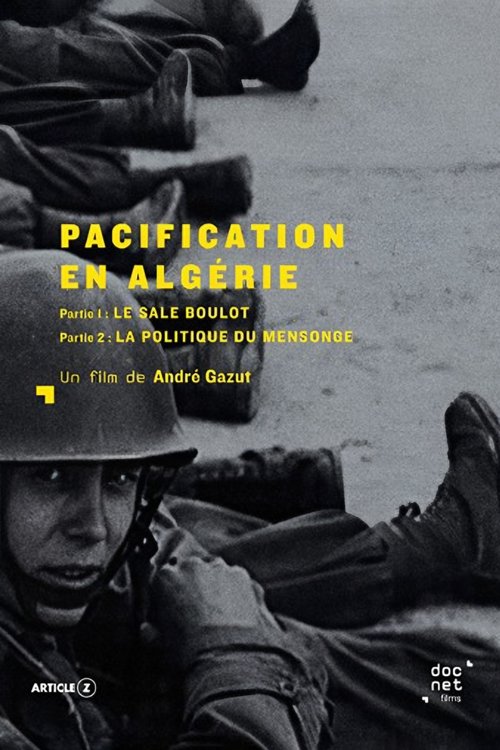
Where does submission to authority end? Where does individual responsibility begin? Each person confronted with violence asks themselves these questions. Through the testimonies of conscripts but also of Algerian activists, a memory of this war is constructed. The atrocities of the Algerian war are known. However, conscripts were pressured not to speak out upon their return. General de Bollardière was punished for opposing torture. Guy Mollet, President of the Council, denied any shameful practice before Parliament…
Pacification en Algérie
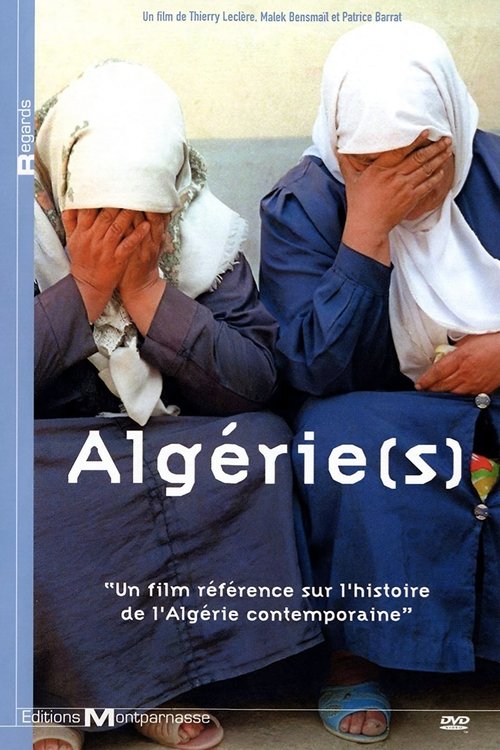
Documentary series in two parts: 1. A people without a voice (80'), 2. A land in mourning (78'). Part 1: A people without a voice: October 88, the Algerian Republic is faltering, the film goes back to the sources of this tragedy and explains how the face to face between the Islamists and those in power began. The interruption of the legislative elections of December 91, followed shortly after the assassination of President Boudiaf in June 92, plunged Algeria into chaos. Part 2: A land in mourning: the cycle of violence that leads to massacres and the economic and geopolitical underside of the war. More than 100,000 deaths, an incredible degree of barbarity, massacres, apparently incomprehensible... Behind the official window of power and its artificial political scene, hides a shadow power.