
John Baldessari
Directing
Biography
John Anthony Baldessari (June 17, 1931 – January 2, 2020) was an American conceptual artist known for his work featuring found photography and appropriated images. He lived and worked in Santa Monica and Venice, California. Initially a painter, Baldessari began to incorporate texts and photography into his canvases in the mid-1960s. In 1970 he began working in printmaking, film, video, installation, sculpture and photography. He created thousands of works which demonstrate—and, in many cases, combine—the narrative potential of images and the associative power of language within the boundaries of the work of art. His art has been featured in more than 200 solo exhibitions in the U.S. and Europe. His work influenced that of Cindy Sherman, David Salle, Annette Lemieux, and Barbara Kruger among others.
Known For
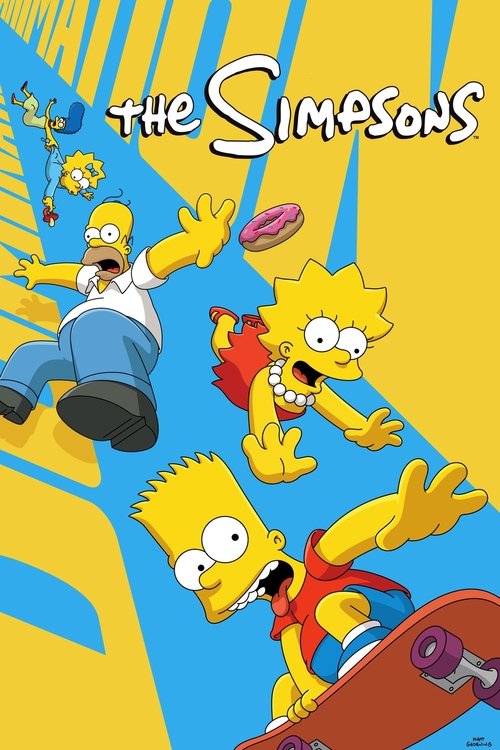
Set in Springfield, the average American town, the show focuses on the antics and everyday adventures of the Simpson family; Homer, Marge, Bart, Lisa and Maggie, as well as a virtual cast of thousands. Since the beginning, the series has been a pop culture icon, attracting hundreds of celebrities to guest star. The show has also made name for itself in its fearless satirical take on politics, media and American life in general.
The Simpsons
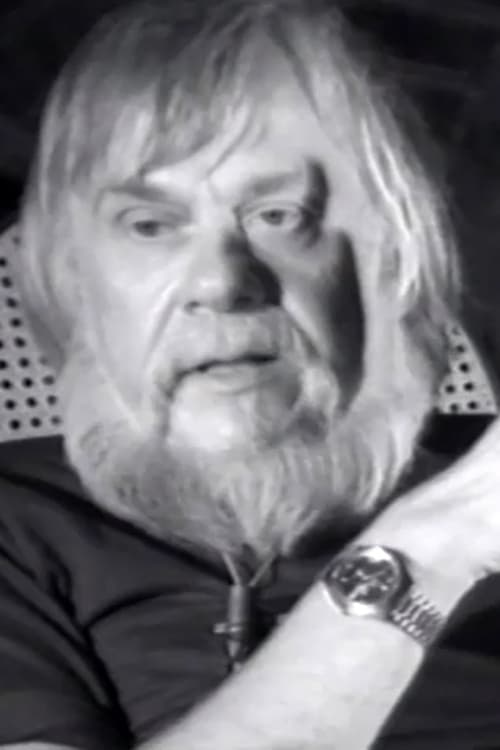
From his photo-text canvases in the 1960s to his video works in the 1970s to his installations in the 1980s, John Baldessari’s (b.1931) varied work has been seminal in the field of conceptual art. Integrating semiology and mass media imagery, he employed such strategies as appropriation, deconstruction, decontextualization, sequentiality, and text/image juxtaposition. With an ironic wit, Baldessari's work considers the gathering, sorting, and reorganizing of information. “Something that is part of my personality is seeing the world slightly askew. It’s a perceptual stance. The real world is absurd sometimes, so I don’t make a conscious attempt, but because I come at it in a certain way, it seems really strange,” Baldessari says in this interview with Nancy Bowen. A historical interview originally recorded in 1979 and re-edited in 2003 with support from the Lyn Blumenthal Memorial Fund.
John Baldessari: An Interview
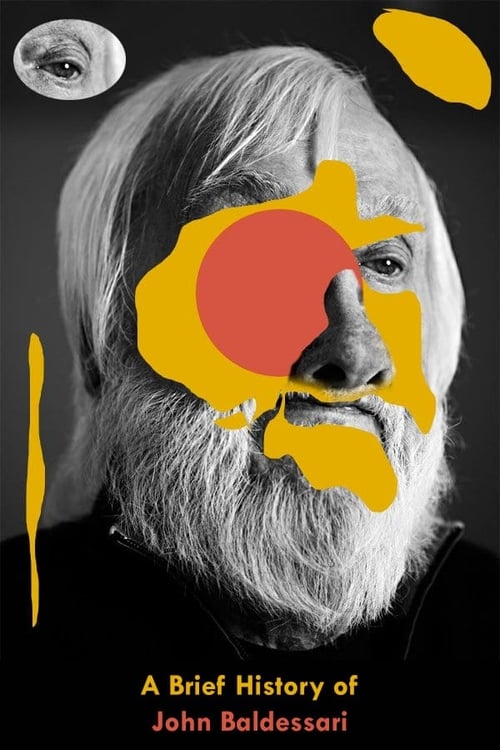
The epic life of a world-class artist, jammed into six minutes.
A Brief History of John Baldessari
Script is the opposite of an improvisational exercise. Seven couples, all amateurs, are handed pages from random movie scripts and instructed to enact the absurd text through force of imagination, without direction or knowledge of what the others are doing.
Script

A series of 19 short parables concerning modes of representation, language and cognition. Often conveyed through conscious misinformation, Baldessari's witty puns and jokes play off the relation of word, image and meaning; the intersection of what is heard or written, what is seen, and what is understood. For example, he shows us an image of a duffel bag and proceeds to describe, in detail, an object bearing no resemblance to a duffel bag, which is eventually revealed to be a stool. In A Sentence with Hidden Meaning, he writes the phrase, "A sentence with hidden meaning" on a legal pad, hiding the word "hidden" so that it reads, "A sentence with meaning."
The Way We Do Art Now and Other Sacred Tales
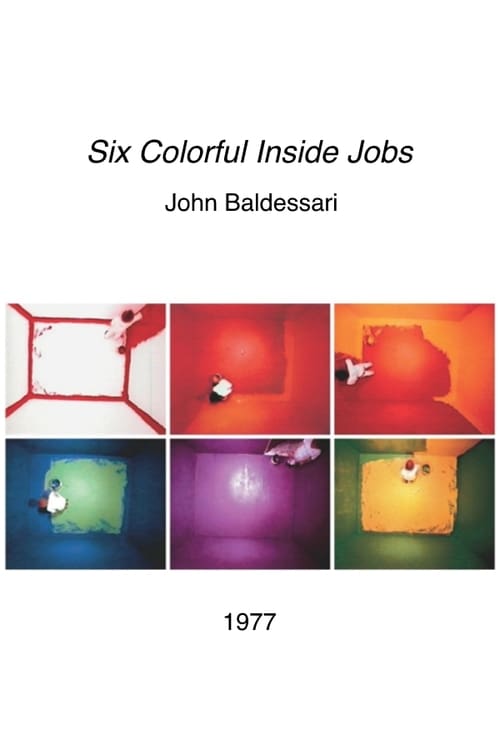
Seen from a bird's eye view, a figure paints the walls and floor of a windowless room six times in six days, using each of the primary and secondary colors.
Six Colorful Inside Jobs
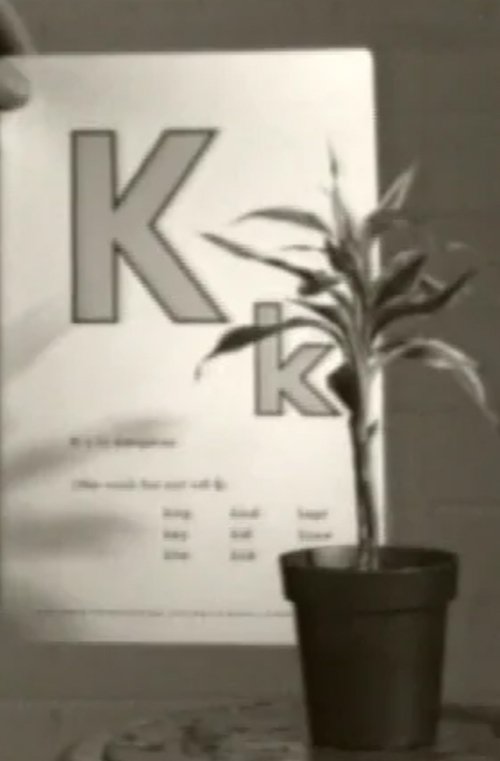
“[A] rather perverse exercise in futility,” this tape documents Baldessari’s response to Joseph Beuys’s influential performance, How to Explain Pictures to a Dead Hare. Baldessari’s approach here is characteristically subtle and ironic, involving ordinary objects and a seemingly banal task. The philosophical underpinnings of Baldessari’s exercise are structuralist theories about the opaque and artificial nature of language as a system of signs. Using a common houseplant to represent nature and instructional flashcards to represent the alphabet, Baldessari ironically illustrates this theorem. That language is the structuring element of the tape—the length of the tape was determined by the number of letters in the alphabet—enforces the connection between language and art, a recurrent theme in Baldessari’s work.
Teaching a Plant the Alphabet
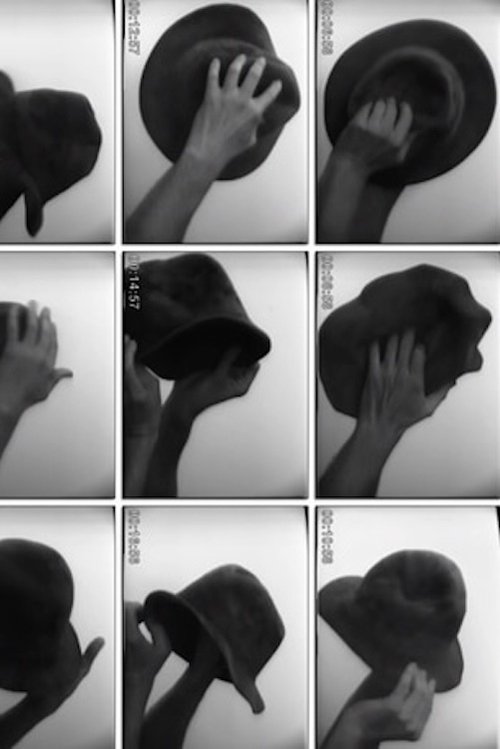
'Folding Hat' is a deadpan conceptual exercise that represents a dashed attempt to rescue an object from the meaning assigned to it. Whistling an aria from The Barber of Seville, Baldessari bends and folds a simple hat into numerous configurations. However, for the duration of the exercise, which unfolds in real time, the object never loses its "hatness." In the end it is untransmutable—no escape can be made from its meaning. Although Baldessari tries to drive a wedge between the signifier and signified, the viewer never misrecognizes the hat.
Folding Hat
Presented without commentary, this film reveals the thinking behind the work of John Baldessari over the course of his career, and provides clues to the understanding of the artist's paintings, photographic work and books.
John Baldessari: Some Stories
In a sly twist on the methodology of the 18th-century "philosophes" who classified the laws and history of the world in massive encyclopedias, Baldessari devises and then subverts his own system for cataloguing the world. In a matter-of-fact tone, he states that he is going to present a precise, methodical inventory of objects, progressing from small to large in size. Drawing on his own collection of found objects, he exhibits and describes a seemingly arbitrary series of over thirty disparate items. By undermining the viewer's empirical perception, video ultimately is proven to be a flawed medium for the indexing and classification of the world.
Inventory

John Baldessari is today known as one of the leading conceptual artists of his generation, using found or appropriated images and exploring the associative power of language. Like many experimental artists Baldessari began his career in the more traditional realm of painting. Rather than merely moving on from these early works, Baldessari decided in 1970 to have them destroyed. In the summer of 1970 all paintings in the artist’s possession dating from the thirteen years 1953–66 were incinerated at a local crematorium. This is the film of that cremation. [Overview Courtesy of Tate Modern]
Cremation
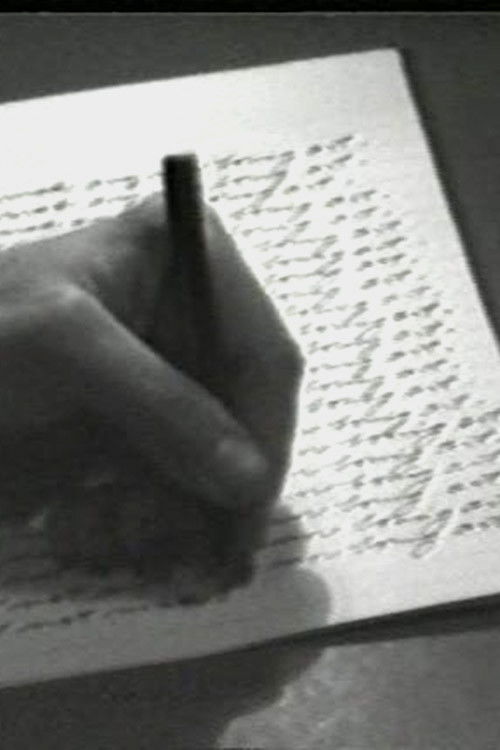
In 1971, Baldessari was commissioned by the Nova Scotia College of Art and Design in Canada to create an original, on-site work. Unable to make the journey himself, he suggested that the students voluntarily write the phrase "I will not make any more boring art" on the gallery walls. Inspired by the work's completion — the students covered the walls with the phrase — Baldessari committed his own version of the piece to videotape. Like an errant schoolboy, he dutifully writes, "I will not make any more boring art" over and over again in a notebook for the duration of the tape. In an ironic disjunction of form and content, Baldessari's methodical, repetitive exercise deliberately contradicts the point of the lesson — to refrain from creating "boring" art.
I Will Not Make Any More Boring Art
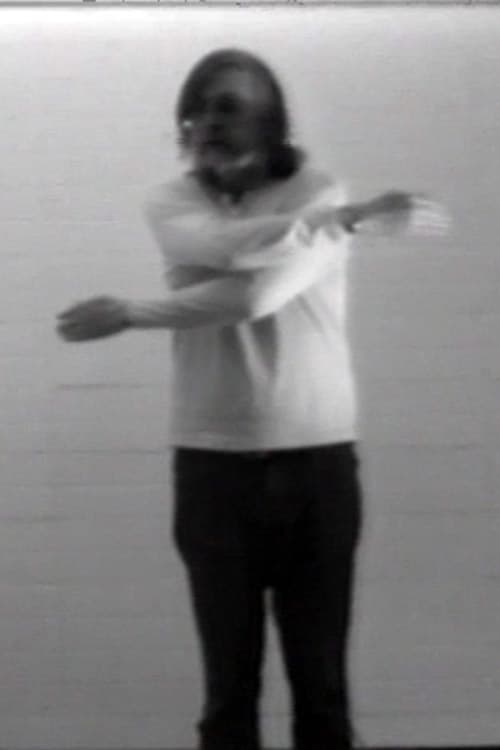
In an ironic reference to body art, process art and performance, Baldessari challenges definitions of the content and execution of art-making. Performing with deadpan precision, he moves his hands, arms and entire body in studied, minute motions, intoning the phrase "I am making art" with each gesture. Each articulation of the phrase is given a different emphasis and nuance, as if art were being created from moment to moment. This index of body movements is ironically offset by the repetitive monotony of the exercise.
I Am Making Art

Contemporaneous to his best-known video works, these Super-8mm films represent Baldessari's conceptual engagement with motion picture film, pointing to the technical strengths and weaknesses of the celluloid medium relative to video, such as the superior reproduction of color, on one hand, and the difficulty of adding synchronized sound on the other. Conceived on an intimate scale (only the artist's hands are visible as he manipulates a range of objects), Baldessari's Super-8 films replace text and speech with a cunning visual language, in which he wordlessly describes physical changes in his environment: a bright light flashes on a mirrored surface, red liquid rises in a thermometer, and powdered pigment makes an indelible mess. Here Baldessari employs a method of communication that is based on spectacle rather than performance.
Four Short Films
In Walking Forward-Running Past, Baldessari ingeniously employs photography and video to examine and ultimately deconstruct film. In this conceptual exercise, he tapes up photographic film stills of himself walking toward the camera—coming closer with each successive image—and then photos of himself running past it. The sequentiality of this action results in a crude montage, an ultimately futile attempt to recreate the phenomenological experience of cinematic movement. Gasping with exertion, Baldessari quickly and repeatedly replaces photo after photo. In his efforts to evoke the cinematic experience, a layered metonymic relationship develops between the static, photographic image of Baldessari running and his "real" movements on video.
Walking Forward-Running Past
Baldessari has Ed Henderson examine obscure movie stills and attempt to reconstruct the films' narratives.
Ed Henderson Reconstructs Movie Scenarios

Baldessari progresses from simple, static images, such as a rock in an empty room, to complex narrative scenes, like a woman eavesdropping on her next-door neighbor. Through the gradual integration of cinematic techniques—motion, color, sound, acting, editing and arc—the artist inverts the traditional Hollywood model, stressing structure over narrative coherence.
Title
Baldessari has commented that he is "less interested in the form art takes than the meaning an image evokes." In Ed Henderson Suggests Sound Tracks for Photographs, he explores the relation between what is heard and what is seen, appropriating deliberately cliched imagery and generic film music to construct a series of surreal mini-movies. Baldessari describes photographs from National Geographic magazine to Ed Henderson, who picks out pieces of mood-setting stock music and sound effects to pair with the images. Baldessari subtly influences Henderson's selections, steering him towards music that he deems more appropriate. This strange collaboration results in an uncanny, often comic conjunction of sound and image. Removing the photographs and music from their original contexts, Baldessari deconstructs mass cultural narrative, suggesting how the associative meanings and evocations of its cliches and genres have permeated the collective unconscious.
Ed Henderson Suggests Sound Tracks for Photographs
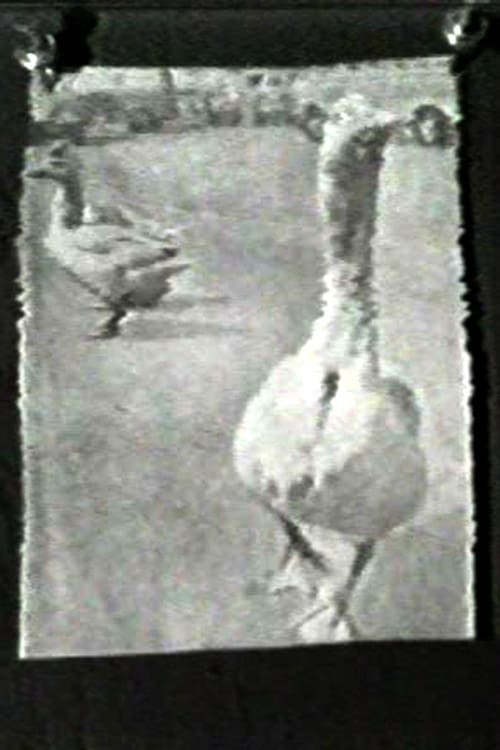
Baldessari introduces eight news photos to Ed Henderson — ranging in subject matter from geese at the zoo to an accidental electrocution — and asks him to identify them. Henderson's associative responses suggest the projection of unconscious desires and fears onto these arbitrary images, which are removed from their original contexts. The implied narratives that emerge from the seemingly random juxtapositions and sequences of photographs give rise to questions of manipulation, inference and meaning.
The Meaning of Various News Photos to Ed Henderson
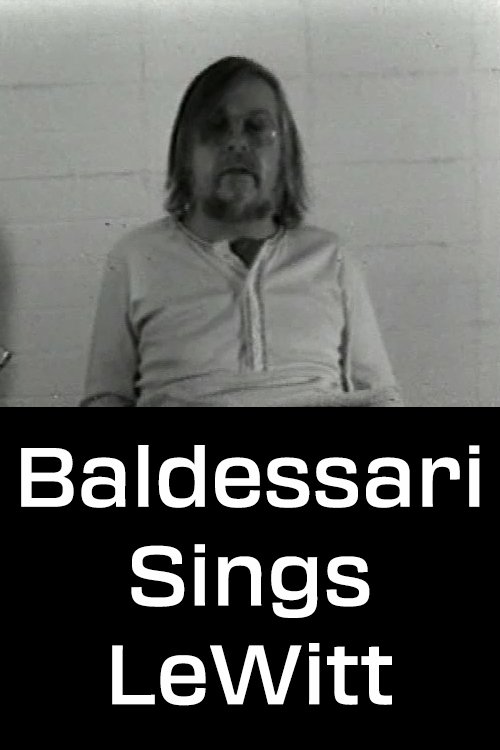
A tribute to fellow artist Sol LeWitt, Baldessari sings lines from LeWitt's thirty-five statements on conceptual art to the tune of popular songs.