Directing
A single thread of 16mm film runs through three side-by-side projectors, all aimed at the same wall. Twenty-two and a half second elapse between the time when the first and the second screen images appear and the same amount of time passes between the appearance of the same silent image in the second and third, so that every image can be expected to occur twice in each 45-second cycle. (Jonathan Rosenbaum)
September 23, 1973: A motion picture camera shooting through a portal in a church began accumulating images of an adjacent Arlington, Texas shopping plaza at the rate of 1 frame per hour, 24 hours a day. September 22, 1974: The camera was stopped. Meteorological fluctuations, this planet's revolutions (solar and axial), and the palpable presence of human cycles are transposed from slow daily change into rapid visual rhythms. The act of metamorphosis during the year visually displaces the pictorial arena in which the year transpires. Space, the image frame, becomes a manifestation of time.
An ironic documentary
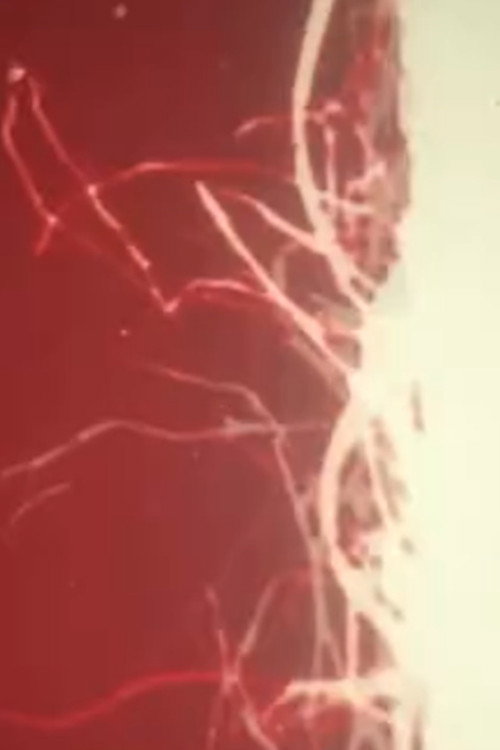
In a completely dark gymnasium, Louis Hock unspooled dozens of feet of 16mm color print stock along the different dimensions of the space, laying equal lengths of gnarly twine on top of it. One brief flash of the gymnasiums lights later, the resulting film functions as an abstract map of the location, a record of a performance, and an unusual meditation on the objecthood of film. The image, a vertical, negative shadow of the twines presence, unspools over time, with occasional bursts of sound that occur when the twine image slides over into the soundtrack area of the film.
In the 1970s, Californian artist Louis Hock created a number of studies in the effects of pure colour. The late 1960s saw the rise of the ‘colour field’ vogue which arose in abstract painting in reaction to the emphasis on individual expressive gestures in Abstract Expressionism. ‘Colour field’ artists like Mark Rothko and Barnett Newman sought to empty the image plane out into broad, flat areas of colour. With its humming bars of pure hues, Light Traps is like a moving ‘colour field’ painting – a ‘colour field’ film. Preserved by the Academy Film Archive in 2013.
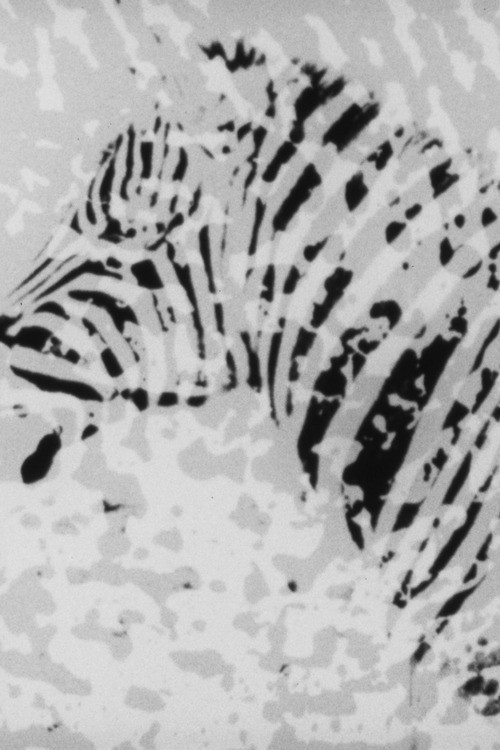
A visual keening for the exterminated quagga. A silent dirge for lost friends, shadowed up against the wall with light from the tombs.
A 26-minute metaphorical narrative in which the character is left alone at his post indefinitely to ponder the existential. In his hopefulness he resorts to a mystical exploration.
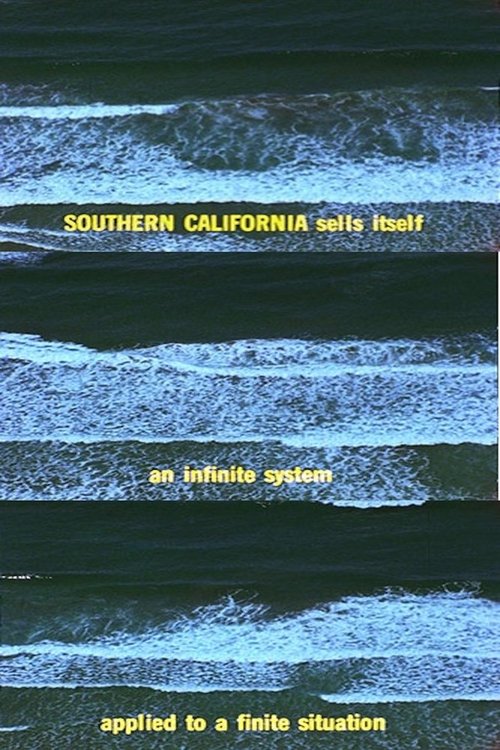
At first viewing PACIFIC TIME appears to be a departure from the more abstract and more purely visual delights of Hock's preceding efforts. Considerably longer, it employs actors, dialogue and 'plot.' Upon closer examination, however, it proves to be of a kind with his earlier output - only more ambitious and perhaps, more mature. Again, distortion of time conventions is at the forefront of Hock's array of stylistic devices. But, rather than the 'magic,' highly assured time-lapse photography of STUDIES IN CHRONOVISION or MISSISSIPPI ROLLS, here Hock employs radical slow-motion sound and brilliantly inventive written subtitles. [Source: Douglas Edwards 'FIlm Commentary: Louis Hock', Gosh!, 1978]
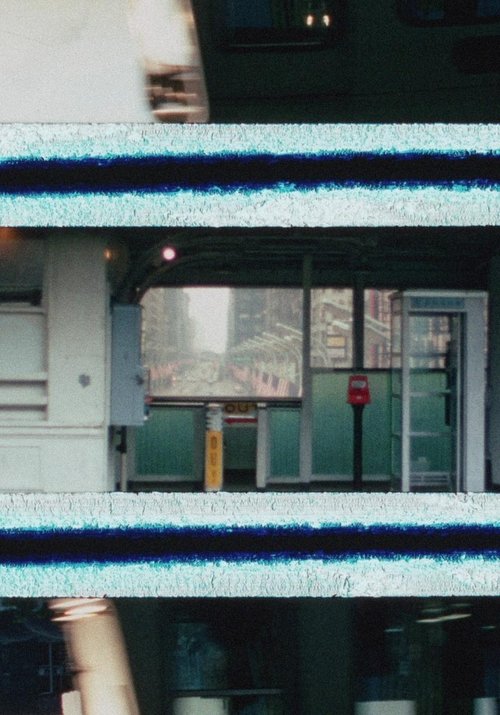
The film does not end, is never rewound, and each frame is seen twice in a single viewing: a palindrome illustrating the Chicago "elevated," the backbone of the city, shuttling its oblivious passengers to death. "Hypnotic study in motion." – Nora Sayre, The New York Times Note: Shown head to tail, then tail to head. Preserved by the Academy Film Archive in 2014.
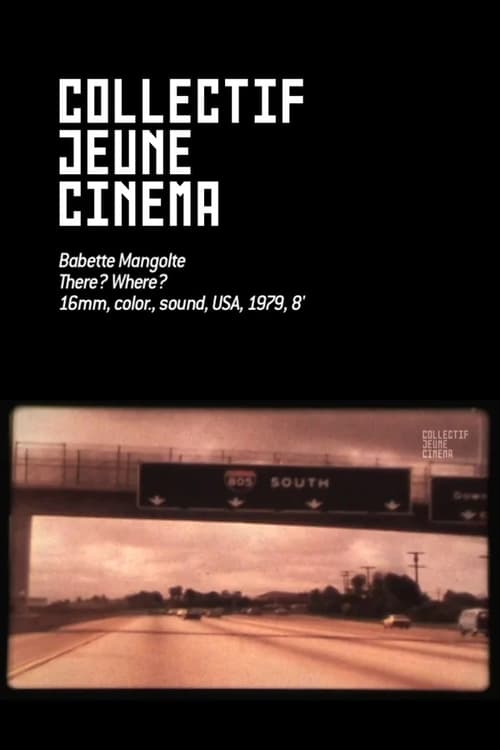
A naive look at Southern California by an outsider, and/or an essay on displacement through the disjunction of Californian images and off screen voices. Where is the location of these voices, here or there? Are the images near or far in relation to the voices? Are the images commenting on the images or vice versa?
Documentary about the lives of three Mexican families living in the U.S. without government paperwork.
"La Mera Frontera" is a meditation on the border and memory which takes as its point of departure the last battle between the United States and Mexico. In 1918, neighbors from the border towns of Nogales, Arizona and Nogales, Sonora shot at each other for a day. Among the many citizens who lay dead was Maria Esquivel, who "returns" in the present to interview surviving witnesses, all now 80 to 90 years old. As a stymied historical detective Maria wrestles with the failure of Nogales' citizens' accounts to coalesce or recollect her and her absence in the local archives and films. Unable to uncover her past, Maria takes history into her own hands.
Beginning with black, the potential, adding only the basis of the film phenomenon, the film ritual, the concepts of causation, and primordial semiotics, the work is an annunciation. –L. H.
Film sketches constructed over the past five years investigating temporal composition via single frame-time lapse techniques: light struck metronomes, 20th century dust from a Mayan dream, horology complete with coordinates, Kodak vs. Timex. Preserved by the Academy Film Archive in 2012.