Norio Imai
Directing
Known For
Writes Imai, "As a photographer during the 1970s, my interest in capturing time led me to explore the video medium. After utilizing video in two or three works, I saw a similarity between videotape and an ancient scroll, in that they both capture a story of our time. I started using physical videotape as a metaphorical representation of time, rolling out the magnetic tape from right to left, representing a narrative from beginning to end."
Digest of Video Performance, 1978 - 1983
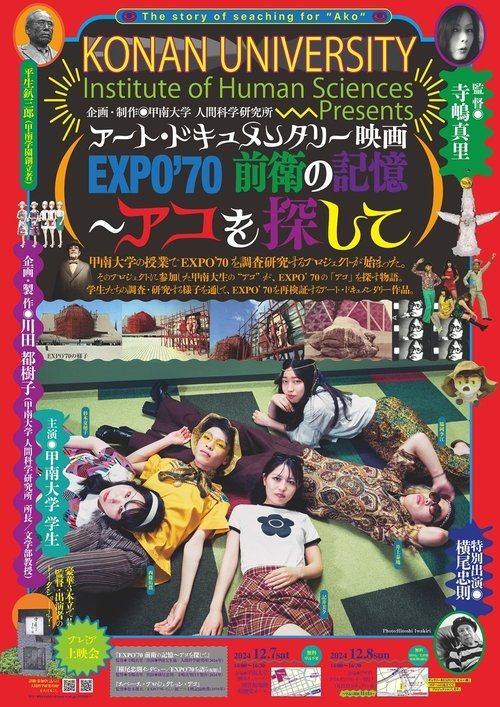
A documentary made in collaboration with students at Konan University, retracing the history of EXPO '70 and attempting to track down the actress who performed in Toshio Matsumoto's installation in the Textiles Pavilion, "Space Projection Ako." Featuring interviews with historians, scholars and artists including Yokoo Tadanori, Norio Imai, and more.
EXPO '70 Avant-Garde Memories - Searching for Ako

No description available.
A Day in the Terminal Building

No description available.
Table in September, or Part of an Incident
Imai films the floor of a room. A 16mm home movie that gives a small impression of how an artist’s mind works when toying with a medium new to him., that of a recording camera. Subtle shifts suggest a drama unfolding out of seemingly nothing.
Floor
In this work performed in 1976 (edited to a video work in 1981), Imai flashes a strobe light directly at the audience seated inside the auditorium in the KBS Laseirum Center in Kyoto and photographs their reaction with his camera. The audience who had expected to see a moving image projected on the surface of a dome-shaped screen on the ceiling is submerged in the dark for the first few minutes. They are left to listen to the recorded sound of a heartbeat and the metronome set to the rhythm of 6/8 time. The sudden eruption of the strobe light as Imai presses the shutter of his camera synchronized to the ringing sound of the metronome brings out diverse reaction from the audience: some cover their eyes with their hands or the pamphlet, while others directly look at the camera and strike some funny poses.
6/8 Time
In this video performance, Imai takes a snapshot of his own face displayed on a TV monitor using a polaroid camera. While the videotape records his performance, he takes out one end of the open-reel video tape from the tape deck, staples his photograph directly on the videotape, and pins it on the wall until the videotape runs out completely. The still photographs of his face are attached to the loose bundles of videotape, which is a material record of the temporal duration of his performance.
Self Portrait
In this performance, Imai remediates photographic images appropriated from popular magazines into a series of line drawings superimposed on each other. Photographs that Imai took with his camera from female fashion magazines and weekly photography magazines are projected one by one on a large white paper attached to the wall using a 35mm color slide projector which displays each image for fifteen seconds. During the fifteen seconds, Imai traces the contour of selected parts of the projected image with a marker pen. Repeating this process for about twenty minutes results in an accumulation of line drawings overlaid on top of each other. Through the process of fragmenting and taking apart each image, Imai seeks to objectify the information environment shaped by today’s mass media.
Sobyō/Eizō
A piece of white paper with “IMAI” typed on its surface is placed on top of a paper cone speaker, which emits the recorded sound of Imai’s heartbeat. As the iron coil fixed to the inner part of the speaker vibrates back and forth, the piece of white paper flips up and down, as if it has a life of its own. This work demonstrates Imai’s desire to visualize the sound created by an inner organ that one is usually not conscious of hearing.
The Heart Beat
Rapidly flickering circles flash and flutter across the screen, accompanied by various sound effects produced by Yamamoto Satoshi. The movement of the circles was produced as a result of Imai’s action of directly punching a hole in each frame of the film strip and projecting it at the spend of twenty-four frames a second. As each hole was punched randomly without exact measurement, the circles appear and disappear in different parts of the screen, which creates the sensation of a flicker film. This work was screened at the first Sōgetsu Experimental Film Festival in 1967 held at the Sōgetsu Art Center in Tokyo. En demonstrates Imai’s interest in foregrounding the materiality of the film celluloid as the source for moving image, as well as the impact of various sounds on the viewer’s perception of the images.
Circle
Starting from May 30, 1979, Imai took a Polaroid photograph of himself every day, holding a photograph of himself taken a day before in his hand. Initially began as a simple action to replace the practice of writing a diary (which he found difficult to continue), Imai has been able to continue this daily action to this day and plans to continue it until the end of his life. In this work, Imai’s daily photographs that he had taken from 1979 to 2004 are sped up to appear like a moving image, akin to an animation.
ときの重奏:デイリーポートレイト
In this work, the television monitor is turned into a mirror-like screen which reflects the activities that occur in the actual space in which it is placed. Braun Tube was recorded at a studio and salesroom operated by Toshiba, one of the largest companies that produce electronic consumer goods in Japan. Imai dims down the scale of brightness of one of the television monitors on display to the point that it begins to reflect the viewers standing in front of the TV. Imai, seated on a chair, chats with the Toshiba salesmen in suits and tie, and their reflection on the monitor is superimposed with the moving images broadcast from live television.