Takahiko Iimura
Directing
Biography
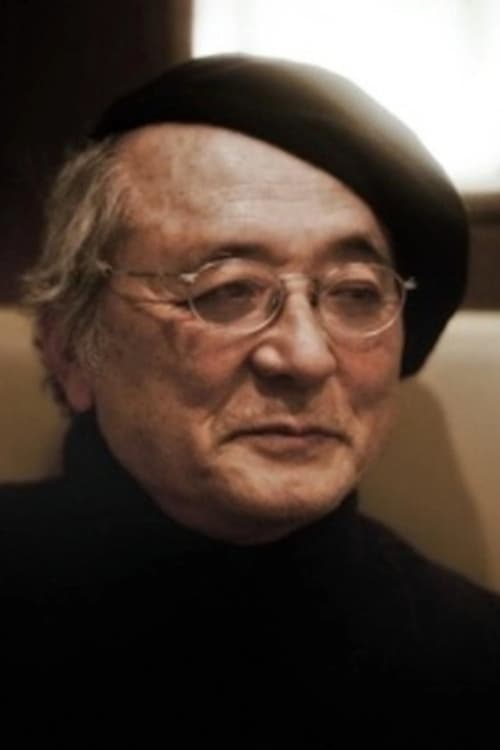
Takahiko Iimura has been a pioneer artist of Japanese experimental film and video, working with film since l960 and with video since 1970 while residing in New York and Tokyo. He is a widely established international artist, having numerous solo exhibitions in major museums such as the Museum of Modern Art, New York, the Whitney Museum, New York, Anthology Film Archives, New York, Centre George Pompidou, Paris, the National Gallery Jeu de Paume, Paris, Palais des Beaux-Arts, Brussels, Reina Sofia National Museum, Madrid, and the Tokyo Metropolitan Museum of Photography, Tokyo in addition to an artist residency at the German Academy of Arts, Berlin, and Bellagio Rockefeller Foundation Study Center, Bellagio, Italy.
Known For

On John's 31st birthday, Yoko held an art exhibit, "This Is Not Here", at the Everson Museum of Art in Syracuse, N.Y.. The show was taped and aired on U.S. TV on May 11, 1972 as "John and Yoko in Syracuse, New York.
Yoko Ono: This Is Not Here

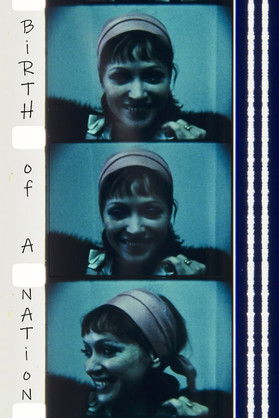
Jonas Mekas assembles 160 portraits, appearances, and fleeting sketches of underground and independent filmmakers captured between 1955 and 1996. Fast-paced and archival in spirit, the film celebrates the avant-garde as its own “nation of cinema,” a vital community existing outside the dominance of commercial film.
Birth of a Nation

“ONAN is a work about desire (masturbation) which has no object but itself. The appearance of the large egg objectifies the man's desires. After colliding with the other (a girl), the hero falls down while still holding the egg, thus caricaturing the desire of the hero.” —Takahiko Iimura (takaiimura.com)
Onan

This is a film about a medium approaching extinction, an 8mm documentary film about a vanishing 8mm cinema. Blending two genres, the science film and the personal film, and benefiting from the participation of multiple generations of cineastes, it is a reflection upon the original cinematic experience.
Associations of Silverpencils
White Calligraphy is an abstract short made by scratching characters from 'Kojiki', an early Japanese text, into the frames of 16mm black leader.
White Calligraphy

One of Takahiko Iimura's (and modern art's) earliest works in conceptual video, A Chair entirely consists of a steady (and usually ghosted) image of a chair to the accompaniment of the firecracker pops of television static. While formally minimal, A Chair is conceptually challenging in its simplicity and its demand that the audience zero in on, of all things, a simple chair. - Tom Fritsche
A Chair

Video began as a medium that inspired discovery. This art documentary traces the expressive roots of “media art” in Japan — works of video, performances, and installations created using video technology that allowed for free and creative visual expression.
KIKAIDE MIRUKOTO = Eye Machine / To See by Chance –The Pioneers of Japanese Video Arts–

A document of Tatsumi Hijikata's Butoh dance with Kazuo Ohno as the guest dancer shot in Hijikata's early period when he was emerging as the originator of Butoh. All of the male dancers are dressed up with evening suits and move gracefully, yet an intruder breaks up the whole scene abruptly. The film is worth seeing, even if just to see a memorable gay duet of Hijikata and Ohno. Overexposed, washed out images are sandwiched among normal ones.
Rose Color Dance
A program of five films on love and sex from the Japanese underground of the experimental cinema, assembled by avant-garde cineaste Takahiko Iimura, and shown at the American Cinematheque from January 19 to 25, 1967.
Japanese Erotica: Five Films on Love and Sex from the Japanese Underground of the Experimental Cinema

Anma (The Masseurs) is a representative and historical work by the creator of Butoh dance, Tatsumi Hijikata in his early period in the 1960s. The film is realized not only as a dance document but also as a Cine-Dance, a term made by Iimura, that is meant to be a choreography of film. The filmmaker "performed" with a camera on the stage in front of the audience. With the main performers: Tatsumi Hijikata and Kazuo Ohno, the film has the highlights such as Butohs of a soldier by Hijikata & a mad woman by Ohno. There is a story of the mad woman, first outcast and ignored, at the end joins to the community through her dance. Inserted descriptions of Anma (The Masseurs) are made for the film by the filmmaker, but were not in the original Butoh. The film, the only document taken of the performance, must be seen for the understanding of Hijikata Butoh and the foundation of Butoh.
The Masseurs

Iimura analyzed some footage he had made in Katmandu of a man taking a bath in a sacred river. A meditational experience is, thus, presented in a film whose minimal action and quiet pace can create meditational possibilities for viewers -Scott MacDonald (Afterimage, April, 1978, N.Y.)
In The River
Takahiko Iimura's Models Series
Models: B-2: A Line 1, 2, 3

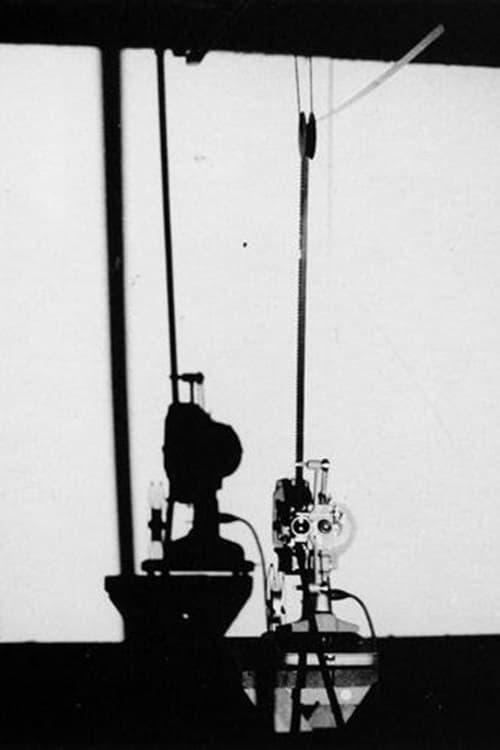
'What I am concerned with in this film is not only the flicker effect, but also the coming and going of an eye-like shape on screen which was created by a fade-in-out device while shooting the light/the bulb of the projector. The viewer literally looks into the light which acts like an eye.'(T.I.)
Shutter
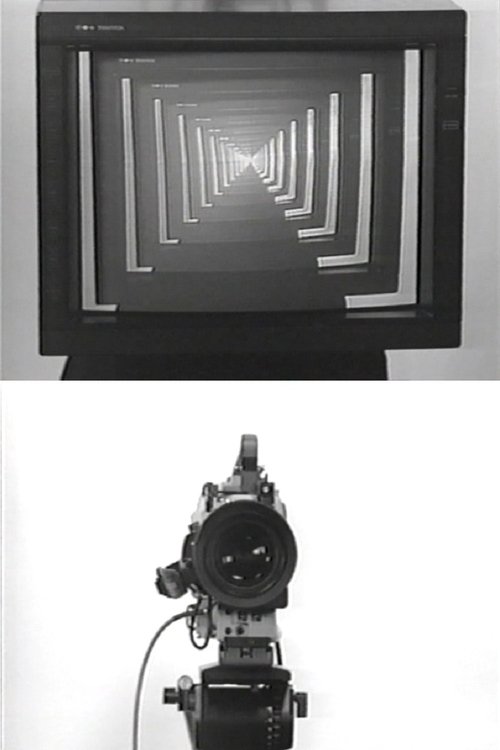
A mind-twisting video, meditating on the experience of watching film/video, and of seeing and being seen. Prodded by a succession of riddles, the videos are lined with humor
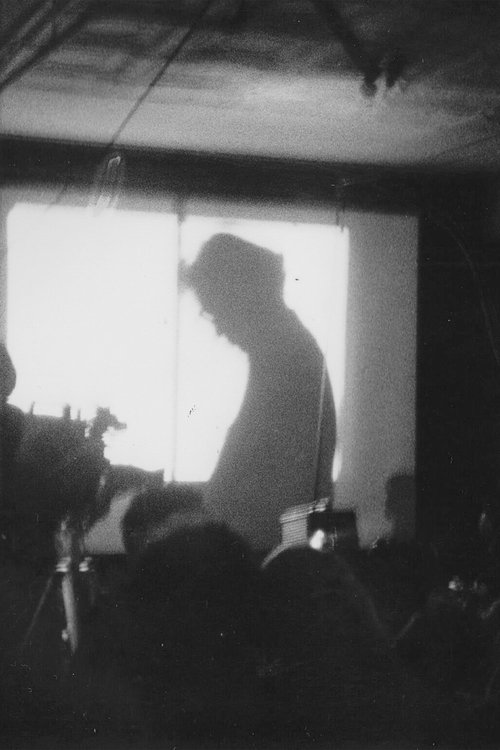
Shadowman (The Structure of Seeing and Hearing)

Home movies shot on Super 8mm by W+B Hein over 10 years.
Home Movies 1971-81
A kind of first person cinema where the filmmaker is the cameraman as well as the actor. Acting like a total stranger in the city who does not speak or hear the language, he walks with a camera to such sight-seeing spots as Times Square,and the top of the Empire State building, etc., only listening to himself speaking the words: "I hear myself at the same time that I speak" in two languages: Japanese and English. The words are a quotation from the book by Jacques Derrida, French philosopher, which he calls "phenomenological essence."
Talking in New York

8mm short by Kenji Onishi and Tohru Mabuchi.
Film Workshop In SANGENJAYA - Summer

While I was staying in New York in the 1960s during the rise of the hippie movement, I filmed performances of body painting by the artist, Kusama Yayoi, together with the performers. As I wasn't satisfied with merely documenting her performance, made super-impositions of flowers over the performance, more as a film poem than a documentary, since flowers was the symbol of the hippie movement as given the name "flower children."
Flowers
"Of the new foreign work I saw, (at the Avantgarde Film Festival in London) that of Taka Iimura interested me most – His film + & -, using scratched signs, displayed how perception can be molded by the concept. By postulating negative duration – a length of black, say six seconds, minus a length of white, say three seconds, equals a length of black three seconds – the gradually emerging experience of 'backward running duration, through a long series of these visual sums, was very surprising." Malcolm Le Grice, Studio International, Nov. 1973
Plus and Minus

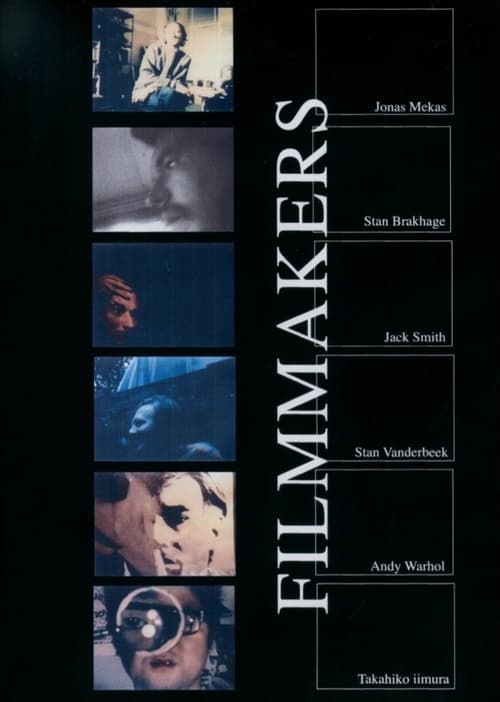
Iimura creates a short self-portrait as well as brief portraits of five of his peers: Brakhage, Vanderbeek, Smith, Mekas and Warhol. In each portrait, Iimura attempts to copy the styles and traits of each artist (Vanderbeek's constantly moving camera; Mekas' experiments with film speed; Warhol's use of flashes of white against a black background), while briefly commenting on the images being shown. The film serves effectively as an introduction to the film styles of these artists.