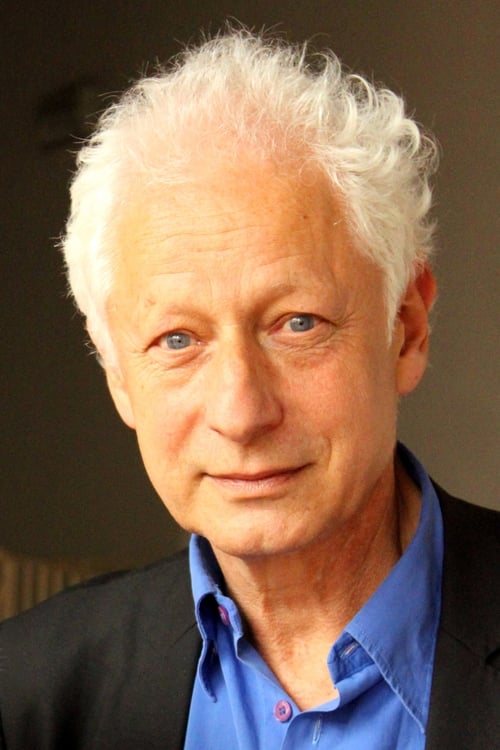
Robert Cahen
Directing
Biography
"Since the 1970s, Robert Cahen's research is haunted by the notion of passing: passing from fix imaged to moving image, passing from a place – and a time-to another, transformation of filmed reality and eye, exploration of sound related to the image. His approach is part of an always renewed dialogue between visible and invisible, narration and poetry, confronting another world, a world made different—beautiful, disturbing-by metamorphoses of time and space." (Sandra Lischi)
Known For

Cinématon is a 156-hour long experimental film by French director Gérard Courant. It was the longest film ever released until 2011. Composed over 36 years from 1978 until 2006, it consists of a series of over 2,821 silent vignettes (cinématons), each 3 minutes and 25 seconds long, of various celebrities, artists, journalists and friends of the director, each doing whatever they want for the allotted time. Subjects of the film include directors Barbet Schroeder, Nagisa Oshima, Volker Schlöndorff, Ken Loach, Benjamin Cuq, Youssef Chahine, Wim Wenders, Joseph Losey, Jean-Luc Godard, Samuel Fuller and Terry Gilliam, chess grandmaster Joël Lautier, and actors Roberto Benigni, Stéphane Audran, Julie Delpy and Lesley Chatterley. Gilliam is featured eating a 100-franc note, while Fuller smokes a cigar. Courant's favourite subject was a 7-month-old baby. The film was screened in its then-entirety in Avignon in November 2009 and was screened in Redondo Beach, CA on April 9, 2010.
Cinématon
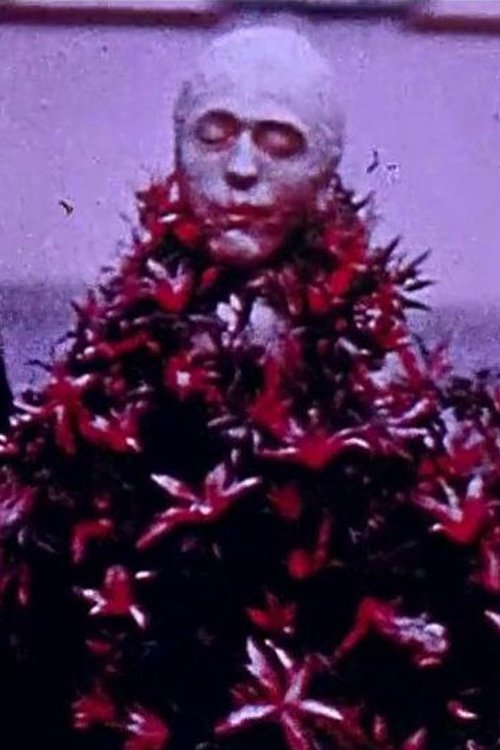
It was in 1973 that this film, the first film shot in Super 8 mm with magnetic sound, was broadcast on television. The Carnival of Basel is famous for the music of its fife-and-drum military bands. The imaginary quality of the carnival comes face to face with musique concrète.
Images du carnaval de Bâle
Cahen surveys a New York in transition, in transit, in smog, in chaos and in peace.
Le deuxième jour
No description available.
Buvards

Once a year, the city of Pisa is lit up by thousands of candles for an age-old religious festival. Magic, visions, dreams and light...
The Night of Candles
A Japan where time stands still; Men and women bound to their land and their work; Bodies floating in thermal springs, shown through the eyes of a painter. The traveller has understood that "everywhere it is difficult to live" and tries to make a picture from real things, so that, through the act of painting, he no longer suffers. Inspired by the characters in Sôseki's novel "Pillow of Herbs", these references give a free interpretation to the images, so that we make the journey in search of temporary solace.
Floating Bodies
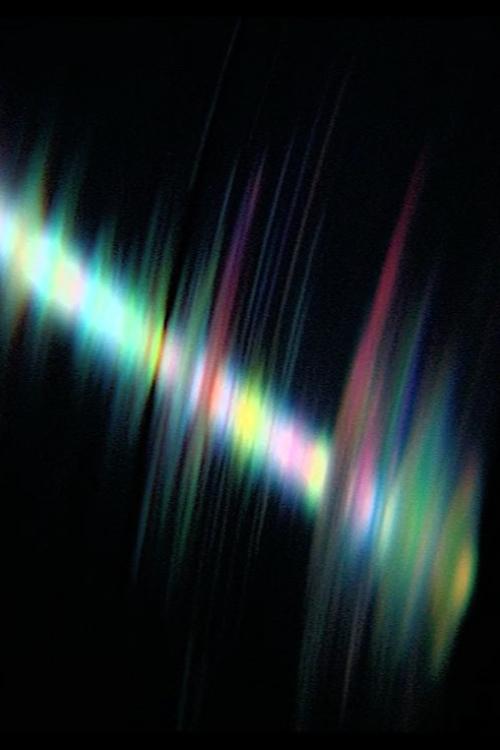
With a musical montage created by Christian Zanessi, Compositeurs à l’écoute provides insight into 18 composers and excerpts from 18 works spanning 50 years of music selected from the repertoire of GRM.
Compositeurs à l'écoute
In this vivid transposition of contemporary music for television, Cahen "responds" to the complex musical transitions of Répons, a work by French composer Pierre Boulez. Performed by the Ensemble InterContemporain and conducted by Boulez, the intricate Répons was designed for an ensemble of twenty-four musicians, six soloists and a "real-time" digital processor. In Cahen's re-composed interpretation, he responds with visual and temporal transformations, "opening" the images in space and time and applying electronic techniques to engulf the instrumentalists in ocean, sky, and trees. Mirage-like superimpositions, temporal shifts, mirroring effects and de-synchronization result in a rhythmic confluence of the illusory and the real. Immersing the viewer in image and sound, Cahen mirrors the transformative process of Boulez's music.
Boulez-Répons
J.M. Tringaud photographed the sea. On the day of the summer solstice 1990, 12 bottles, each containing an original photo are cast into 12 seas and oceans around the globe. In a kind of melancholy chant, Robert Cahen takes us across the solitude of these giant oceans where occasionally a lighthouse provides a human dimension.
The Last Goodbye
A contemporary dance video and a tribute to Patrick Bokanowski. The choreography of Bernardo Montet, conceived and created to be filmed by Robert Cahen, is based on the music of Michèle Bokanowski. It speaks of the loneliness of the dancer in the centre of the stage.
Solo

"L'invitation au voyage” is articulated around the combining of images of memories. On a technical level, this is obtained by using fading photographs followed by solarised landscapes produced using the universal special effects device developed by the research department of the ORTF (the French national radio and TV broadcasting corporation) and a scene filmed in slow motion using a high-speed camera operating at 200 frames per second.
L'invitation au voyage
About “Four Doors” André Bon writes : these doors open onto four soundscapes which express in the order : tension, relaxation, expectation, ecstasy. We say : Sign. Symphonic breathing in four movements where music and sensuality of the images are offered in counterpoint, by subtle shifts. Small story of an encounter to decipher.
sign
L'Eclipse, is composed as a visual little poem using light, colour, rhythm, to present a universe that is half celestial, half cerebral, in which graphic grids play with disappearing and setting suns. Robert Cahen creates effects of fire, clouds, steam, that contrast with the regular and geometric structure of the image.
L'Eclipse
"Chili-Impressions" is the diary of a journey made by Robert Cahen during his stay in Chile in 1987. Like flicking through the pages in a notepad, the images constantly superimpose themselves and always seem to spring from a place beyond memory: the wind, the river, the rails, which carry them to the source of the impression. The journey never stops, it returns more distant still, until the jogging of memory caused by the simple power of these fleeting scenes suddenly gives a sense of place, of place in this world.
Chili - Impressions
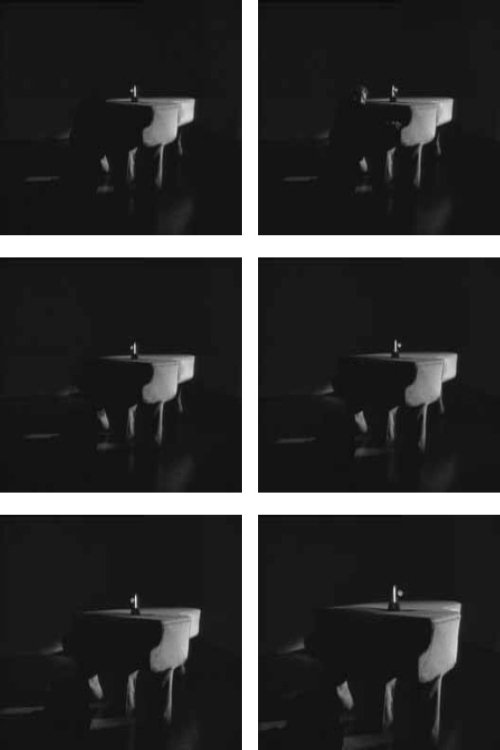
The union of the Indestructible Objet (1923-1959) by Man Ray and L'Infiltration homogenee for grand piano by Joseph Beuys (1966). Here the intersection of two temporalities is at stake: one punctuated by the pulsations of the metronome, the other marked by the continuous silence of Beuys’ piano.
Temps contre temps
The still photograph is transformed and reframed in time in these exquisite collections of thirty-second "video postcards." An image of a city appears to be captured as a traditional postcard, frozen in time. Suddenly the photograph is "released," electronically brought to life for one heightened, anecdotal moment — a single gesture, a punctuating sound — and then frozen again. Witty and often poignant, these revelatory documents of time, place and memory denote a fleeting, ephemeral reality. A 32-minute version also exists, featuring additional postcards.
Video Postcards
The images of this short film are linked to the concrete music by Michel Chion, and let the monologue of Saint Antoine (Pierre Schaeffer's voice) unfold and offer itself completely. The imagery, presented in parallel pictures, is intended to be earthy and close to nature, rediscovering, when necessary, the material which is offered in a metaphor surrounded by mists. At the sound of the gunshot, concrete in the music, occurs this break in the discourse, and the image, like this gunshot, finds the Asian connotation of death. And the dream raises the human form, then a face which offers itself before disappearing in the tumults of an imaginary sea. The earth seen from the sky then the sky itself take us very far (Robert Cahen)
La Voix
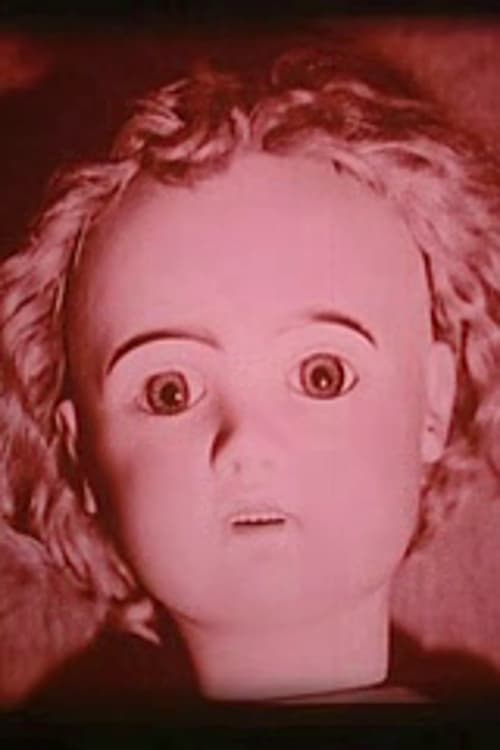
No description available.
Poupees...Qu'on Les Appelle
A fictional video excursion: on a beautiful summer day, peaceable tourists take the Montenvers cog railway right up to the Mer de glace. Full of humour and affection, it pays homage to the films of Jacques Tati.
Montenvers et Mer de glace
No description available.