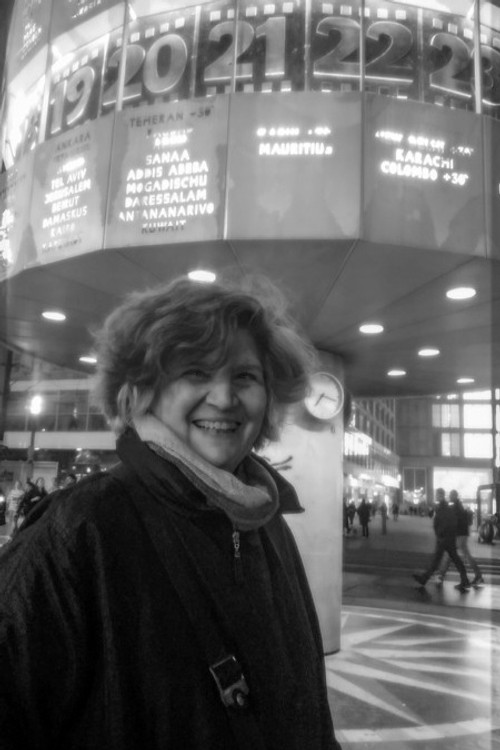
Vouvoula Skoura
Directing
Biography
Vouvoula Skoura was born in Thessaloniki. She studied Graphic Arts at the Athens Institute of Technology (ATI). She lived in London during the dictatorship in Greece, where she attended Art History courses (1970) and a Computer Graphics for Video seminar at Middlesex Polytechnic (1988). She worked with experimental mixed media on photography, which she applied both to her prints (books, posters) and to her films. Her works, both film and video, have been presented at international festivals and universities in more than fifty cities (Athens, Beirut, Berlin, Bilbao, Brussels, Cetinje, Chania, Krakow, Delphi, Ghent, Frankfurt, Kassel, Leeds, London, Naples, Patras, Pristina, São Paulo, Sofia, Strasbourg, Tampere, Thessaloniki, etc.), as well as on ERT1, ARTE and the BBC. She has collaborated with the Ministry of Culture, the Athens Concert Hall, the Municipal Council of Thessaly, the Municipal Council of Patras and many other cultural institutions, such as the Aplo Theatre, the Attis Theatre, the Fournos Digital Culture Center, Patras – European Capital of Culture and the KAM (Center for Mediterranean Architecture). Her films Internal Migration (1984) and Slag of Light (1989) were awarded a special mention by the Jury at the Drama Festival. The video Black Moon won first prize at the Athens Video Art competition (1998). The film Ethel Adnan: Exiled Words won the Greek Film Center Award at the 10th Thessaloniki Documentary Festival (2008). In 2009 she was honored with the EBGE Lifetime Achievement Award of the Graphic Designers Association of Greece. From the Thessaloniki Film Festival website.
Known For
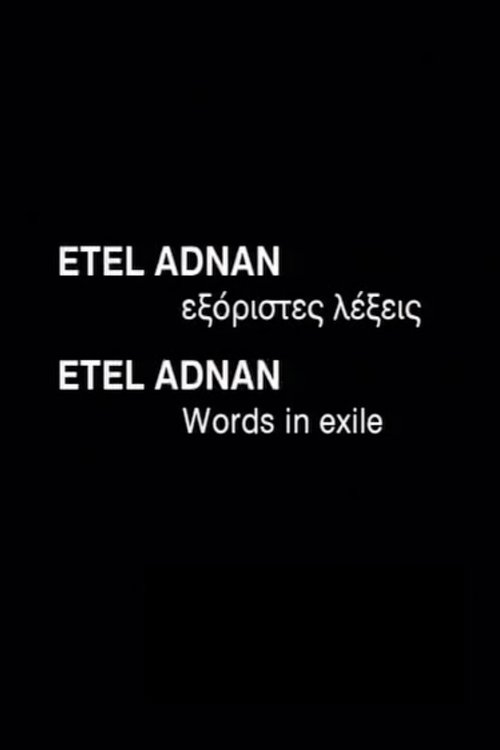
The film reconstructs through an array of visual fragments, a multiplicity of languages, of peoples and their identities, the unique portrait of the poet and painter Etel Adnan.
Etel Adnan: Words in Exile
Etel Adnan’s last words recorded by her close friend, the Lebanese historian and writer Fawwaz Traboulsi, on colours, Nietzsche and poetry. Twenty years after her film Etel Adnan: Words in Exile (2007), the filmaker returns to find Etel Adnan’s lost voice in a Lebanon marked by ongoing historical fractures.
Etel Adnan: Undying Colours

The life of Melpo Axioti, a modern Greek novelist and poetess. A navigation in the labyrinth of her life and her expression, through the analysis of the psychiatrist Spilios Argyropoulos.
CONTRABANDO – Seeking Melpo
The film follows a woman's internal migration through her childhood memories and descriptions of places and situations. In 1950, we see her at age 10 in her village in Macedonia; in 1956, at age 16 in Thessaloniki; and in 1960, her wedding in Athens marks a new phase in her life. Internal Migration, the director's most autobiographical film, was groundbreaking for its time in addressing the violent separation of a woman from her environment, while her move from her birthplace to another place becomes the occasion for an inner journey through the times and spaces of memory. She is followed by the echoes of the Civil War, rock and roll, the poets she loved—Karyotakis, Patrikios, Embeirikos—books, and films.
Internal Migration
From the islands of the Aegean (Tinos and Mykonos) to the cities of exile: Paris, Berlin, Budapest. Urbad and rural landscapes, connected not only with the continuous movement of Melpo but mainly with permanent exclusions and confinements in mental institutions. A Maze of history and its expression in accordance with the plans of the psychiatrist & poet Spilios Argyropoulos and linguist Vangelis Intzidis.
Contrabando: A Film For Melpo Axioti
Fragments of personal experiences. A notebook of memory. Family photographs, ftexts abandoned by others and kept by me. Relics. Heirlooms. Sailing to Aegina – the first images, the sea – clutching Elytis’ Carte Blance[. “It’s the girl”, says the poet, “with a jug in her hand.” Milta or the Archetype. It’s “Milta,” the women of the Mediterranean, it’s “Milta” of the sea, of memory, and of poetry. Predominantly the poetry of the word, but also of the image. So I surrendered myself to my memories, to the house, to the book, to the street. Summer, heat – as “The Garden Entered the Sea.” The time has come to offer them to you, like water on the table.
Water on Table – Homage to Odysseas Elytis
This documentary aims to register this unknown side of James Joyce: His Greek Notebooks. Trieste. Bloomsday, 2013. Dance in slow motion, accompanied by text. By deconstructing the body, we turn it into a memory: of the body, of life, of texts. The biographical references to Joyce and Mando Aravantinou, combined with the diagonal slicing of the image, cancel the realism of the landscape, including that of the Narrator’s space/study. As a culmination, Joyce’s letter “A request for a loan in Greek” functions as a timely denunciation. Various routes through cities, such as Trieste, London, New York, and Athens; languages such as Greek and English. In addition to the primal myth of Ulysses, there is another issue: Greek is “the language of the subject of Ulysses”
The Red Bank. James Joyce: His Greek Notebooks
References to great Renaissance painters, to figures who defined the 20th century (Samuel Beckett, Man Ray, Luis Buñuel, Sergei Eisenstein) and to architectural models (Hadrian's Villa, Villa d'Este, the Capitol, the Vatican, the E.U.R. district) form a set of "sibylline sayings" in the film through the use of double images. A discourse that is unpredictable, internal, mystical, and above all silent, which predicts the end of innocence (Part I), of enigmatic and irrational love (Part II), of death (Part III), and of despair (Part IV). And with the masses now being dissolved by the violence of power, which leads the individual to isolation or madness. And in the end, the silent, desperate song of Sibyl, in the shadow of the buildings of the fascist period, signals her return as a prediction.
Sibyls
In memory of a fifteen-year-old boy who was killed by a police officer in Athens in 2008.
In Memory of...
This film was shot 60 years after Antonin Artaud’s death. Attempting a return to the author’s childhood, it examines the field for encountering the ideas, addictions, and people who influenced his oeuvre with new eyes.
The Four Stages of Cruelty – For Antonin Artaud
The beginning. A one-take shot, images of Famagusta, as Pyrros Theofanopoulos recites the text of Niki Marangou, while the gaze of Niovi Charalambous describes the dead city. Composing images and secret connotations that map out the signs of people as they travel, following the routes of memory. Words flow across divided grounds and lands of exile, yearning to overcome separation lines and borders. Niki in Cyprus, Niki in Berlin.
UTOPIA. The Poetics of Borders: Berlin – Nicosia
Poet Nanos Valaoritis talks with theater scholar Orsia Sofra about the years Manto Aravantinou spent in Paris (1967–1974), self-exiled from the junta of the colonels, began her research on Joyce's Greek.
Nanos Valaoritis
The multilingual landscape, together with the continuous and repetitive image of the sea, are the elements that represent her inner, emotional space. There is a sudden interruption of the film: breaking news. Moving images and photos of an Irish Navy’s ship whose name is Lé James Joyce, and had the mission to save refugees in the Mediterranean Sea; simultaneously, a girl sings a contemporary song, inconsistent with the form and action of the film. Is this girl Eveline in 2020, or maybe not? We return to the third part of the film and the narrative flow of Joyce’s short story. A ship, a black ship. Is it the ship of the journey that Eveline denied, or is it the ship that the refugees are hoping for?
Eveline 2020
The film is a collage of computer-generated works that reproduce erotic designs from classical antiquity to contemporary photographs and live footage. Through different filming techniques, a unique construction emerges, where the aesthetics of modern technology do not prevail, but rather a very personal perspective is discernible. The subject of the film refers to the diptych "Love-Death" – a theme familiar in the art world. Still lifes refer to painters such as Morandi, Caravaggio, or Lopez. The acceptance of ancient and contemporary heritage works in tandem with its rejection, as it is deconstructed through the destruction of materials and images.
Σκωρία φωτός
In 2012, four years later, a large demonstration was held in Athens in memory of Alexis Grigoropoulos, who was killed by a police officer in Athens in 2008.
In Memory of... II
A vast photographic archive –like a long journey through the 20th century– featuring documents from the life of Giorgos Seferis, period materials from around the world, and records from the places the poet traveled.
Giorgos Seferis: Poet and Citizen. A Journey in Space and Time
A video installation dedicated to the poetess Niki Marangou. Footage from the Green Line dividing Cyprus. Niki Marangou’s poetry unfolds in an anarchic visual rendering. Images of Cyprus expand or become trapped, repeated or not. Their form is changing, the colors too. The Mediterranean as a woman, the poetess reflects the flows of immigration, of human drifting and displacement, but also the umbilical cord between memory and the freedom of traveling.
Niki Marangou: Water Surfaces
The theme of violence transforms the natural face into something fluid. It refers to the portraits of Francis Bacon. Pain is ultimately altered. Death has been established, and the dead animals—even though they continue to fly—belong to an image that is "frozen" and ultimately serene.
Philoktetes – The Wound
A vast photographic archive –like a long journey through the 20th century– featuring documents from the life of Giorgos Seferis, period materials from around the world, and records from the places the poet traveled.
Giorgos Seferis: Poet and Citizen. The Experience of Love + War and Decay
Through fragments of images, through cracks, love, anger, murder as an extreme act, and Medea's "exile," predetermined. Memories of functioning, revenge, punishment. Love is Memory. And Jason's absence—even as a black-and-white image—is precisely the admission of her great love. The music from Central Asia is her own memory, a past that also becomes the future. A return to mourning, without guilt.