Acting
An unreleased diary film shot during the Fairleigh-Dickinson Artist Seminar simultaneous to the production of Back and Forth by Michael Snow.
Filmed in West Berlin, WARM-UPS, by the American conceptual artist Allan Kaprow, is a recreation of a performance originally enacted in Boston, in which individuals assess the flow of body heat from hands, torsos, and feet to adjacent surfaces. As the film’s voiceover itself notes, “Using words and pictures it condenses the times and spaces of the real event into a graphic illustration of what happened.”
An essayistic documentary about the action art movement that emerged in the 1960s: In interviews with various action artists, including Wolf Vostell, Joseph Beuys and Allan Kaprow, director Helmut Herbst illuminates the performative and participatory tendencies in art that began in the 1960s and outlines the diversity of motives and strategies.
This fascinating film documents the U.S. premiere production of Originale, a Happening by German composer Karlheinz Stockhausen. Filmed at the "2nd Annual Avant Garde Festival of New York," which was produced by Norman Seaman and Charlotte Moorman, the stage production was directed by Allan Kaprow. Performers include Nam June Paik, Moorman, Jackson Mac Low and Allen Ginsberg, among many others.
A comprehensive documentation of new art movements from 1945 to the present day. Beginning with the "Internationale Situationniste," "Cobra," "Spur," and "Wiener Gruppe" groups in Europe, and moving on to the international Happening and Fluxus movements, including the Viennese Actionists, and from 1970 onward to international Body and Performance Art, which also encompassed media art—film and video—the documentary presents film and photographic material from these art movements.
Produced by WGBH-TV in Boston, THE MEDIUM IS THE MEDIUM is one of the earliest and most prescient examples of the collaboration between public television and the emerging field of video art in the U.S. WGBH commissioned artists – Allan Kaprow, Nam June Paik, Otto Piene, James Seawright, Thomas Tadlock, and Aldo Tambellini – to create original works for broadcast television. Their works explored the parameters of the new medium, from image processing and interactivity to video dance and sculpture.
At first viewing PACIFIC TIME appears to be a departure from the more abstract and more purely visual delights of Hock's preceding efforts. Considerably longer, it employs actors, dialogue and 'plot.' Upon closer examination, however, it proves to be of a kind with his earlier output - only more ambitious and perhaps, more mature. Again, distortion of time conventions is at the forefront of Hock's array of stylistic devices. But, rather than the 'magic,' highly assured time-lapse photography of STUDIES IN CHRONOVISION or MISSISSIPPI ROLLS, here Hock employs radical slow-motion sound and brilliantly inventive written subtitles. [Source: Douglas Edwards 'FIlm Commentary: Louis Hock', Gosh!, 1978]
The influence of Jewish fathers on their sons and the complexity of familial relationships are explored in a witty, poignant portrait of two artists. Beat poet Allen Ginsberg (whose father Louis was a poet in his own right) and performance artist/sculptor Allan Kaprow (whose father is a high-powered lawyer) are the sons who struggle with and against the influences of these patriarchal figures.
A camera moves back and forth at an increasing pace. Back and forth, back and forth...
Produced by WGBH-TV in Boston, the Medium Is the Medium is one of the earliest and most prescient examples of the collaboration between public television and the emerging field of video art in the U.S. WGBH commissioned artists — Allan Kaprow, Nam June Paik, Otto Piene, James Seawright, Thomas Tadlock and Aldo Tambellini — to create original works for broadcast television. Their works explored the parameters of the new medium, from image processing and interactivity to video dance and sculpture.
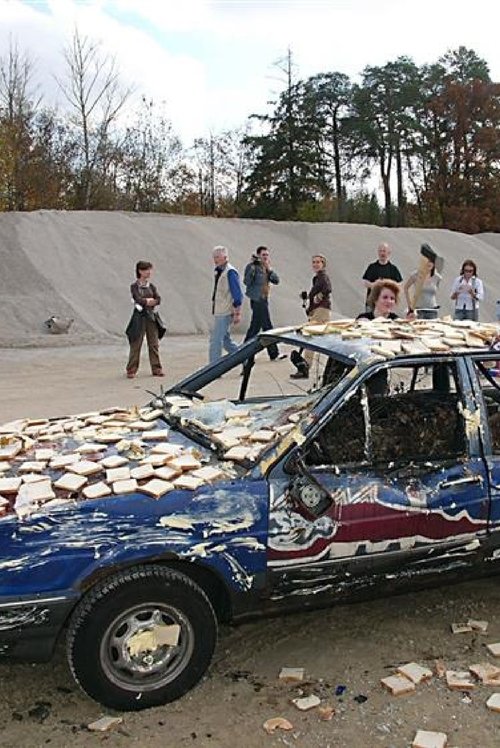
A film of a happening by Allan Kaprow.
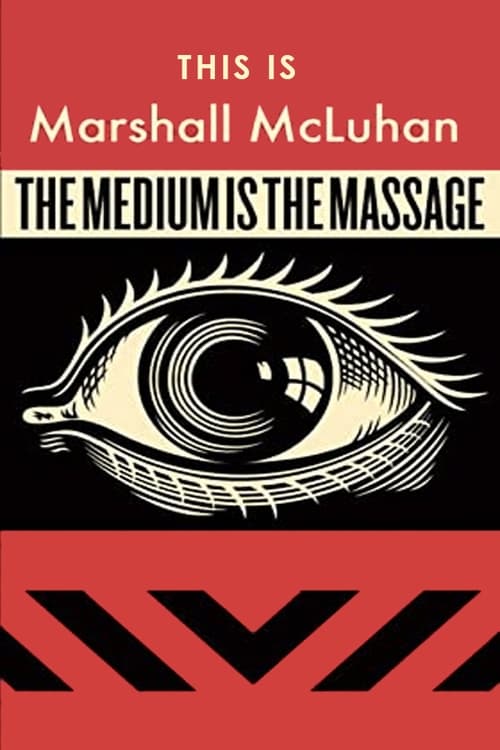
Investigates the central ideas of Marshall McLuhan using pictorial techniques and including his own comments. Examines the reaction of others to his views and points out that his interest is the impact of electronic technology on the contemporary world.