Aleksandr Balagura
Directing
Known For
In 1998 it seemed impossible to Balagura to make films in the Ukraine without becoming a slave to television; he therefore left for Italy, the "country of culture". With no immigration papers, with a wife and two children, the less agreeable realities of his situation soon caught up with him. In 2004, armed with a basic mini-DV camera borrowed from a friend, with a casual acquaintance as camera operator, he shot 'Pausa Italiana'. From a small village in the Abruzzi region, he observed the reality surrounding him; he also turned the camera upon his own status as migrant, a situation no documentarist could capture. He allies precise recordings with a fragmentary narrative of literary quality, giving the film a particular quality: auto-fiction and ethnography intersect to form an Aristotelian poetic, avoiding separation between self and other, observer and observed, the real and the cosmic
Pausa Italiana
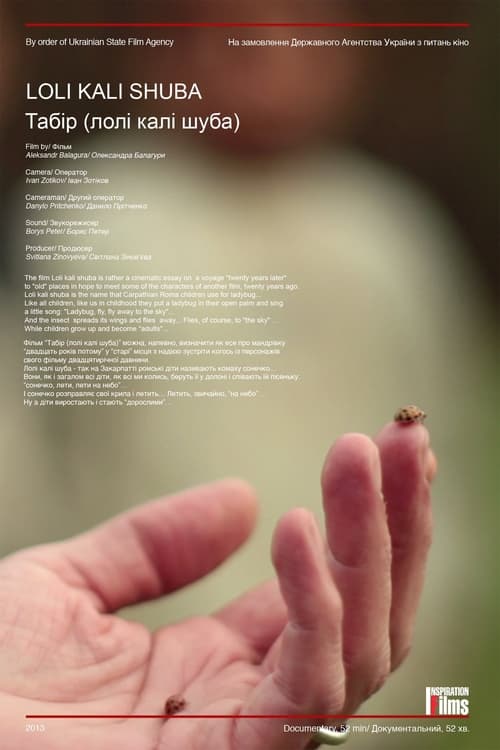
Prominent Ukrainian/Italian documentary film director Oleksandr Balahura (most known for link) visits Roma neighborhoods and social events in Zakarpattia (Western Ukraine) and re-visits his earlier work, "Widow-Street", shot on same locations in 1991. He also screens "Widow-Street" to its characters, whom he meets again in 2013.
Loli Kali Shuba
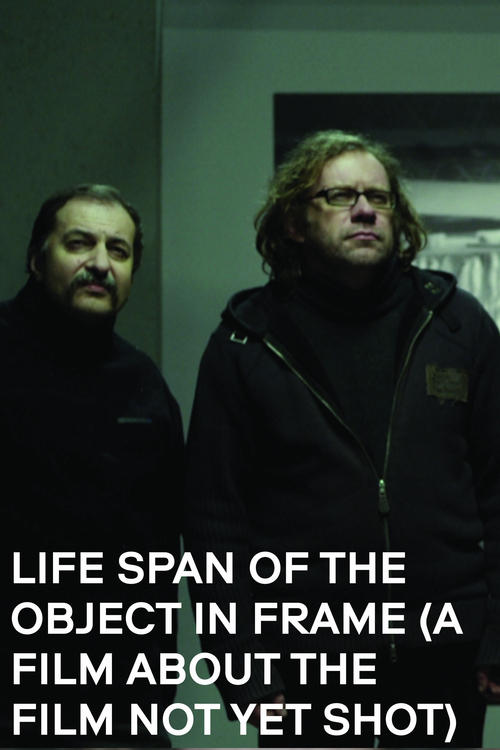
The time of exposure is the life span of an object in frame. In this regard, no photo is just a two-dimensional graphic composition - it always has the third, temporal dimension. A photo is a time carrier, the vessel of memory... But whose memory? Of the Face or the Thing or the Landscape which are still on the photo? Of the photographer?
Life Span of the Object in Frame (a Film about the Film not yet shot)

Film about the unfinished film. "Three butterflies... Suddenly - two butterflies... And nobody has realized how the souls disappear..." Twenty-five years ago, in kyiv, his mother gave to the author a camcorder 16 mm. His friends and he, interested in cinema, started to make everyone own movie. Today, the camcorder has disappeared, as a part of the friends and the country where this happened. But the spools of the films shooted at that time stay. This new film tries to understand then the meaning of the initiated film, and perhaps, in a certain sense, to finish it...
Wings Of Butterfly
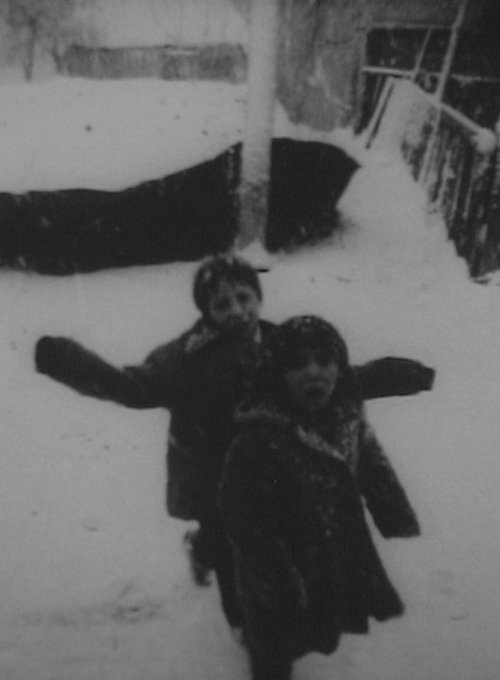
The example of the Roma camp in the village of Pidvynogradiv, at the border between Ukraine and Hungary in Zakarpattia Region, illustrates unresolved problems faced by the Roma communities during the Soviet period. “Widowstreet” is the name given by the inhabitants of the poorest part of the village to the street where they live.
Widowstreet
The film was made in 1989, in Demianov Laz Valley, where a mass grave from the period around the Second World War was opened and reburied. Apart from the historical event itself, the subject of the film is the rare meeting between the living and the dead, face to face, reunited by that event. What can actually a living man do in front of another who is no longer alive? He can cry, he can pray, he can suffer...but what else can he do? At the end he reburies them in the ground. The film shows somehow both the possibility to put the living and the dead in the same frame, and the impossibility for them to interact.
To Our Brothers and Sisters
«Antologion (ukrainian film)» is a film of assemblage, - an attempt to imagine an ukrainian film with its own plot, aesthetics, intonation, an attempt to create an organic interlacement, a cine- rhapsody, founded on fragments of classical films produced in Ukraine during the soviet period. This film is a homage to the centennial of the cinema. For this the author is allowed the use of the "Pigeon flying" of Eadweard Muybridge as the image of the cinema. The dedication of the film is «To the happy ones who have gone»...