Ed Atkins
Directing
Biography
Ed Atkins is a British contemporary artist best known for his video art and poetry. He is currently based in Berlin. Atkins lectures at Goldsmiths College in London and has been referred to as "one of the great artists of our time" by the Swiss curator Hans-Ulrich Obrist. (Wikipedia)
Known For

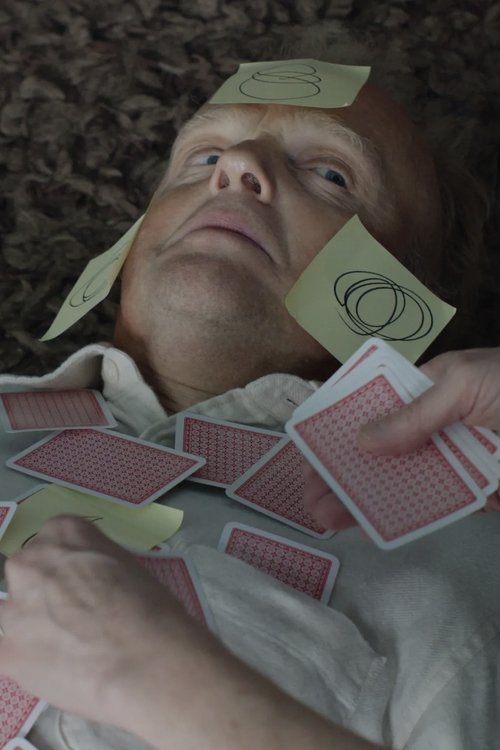
The film by Ed Atkins and Steven Zultanski combines a performative reading of Philip Atkins’ (Ed’s father) diary, written during the six months leading up to his death, with the reenactment of The Ambulance Game, a role-playing game played by Atkins and his daughter. Originally private, both the diary and the game are now performed publicly, with the camera alternating between the performers and the audience, emphasising voyeurism and shared intimacy. Exhibited at Tate Britain alongside Atkins’ writings, paintings, embroideries, video works, and drawings, Nurses come and go, but none for me (2025) marks both Hartwig Art Foundation’s first commission of a work by Ed Atkins and the artist's debut feature-length film.
Nurses Come and Go, But None for Me

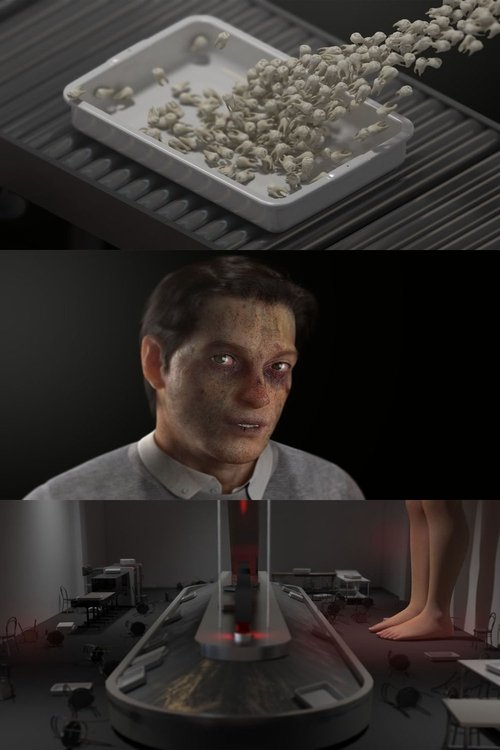
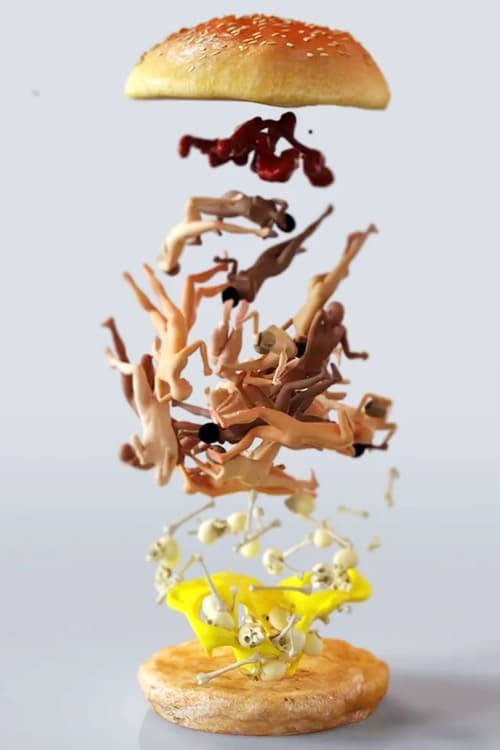
In this hyper-realistic digitally rendered video, sandwiches are assembled in sequence. Each component, from the first slice of bread to the last, is dropped dramatically from a height, before bouncing and settling into place in slow motion. Mayonnaise, then ham, lettuce, tomato, cucumber, and the final slice on top. This perfect yet uncanny choreography reads like an exaggerated, perverse take on ‘food-porn’ obsessed advertising campaigns. These sequences repeat, the sound gradually incorporates saws and machinery, echos from empty environments, pianos breaking, smashes, crashes and mechanical crescendos like jet engines alongside eerie drones, bells, and hard rummaging noises. Another piece of bread lands, some rubber baby dolls fall onto it, some brown slop, a blanket, denim jeans, some businessmen in suits, and more slop. Ketchup, then a union jack, all encased in the final layer of bread that falls to the top of the pile to the sound of a tolling bell. Infinite continuation, loop.
Untitled
A computer-generated figure sits in a television studio and invokes a-histories and immaterial indices; thick, warm surfaces and dramatic lighting states; a neural network and those eternal celestial bodies; a final broadcast and some overt tattoos; a map of its being and the space where the crime occurred…
Material Witness OR A Liquid Cop

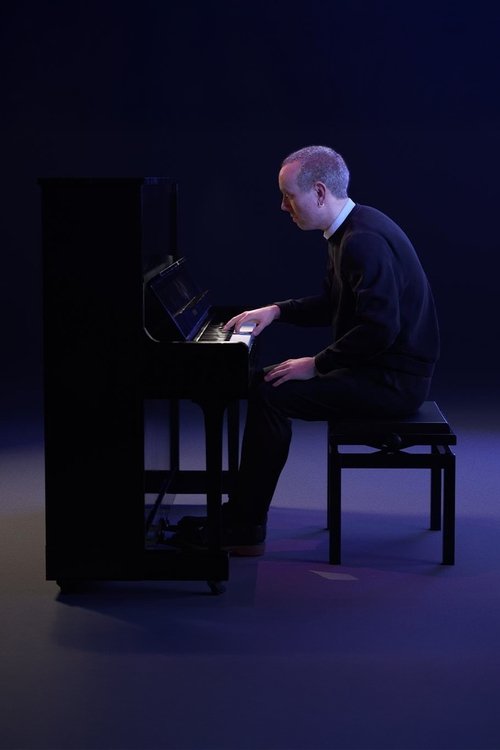
Pianowork 2 is an animated recording of me playing Jürg Frey’s ‘Klavierstück 2’ at Mimic Productions in Berlin on 22 June 2023. It was a very hot, early summer’s day. Mimic created a ‘digital double’ of me, scanning my head and hands. It was the first time I’d used a computer-generated figure with my own likeness. I played the piece at an upright piano, wearing a sensor-filled Lycra onesie with a head-mounted rig holding an iPhone a short distance from my face. I tried very hard to do what Frey’s score asks. I counted the beats in the vast rests, the 468 instances of the same fourth, the precisely instructed micro-shifts of tempo. I worried about and tried to depress the keys with the correct pianissimo dynamic to follow the previous decayed chord played 40 seconds prior. This agonising pace makes for a terrific mounting of anxiety.
Pianowork 2

The story told in Hisser was inspired by a true occurrence. In 2013, a young man in Florida was literally "swallowed up by the earth" when a cesspool suddenly opened up under his bedroom. The film's main setting is a bedroom by night. From the way it was shot, the viewer has the feeling of peering into an abandoned life-size dollhouse. Other sequences show close-up views of a young man lying on a bed with a tormented look on his face or cowering in a corner. The scene is accompanied by an exaggeratedly romantic song whose refrain – "It took me so long to get my feet back off the ground" – alludes to the loss of a loved one and a sense of abysmal loneliness. The song's emotionality contrasts starkly with the artificiality of the scene. The boundary between reproduction and reality grows fluid, and the virtuality – which the artist has carried to a near- perfect extreme – begins to crumble in view of the protagonist's physical and emotional frailty.
Hisser

In this audiovisual performance, Ed Atkins lyrically explores the subject of depression and the digital age.
DEPRESSION
A dark and magical visit to the fabled Parisian address Rue Fontaine 42. This was the residence of André Breton, the mastermind of surrealism, who surrounded himself with an impressive collection of modern, Western art and ethnographic objects from Oceania and North America. The collection was sold and divided up in 2003 at a controversial auction. 'The Trick Brain' is a delirious montage and a trip back in time to Breton's private art collection, where Atkins has been scouring the archives and come up with a possessing interior film of the place that once was, complete with surrealistic paintings, scores of Indian figures and hundreds of other displayed rarities. The film's soundtrack is provided by an observant narrator, who reveals to us that the objects shown are not necessarily what they claim to be - but instead are catalysts for some kind of wonderful linguistic virus which reveals the real identity of things.
The Trick Brain

Ed Atkins’ Death Mask 3 takes stock-like visions of sea and stone and undercuts their grandeur with jolts of noise, cuts, and filters. Sublime images collapse into pure “image-ness,” a study of interruption and the refusal of illusion.
Death Mask III

Even Pricks is sort of an homage to the repeating loss and gain of an erection—metaphorical or not—as mediated through all the stimuli we humans sort through and judge and despair of throughout the course of any quotidian day. The erection here is the (now nearly as familiar) thumbs up/thumbs down—sliding in and out of frame as a pale, disembodied man’s arm. It pokes up into a floating eye and nostril, and down into a human navel. It’s doused with fluids and submerged. The thumb inflates and deflates, over various backdrops of crumbling structures and hazy rooms. At one point, a very real-looking chimp delivers a string of spoken words in a crisp English accent. His assertive thumbs-up makes an appearance as well. The artist is interested in the potential to express emotion through cold and flawless digital means and plays with the convention of aggressive advertising slogans and film trailers, urging the viewer to “this summer destroy their lives.
Even Pricks
16 minute seamless loop.
up/down, in/out
A short video that reworks a single sequence from the silent film Ménilmontant (Dimitri Kirsanoff, 1926). It was digitised from a knackered, toned print lent by an archive, and enhanced with various AI tools.
Voilà la vérité
A High Definition video projection, just over eight minutes long, that presents an immersive sequence of interconnected images repeated and distorted through various lighting effects and digital technique.
Death Mask II: The Scent

‘The Worm’ is a performative video work based on a call from artist Ed Atkins to his mother, with Atkins himself as the digital avatar, caught in an endless loop of glitches.
The Worm

A live-action and CGI burlesque of airport security instruction videos set to Ravel’s Bolero: A carousel of protocol, rendered bodies, abattoirs and metal detectors.
Safe Conduct

In his new video work, Atkins plumbs the corporeal depths of digital moving imagery. Computer generated animation, emo musical theatre, collaged stock imagery, field recording, performance capture, disease, motion graphics and starless humour muster within his videos. Atkins’ unique visual language, both melancholic and absurd, confronts the viewer with intimate, arcane visions that seem caught in a purgatory of afterwards.
Death Mask 5

A very intimate video that quickly sheds its specificity in order to foreground its construction. As well as using cliched emotional cues and tropes, this happens through performative (deliberate) 'accidents'. Autofocus racks badly, lens flares are sought and dwelled on and audio blurts and cuts unceremoniously.
Cur

Delivery to the Following Recipient Failed Permanently, is visually restrained compared with his usual experiential overload. There is, though, an astonishing monologue, designed to invoke a material sense of the word "smoke" like a haemorrhage in your brain. - The Guardian