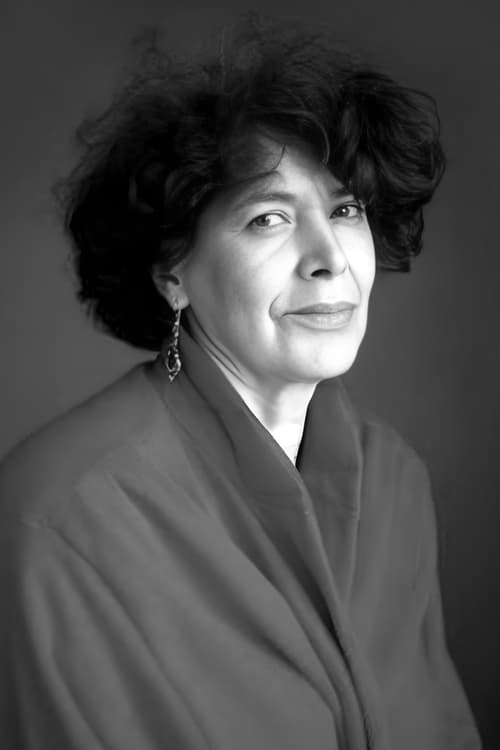
Assia Djebar
Directing
Biography
Assia Djebar (آسيا جبار), pen name of Fatima-Zohra Imalhayène, born June 30, 1936 in Cherchell in Algeria and died February 6, 2015 in Paris, is an Algerian woman of letters, she obtained French nationality in 1967. She is considered one of the most famous and influential authors in the Maghreb. She was elected to the French Academy in 2005, becoming the first North African writer to be admitted there. Assia Djebar was born on June 30, 1936 into a traditional Algerian lower middle class family. His father is a teacher, his mother belongs to the Berkani family, an ancestor of whom fought alongside Abd El-Kader. Assia Djebar spent her childhood in Mouzaïa, studying at the French school, then in a private Koranic school. From the age of 10, she studied at Blida college and learned ancient Greek, Latin and English. She obtained the baccalaureate in 1953, entered hypokhâgne at the current Emir Abdelkader high school. In 1954, she entered khâgne at the Lycée Fénelon (Paris). The following year, she joined the École Normale Supérieure for young girls in Sèvres, in the History section. She is the first Algerian woman to join the school. In 1956, she followed the strike slogan of the General Union of Algerian Muslim Students, which protested against colonial repression in Algeria, and did not pass her exams, she would be excluded from school. She then decided to write her first novel, La Soif, under the pen name, "Assia Djebar": Assia, consolation, and Djebar, intransigence. General de Gaulle will request his reinstatement in the School in 1959 because of his “literary talent”. She married the writer Walid Garn and left France for North Africa. From that year, she studied and taught modern and contemporary history of the Maghreb at the Faculty of Letters in Rabat. She is putting together a thesis project on Lalla Manoubia, a holy matron from Tunis. On July 1, 1962, she returned to Algeria. She was appointed professor at the University of Algiers. In 1965 she adopted, with Walid Garn, the orphan Mohamed Garne. From 1966 to 1975, she lived most often in France, and regularly stayed in Algeria. She married Malek Alloula for the second time, from whom she subsequently separated. She directed two films, La Nouba Des Femmes Du Mont Chenoua in 1978, a feature film which earned her the FIPRESCI prize at the 1979 Venice Film Festival, and a short film, La Zerda Ou Les Chants De L'Oubli, in 1982. From 1997 to 2001, she directed the Center for Francophone and French Studies at Louisiana State University. In 1999, she defended her thesis at Paul-Valéry Montpellier University, on the subject of her own work. The same year, she was elected a member of the Royal Academy of French Language and Literature of Belgium. Since 2001, she has taught in the French studies department at New York University. On June 16, 2005, she was elected to the chair of the French Academy. She is an honorary doctor from the University of Vienna (Austria), Concordia University of Montreal (Canada) and the University of Osnabrück (Germany). She died on February 6, 2015 in Paris. She was buried on February 13, 2015 in her hometown of Cherchell, 100 km west of Algiers, in the presence of her loved ones, literary and political figures and a large crowd.
Known For
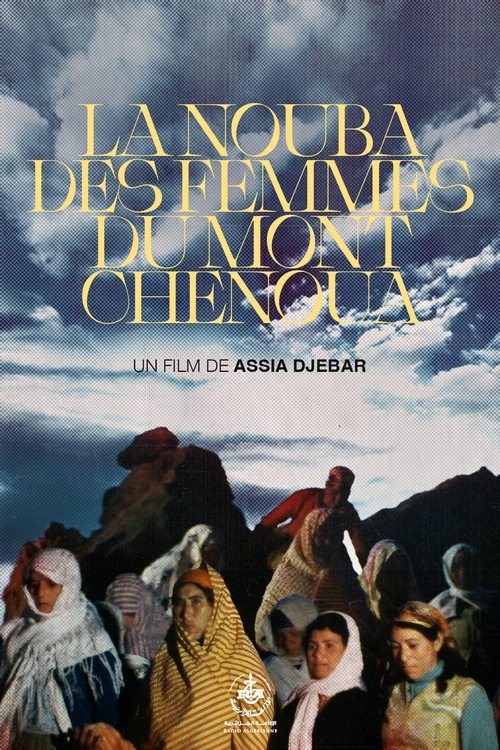
Writer and filmmaker Assia Djebar explores Algerian history, the psychological impact of war, and post-colonial female identity in this 1979 classic of film literature. Named for (and taking its structure from) a traditional song with five distinct movements, the film combines documentary-style observation with loose narrative form to tell the story of Lila, an Algerian expatriate returning to her country 15 years after independence has been won. In comparing her life with the lives and experiences of rural Algeriennes, Lila is able to put her childhood demons to rest and discover a new history -- one written in the ongoing strength of generations of women. Like much of Djebar's writing, the film has a strong subtext dealing with resistance to patriarchy and women's desire to appropriate the means of power and expression -- one of which, of course, is the filmmaker's camera.
The Nouba of the Women of Mount Chenoua
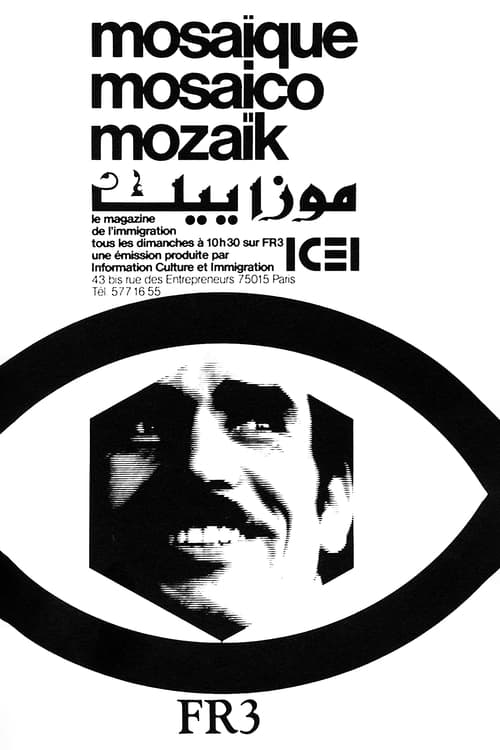
Broadcast from 1977 to 1987 on FR3, every Sunday morning, for 1h30, Mosaïque is a variety show with a set where music groups from the countries of origin of immigration perform, and which broadcasts reports on these countries and on immigrants who live in France. When it was created, it aimed to promote the cultures of origin of immigrants, but also to make them better known to the rest of the population. However, the program was never financed by public television which considers that it was aimed at a specific audience and was therefore not part of a public service mission. It received financial support from the Ministry of Labor, through its subsidy to the National Office for the Cultural Promotion of Immigrants, ONPCI (later becoming Information Culture and Immigration, ICEI, in 1977, then Agency for the Development of Intercultural Relations , ADRI). , in 1982).
Mosaïque
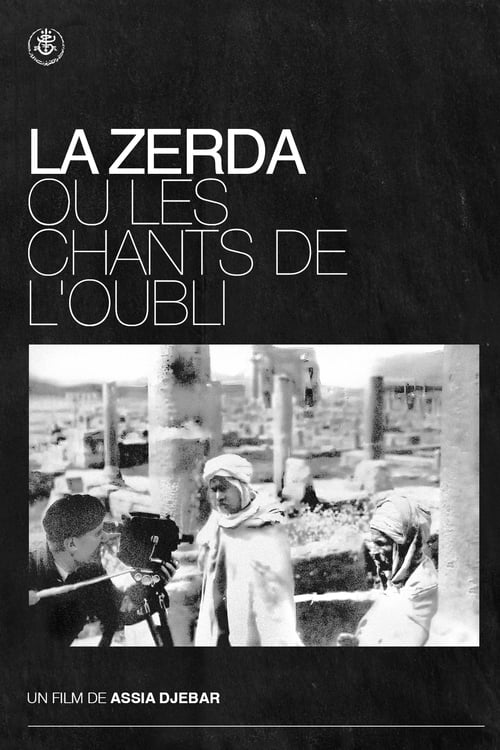
“La Zerda and the songs of oblivion” (1982) is one of only two films made by the Algerian novelist Assia Djebar, with “La Nouba des femmes du mont Chenoua” (1977). Powerful poetic essay based on archives, in which Assia Djebar – in collaboration with the poet Malek Alloula and the composer Ahmed Essyad – deconstructs the French colonial propaganda of the Pathé-Gaumont newsreels from 1912 to 1942, to reveal the signs of revolt among the subjugated North African population. Through the reassembly of these propaganda images, Djebar recovers the history of the Zerda ceremonies, suggesting that the power and mysticism of this tradition were obliterated and erased by the predatory voyeurism of the colonial gaze. This very gaze is thus subverted and a hidden tradition of resistance and struggle is revealed, against any exoticizing and orientalist temptation.
The Zerda or the Songs of Forgetting
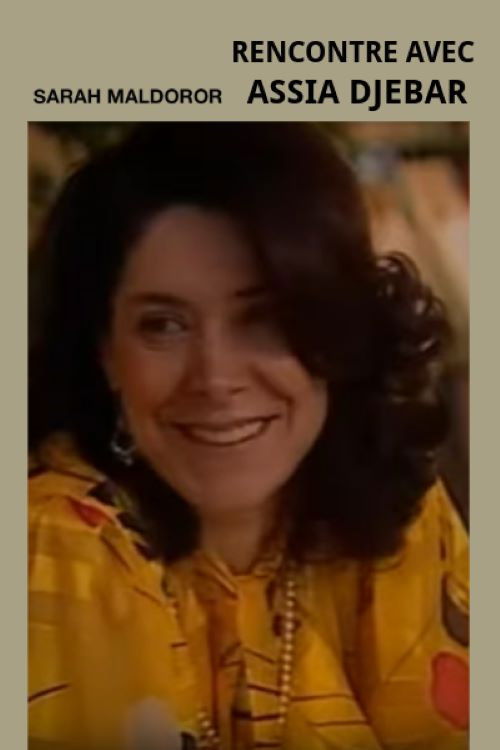
For the France 3 show, Mosaïque, Sarah Maldoror met Assia Djebar on Sunday March 29, 1987 on the occasion of the publication of her book Ombre Sultane. She discusses the status of the traditional woman in the Arab Muslim world: "The woman is always on the move, she is never anchored. To the extent that she is always in the process of repudiation, she is in the process of leaving. With Ombre Sultana, I wanted to make the reader feel that these women from elsewhere are like her, even if the reader is Western.
Rencontre avec Assia Djebar
No description available.