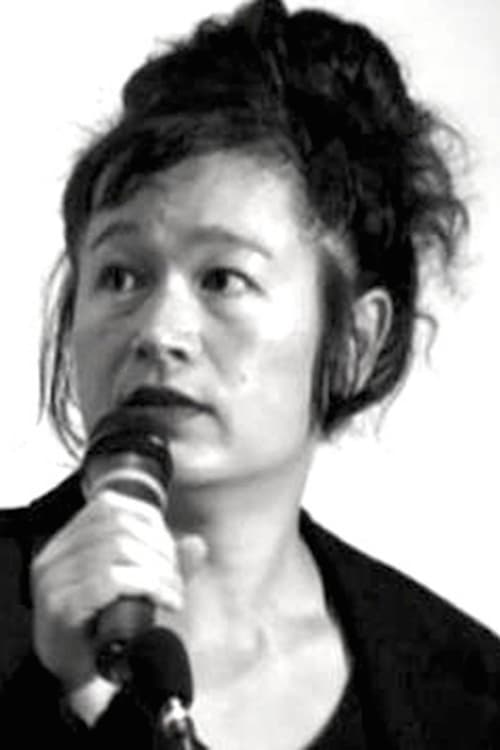
Hito Steyerl
Directing
Biography
Hito Steyerl (born 1966 in Munich) is a German filmmaker, visual artist, writer, and innovator of the essay documentary. Her principal topics of interest are media, technology, and the global circulation of images. Steyerl holds a PhD in Philosophy from the Academy of Fine Arts Vienna. She is currently a professor of New Media Art at the Berlin University of the Arts, where she co-founded the Research Center for Proxy Politics, together with Vera Tollmann, Maximilian Schmoetzer, and Boaz Levin.
Known For
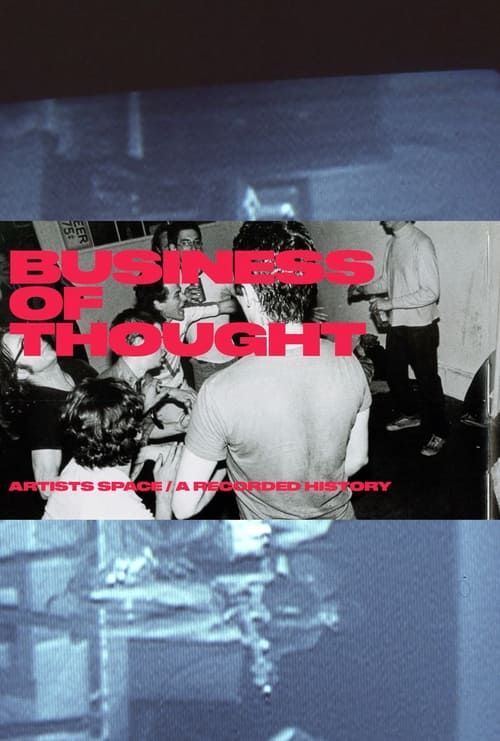
An oral history of Artists Space, the legendary New York artists organization. Told through the voices of the artists, critics and curators who formed it, the film is narrated by voiceover culled from 30 hours of archival cassette tape interviews over a 45 year period. Artists such as Laurie Anderson, Mike Kelley, Hito Steyerl and David Wojnarowicz walk us through the decades. A formally-experimental and raucously-told chronology composed of rare archival documentation, The Business of Thought... is a reminder of the radical potential of the arts and the importance of collective, cultural spaces.
The Business of Thought: A Recorded History of Artists Space
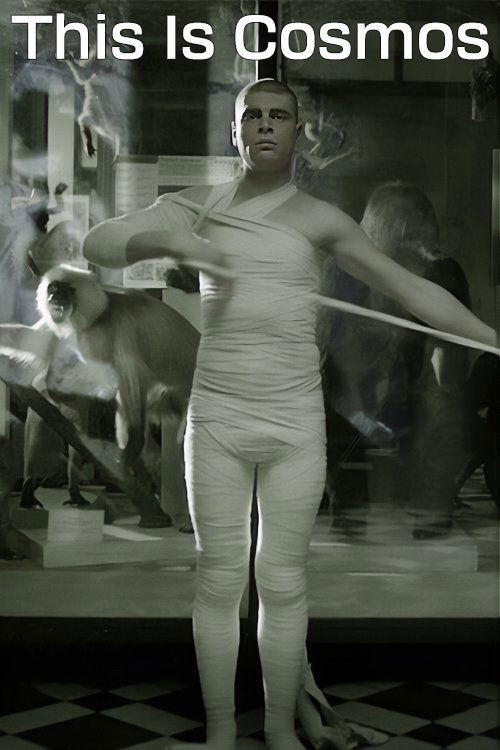
Based on the ideas of Russian philosopher, Nikolai Fedorov, Anton Vidokle’s film was shot in Siberia, Crimea, and Kazakhstan. Fedorov, like others, believed that death was a mistake, “because the energy of cosmos is indestructible, because true religion is a cult of ancestors, because true social equality is immortality for all.” Fedorov was one of the Cosmo-Immortalists, a surge of thinkers that emerged in Russia in the late 19th and early 20th centuries. They linked Western Enlightenment with Russian Orthodoxy and Eastern philosophical traditions, as well as Marxism, to create an idiosyncratically concrete metaphysics. For the Russian cosmists, cosmos did not mean outer space: rather, they wanted to create “cosmos” on earth. “To construct a new reality, free of hunger, disease, violence, death, need, inequality – like communism.”
This Is Cosmos
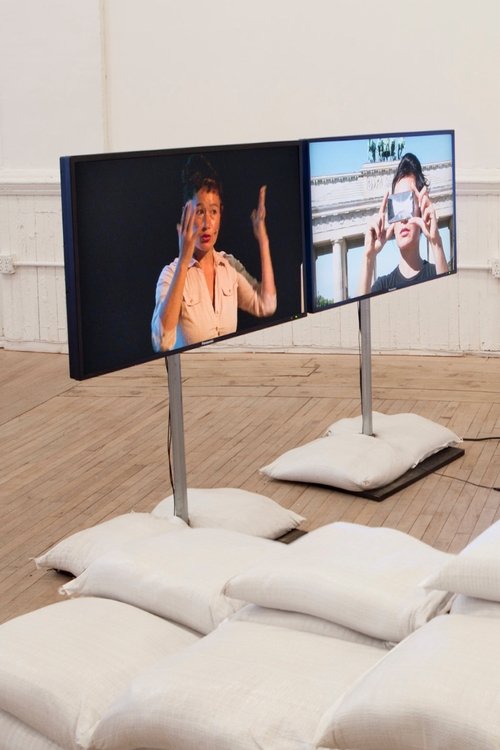
Steyerl’s new lecture, produced for the 13th Istanbul Biennial, takes as its departure point her March 2013 talk ‘I Dreamed a Dream: Politics in the Age of Mass Art Production’ and focuses on the arms industry, a phenomenon constantly re-conceptualized by the media through the regular flow of images. It asks the question of how a museum and a battlefield could be related. The question emerges when Steyerl follows the trace of an empty bullet casing which she found in the area where the mass grave of Andrea Wolf and her friends were located in Van, Turkey.
Is the Museum a Battlefield?
Steyerl’s film traces the impact of an influx of transnational companies on the city dwellers of Berlin in post-reunification Germany. The effect of the changing economy and politics on the city and its inhabitants is echoed through their physical relocation to its outer edges. In 1990, squatters proclaim a socialist republic on the death strip. Eight years later, the new headquarters of Mercedes Benz are built in the same location. The film makes use of slow super-impositions to uncover a journey across changing architectural and cultural boundaries. "The Empty Centre" tries to give a voice and a history to those who continue to be marginalised by the simultaneous dismantling and reconstruction of the borders which they are trying to cross.
The Empty Center
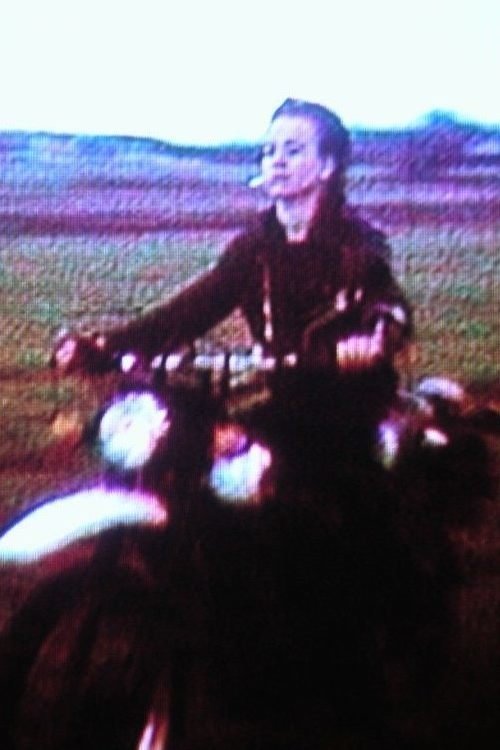
In the eighties, Hito Steyerl shot a feminist martial arts film on Super-8 stock. Her best friend Andrea Wolf played the lead role, that of a woman warrior dressed in leather and mounted on a motorcycle. The engagement expressed in the formal grammar of exploitation films later became Wolf’s political praxis: She went to fight alongside the PKK in the Kurdish regions between Turkey and northern Iraq, where she was killed in 1998. Now honoured by Kurds as an “immortal revolutionary,” her portrait is carried at demonstrations.
November
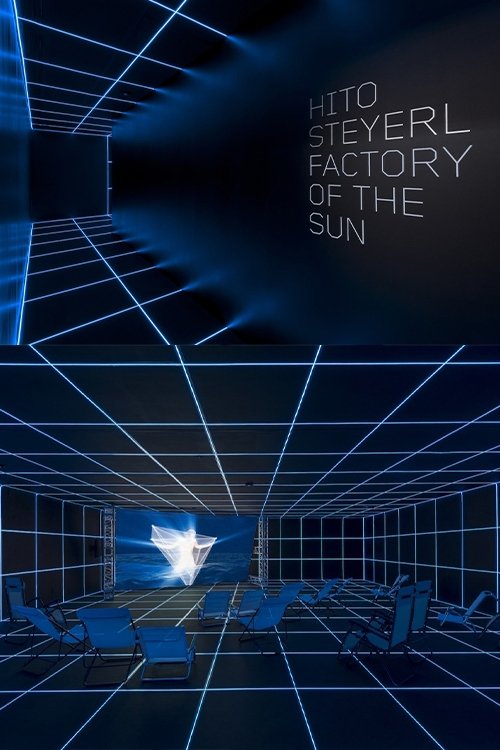
In this immersive work, which debuted at the 2015 German Pavilion at the Venice Biennale, Steyerl probes the pleasures and perils of image circulation in a moment defined by the unprecedented global flow of data. Ricocheting between genres—news reportage, documentary film, video games, and internet dance videos—Factory of the Sun uses the motifs of light and acceleration to explore what possibilities are still available for collective resistance when surveillance has become a mundane part of an increasingly virtual world. Factory of the Sun tells the surreal story of workers whose forced moves in a motion capture studio are turned into artificial sunshine.
Factory of the Sun
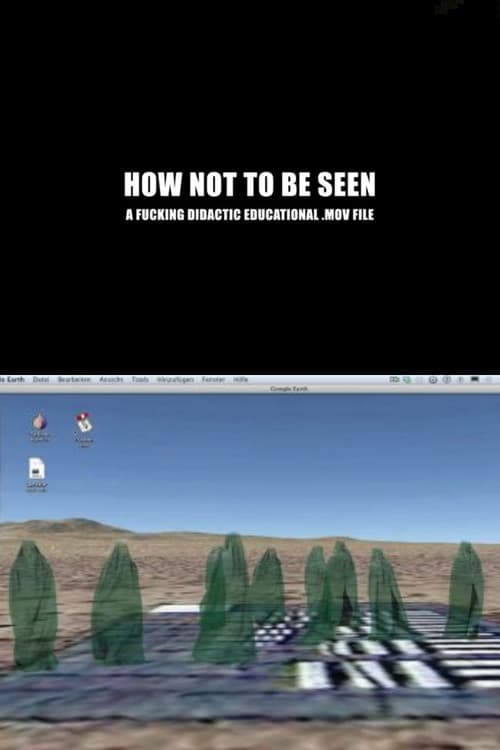
The film mocks an instructional film on the idea of becoming invisible in the digital world.
How Not to Be Seen: A Fucking Didactic Educational .MOV File

No description available.
Mechanical Kurds
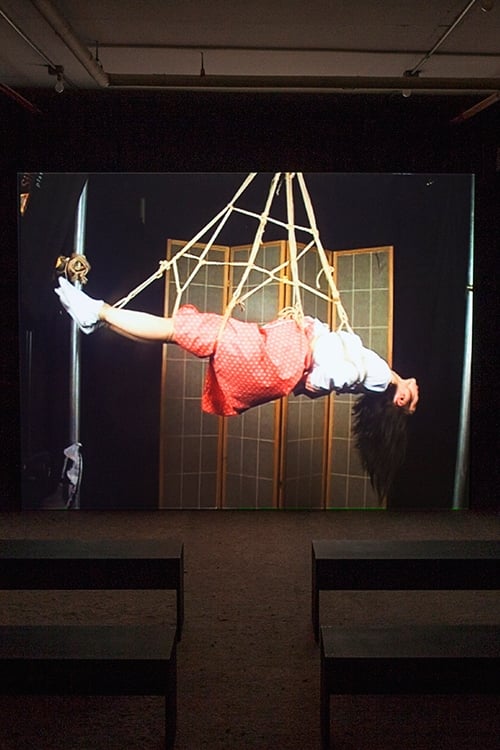
If all pictures became current, in that they pass by and in doing so, are connectable with one another, whether elegantly or obscenely, through translation or associationhow would it be possible to fasten down a picture? Hito Steyerls light-hearted picture translations are about fastening things in an elegant-obscene way: In Tokyo she is looking for a photo series that she posed for in 1987 as a rope bondage model. While making inquiries with experts and authorities in the bondage arts (which are mainly marketed online nowadays), she found what she was looking for in a magazine archive. The cinematic tension is extremely high just now says the translator while Steyerl looks through photos of herself from her days as a film student.
Lovely Andrea
As part of an art installation, Steyerl uses AI technology to create a garden of the future that emulates the Venetian landscape of elevated walkways. Viewers walk among digital flowers that cycle through their lifespan without ever actually existing. Through Steyerl’s self-created technology, she asks whether AI can successfully predict the future, the answer being an explicit ‘no’.
This Is The Future
Steyerl’s immersive installation focuses on the making of the video game "Skyscraper: Stairway to Chaos" by the Ukrainian company Ace3D, based on Saddam Hussein’s unrealised plans to reconstruct the Tower of Babel in Babylon, the ancient capital that he began rebuilding in the 1980s.
The Tower
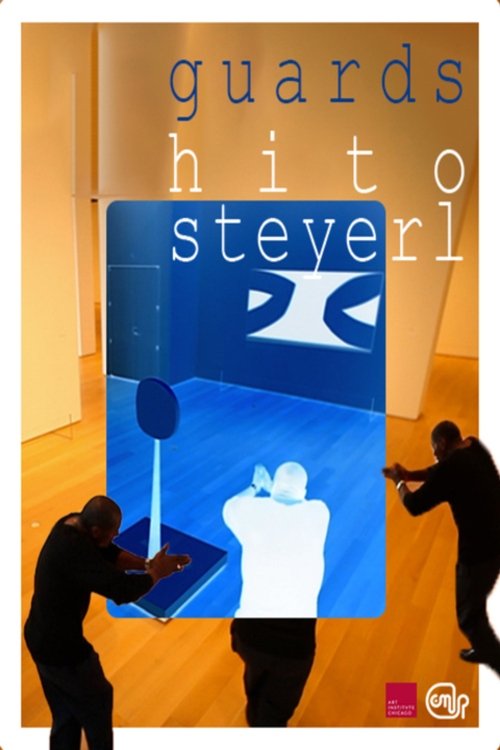
A film about museum guards with a background as law enforcement officers or military personnel.
Guards
The space of the junkyard allows various ‘crash’ narratives to unfold, with the stories of actual crashes and the remnants and afterlife of these machines becoming metaphors for economic decline. This is an investigation of planes as they are parked during the economic downturn, stored and recycled, revealing unexpected connections between economy, violence and spectacle, finding perfect example in the form of the Boeing 4X-JYI, an aircraft first acquired by film director Howard Hughes for TWA, which was subsequently flown by the Israeli Airforce before finding its way to the Californian desert to be blown up for the Hollywood blockbuster Speed. Through intertwined narratives of people, planes and places Steyerl reveals cycles of capitalism incorporating and adapting to the changing status of the commodity, but also points at a horizon beyond this endless repetition.
In Free Fall
The story of the good citizen and postworker Bernhardt Stachoviak, who ends up running amok. Others would say: Out of his immense hatred towards mankind. He would say: Against his own will.
Stachoviak!
Using video, sculpture and archival material, the work gives form to a dramatic event that took place in 1993 during the war in Bosnia, when a paramilitary unit abducted 20 people from a train. Hito Steyerl has made her mark on the international art scene as one of the sharpest observers and innovators in the documentary genre. In her critical perspective on documentary, the only objective truth appears to be the lack of information. On this basis, Steyerl examines the role played by the image production process – of which she is herself a part – and technological tools as witnesses to the truth when we write our common history.
The Kiss
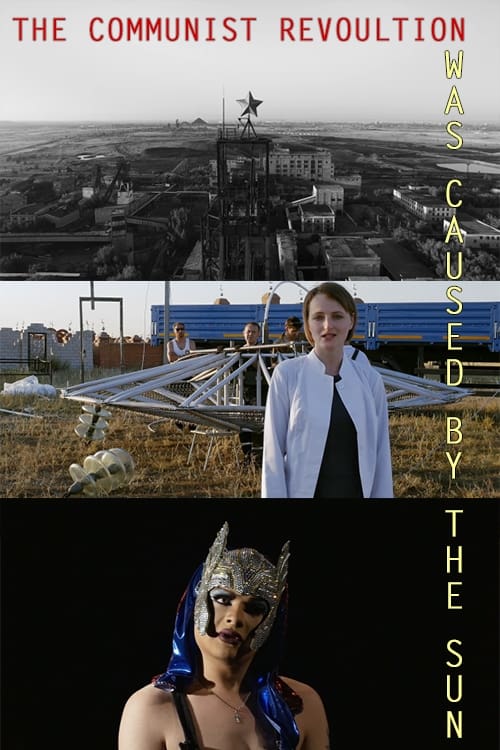
The second installment of Anton Vidokle’s trilogy on Russian cosmism, The Communist Revolution Was Caused By The Sun, looks at the poetic dimension of the solar cosmology of Soviet biophysicist Alexander Chizhevsky. Shot in Kazakhstan, where Chizhevsky was imprisoned and later exiled, the film introduces Сhizhevsky’s research into the impact of solar emissions on human sociology, psychology, politics, and economics in the form of wars, revolutions, epidemics, and other upheavals. It aligns the life of post-Soviet rural residents and the futurological projects of Russian cosmism to emphasize that the goal of the early Soviet breakthroughs aimed at the conquest of outer space was not so much technical acceleration, but the common cause of humankind in their struggle against the limitations of earthly life.
The Communist Revolution Was Caused By The Sun
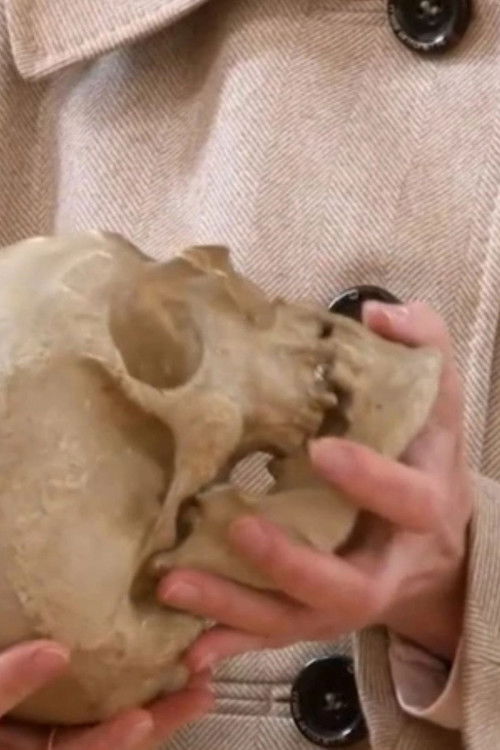
The exhibition „Mengele's Skull“ is structured around a specially commissioned book of the same title co-authored by Thomas Keenan and Eyal Weizman. Artist and filmmaker Hito Steyerl has been commissioned to respond to the proposition laid out in this book. Next to major new works by Hito Steyerl, this exhibition presents documentary and source materials.
Leibnitz' Skull
In Strike II, the artist and her daughter hit the camera with a pair of hammers, attacking image-making apparatus and representation.
Strike II

Abstract (2012) is a return to the contested narrative of Andrea Wolf’s death, with Steyerl traveling to Kurdistan in search of information about her friend's murder. The work links cinematic shooting and military warfare together, implicating Germany’s role in the operation. This has been screened in the past as a dual-channel work. But in this case it has been re-purposed by the artist as a split screen film. (KG) From e-flux: Abstract presents a scenario in which the violence of warfare and the violence of aesthetics twist around each other. The two-channel video visits the site where Steyerl’s friend Andrea Wolf was killed in 1998, but through a prism that refracts cinematic language against the weapons that killed her friend. As the site and circumstances of her death fold into the act of witnessing it from a distance, the ethical burden of identifying those responsible also appears to live and die with the debris that still remains at the site of the helicopter attack.
Abstract

What is declared normal by some and accepted as such by the majority sometimes represents a concrete threat to others. Normality 1-10, a series of short video essays, registers everyday neo-fascist violence as being an instrument of such "normalization." In a matter-of-fact and at the same time insistent manner, Hito Steyerl offers a richly detailed report on the growing number of anti-Semitic and racist attacks - on cemeteries, monuments and human beings - in both Austria and Germany. In a sober visual language, she develops a number of forms and styles of commentary to pose questions concerning the social structures inherent to this variety of violence and their representation. From sixpackfilm.com