Acting
Zora, a girl of French origin, is raised by a wealthy Bedouin family after her mother Valerie dies while eloping with another man. Zora feels such great longing for the French artist Adrien that she accepts the offer of another artist, Raoul, to take her to Paris with the stipulation that if Adrien rejects her, she must give herself to him. Jan, the chieftain's son who is in love with Zora, follows the two to Paris. There Zora realizes that Adrien does not love her and discovers her real love for Jan. However, she feels bound to honor her pact with Raoul and is about to succumb to his advances when her father appears and recognizes Raoul as the man who destroyed his home years earlier. In the ensuing fight between the two men, Raoul is killed, thus freeing Zora to accept Jan's love.
Jim Lassells travels to Africa to obtain proof that his cousin Harold Brooks is dead as rumored, and learns that an Algerian sultan killed the rich American. Since it is assumed that Brooks was childless, Jim inherits his cousin's fortune. At a slave market he buys a young girl named Perdita and sends her to a convent in Corsica to be educated. Years later, Jim meets Perdita again while traveling through Corsica with the impecunious Duchess of Westgate and her daughter, Lady Lilah Grey. When the party stops at an inn, Jim discovers that Perdita is not only a Persian princess, but also the long-lost daughter of Brooks, and therefore the rightful heir to Brooks' fortune.
Jack, a little orphan, is anxious to become a sailor, and although Captain Rhines refuses to take him aboard his ship, manages to sneak in as a stowaway. When out to sea a few days, he is discovered, and is about to be disciplined, when the captain's daughter, May, intercedes. A terrific storm strikes them, and the ship is dashed to pieces. The captain, with the assistance of Jack, builds a little raft, and with little May, they set out for an island which they can hardly discern, as it is so many miles away. After drifting for many hours, they at last reach the island, which is inhabited by a savage tribe.
When Julie De Varion's old father is imprisoned for harboring fugitive Huguenots, she goes to the authorities and begs for his freedom, declaring that he only did it out of kindness of heart. They refuse to release her father unless she locates the Catholic's greatest enemy, Ernanton De Launay, who lives in the depths of the forests and who has been vainly sought after for years.
Garment manufacturer Sergius cuts his workers' wages, prompting a protest led by two Russian sisters, Olga and Vera. Sergius's affluent daughters, Hattie and Helen, decide to support the workers' cause, moving into the sisters' tenement and joining the workforce, much to their father's dismay. In a dramatic turn, the daughters bring their work to the factory and confront Sergius. They make a final appeal to him in his office, where he eventually relents and agrees to meet the workers' demands. Following this victory, Hattie and Helen decide to return home to their father, and the good news is shared with all the factory girls, ending the story on a note of general rejoicing.
Ellen Carson volunteers to serve with Florence Nightingale in the Crimean war and witnesses the charge of the Light Brigade.
After her father dies, Chloe, played by Edith Storey, is left alone in the world. She is discovered and taken home to their cave by brothers Dagban and Eric, who vie for her affection in an allegory about “brain vs. brawn.” When “Dagban threatens to do her bodily harm unless she accedes to his intentions” Eric beats up his brother to protect Chloe, and then subsequently leaves the cave he calls home to avoid further conflict. By this point, he has won Chloe’s affection with his kindness and love, and she decides to follow him and “together they continue their journey, seeking happiness in the land beyond the horizon, which joins earth with heaven.”
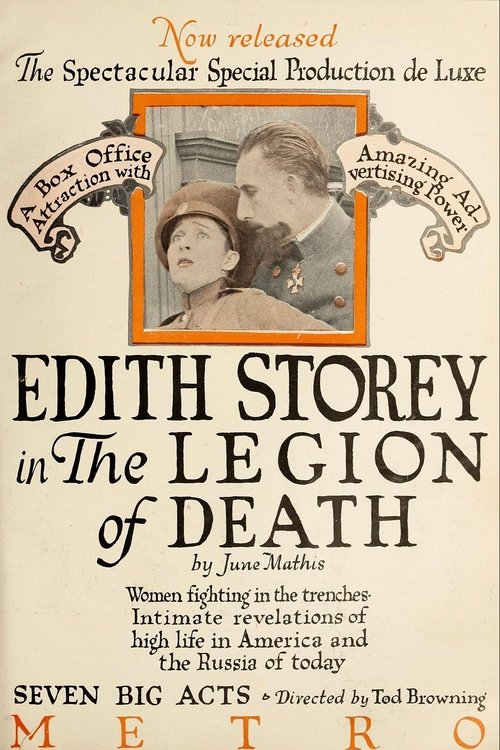
Princess Marya and her brother, the Grand Duke Paul of Russia, are studying in the U.S. when word reaches them that Rasputin is to be killed. Paul is seized by Russian secret service men, but through Marya's appeal to Captain Rodney Willard, he is released. In Russia, Marya participates actively in the Revolution, while Willard, with whom she has fallen in love, joins the Allied Commission. Deeply troubled by the influence of German agents in Russia, Marya organizes the Legion of Death, a fighting unit of peasant women, and leads them into battle against the Germans. The legion suffers defeat and Marya is captured, but in the end, she wins her freedom.
Captain George Curtis is sent from Washington, D.C. to improve conditions on an Indian reservation. After ousting a prejudiced government agent, George earns both the allegiance of the Indians and the hostility of neighboring cattlemen, who hope to appropriate the reservation through political corruption.
Noble born but dissolute M. Jean de Segni receives word from his lawyers that his profligate ways, including keeping mercenary actress Dorothea Jardeau, have led to his ruin which he accepts with a shrug of the shoulders. As word spreads Jean’s father-the Duke, who has managed to keep the boy’s mother in the dark about her son’s true nature, realizes she will soon know. Terminally ill and fearing Jean reducing them to penury, the father decides to take his beloved wife with him and kills her. Jean is at first suspected but the Duke saves him by confessing his guilt. Nevertheless, everyone, including his Dorothea, believes the Duke lied to save his son, and after his father's death Jean finds himself a social outcast. An argument leads to a duel where Jean realizes his folly has killed his parents, and he fires in the air, receiving a mortal wound from his adversary.
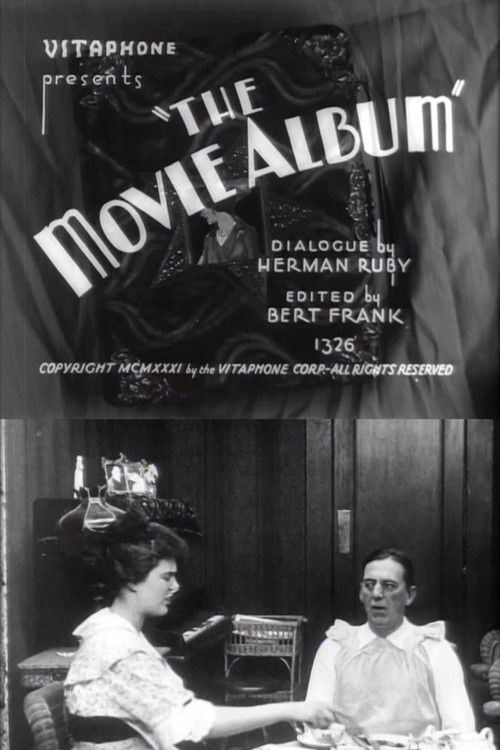
This short features clips from silent films (mostly unidentified) of the 1910's, accompanied by humorous commentary. Highlighted are early appearances of stars still recognized today (e.g., Lionel Barrymore, Norma Shearer), as well as stars whose careers did not extend to the sound era (e.g., John Bunny, Edith Storey).
Maury Brady, a product of New York's East Side, has learned the craft of safe-cracking and shoplifting from her uncle, "Nunc." While "working" a department store, she captures a lost poodle belonging to Mrs. Hardage, wife of a millionaire. When Maury later is caught lifting some lace, Mrs. Hardage vouches for her, takes her into her home, and puts her to work on a crusade against profiteers.
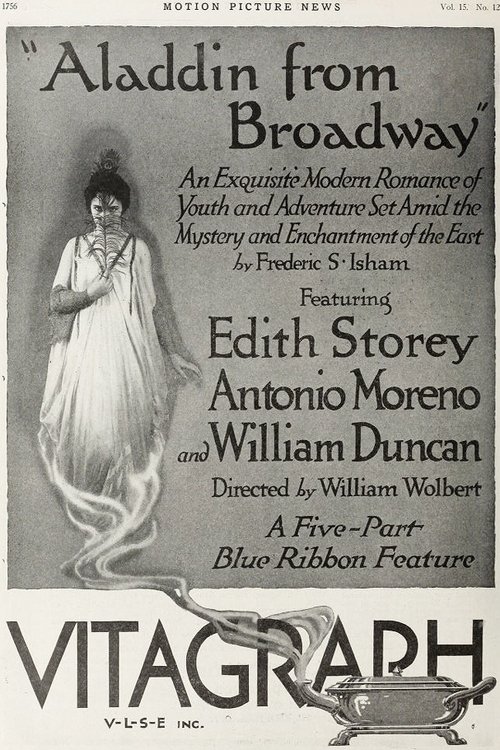
Aladdin from Broadway is a 1917 American silent adventure film directed by William Wolbert.
In the Latin Quarter is a 1915 silent short film directed by Lionel Belmore and starring Edith Storey and Antonio Moreno. It was produced and distributed by the Vitagraph Company of America.
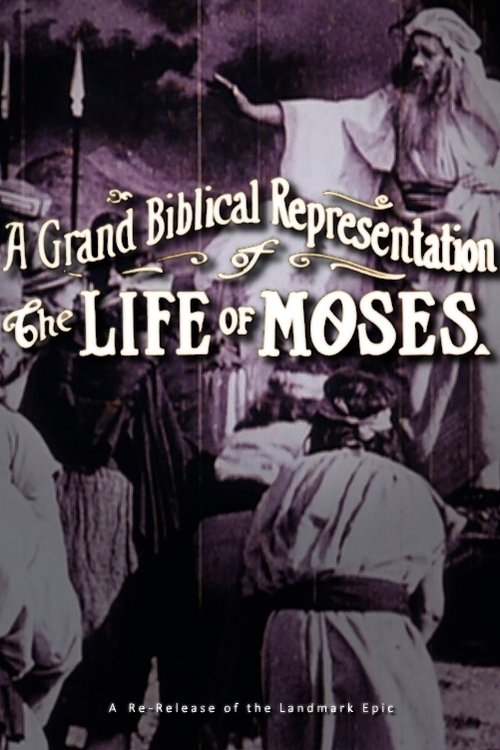
Released in five parts (The Persecution of the Children of Israel by the Egyptians, Forty Years in the Land of Midian, The Plagues of Egypt and the Deliverance of the Hebrews, The Victory of Israel, The Promised Land), 4 December 1909 to 19 February 1910. A Vitagraph advertisement in the Moving Picture World (31 Dec. 1909) refers to The Life of Moses as a "Biblical Film-de-Luxe". It is preserved in the Library of Congress collection.
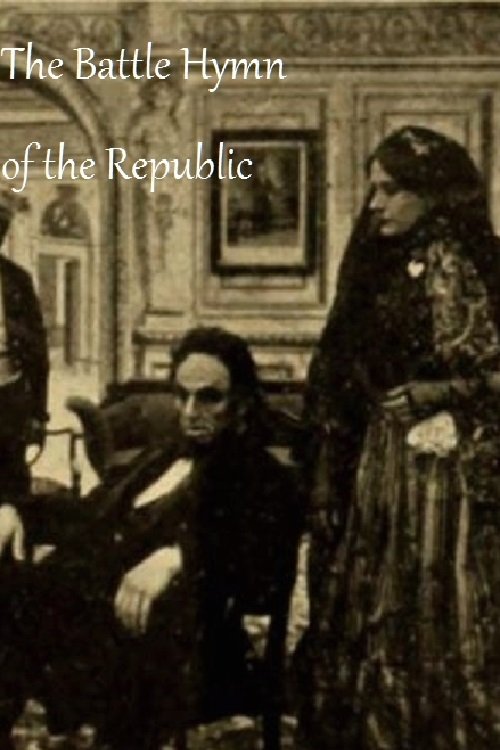
This patriotic and historic picture portrays the writing of the famous national hymn by Mrs. Julia Ward Howe. In the early part of the Civil War President Lincoln was very much discouraged at the lack of enthusiasm and the tardiness with which the people answered the call for volunteers to join the army.
No description available.
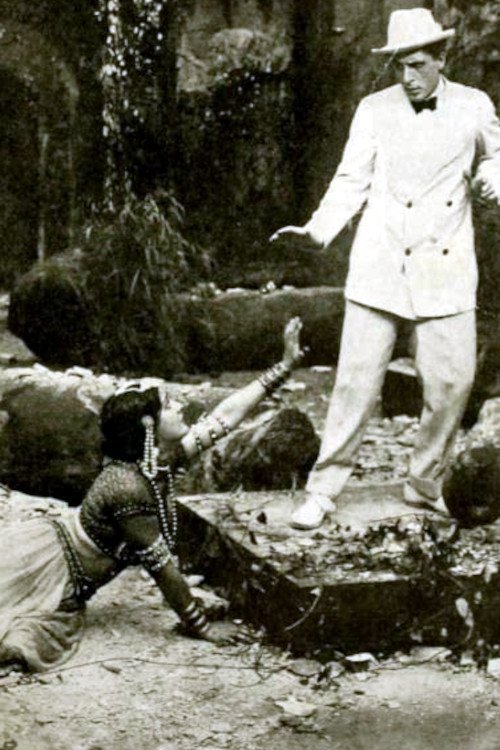
In India, Leslie Adams dreams of a priestess who is turned into a snake by Karma, the high priest. While touring a ruined temple, he finds the snake, who is said to resume human form every 100 years. Assuming her human form, Qunitreea give Leslie's fiancée an amulet, causing her to fall into a permanent sleep. Leslie realizes he is the high priest Karma reincarnated, and that Qunitreea has had her revenge.
A story of ancient Rome. The scene of this story is laid in Rome in the days of Nero. Rome has recently suffered conflagrations and other disasters, and Nero, hoping to divert the public wrath from his own misconduct, has encouraged the persecution of the growing sect of Christians. Valerius, the hero of the story, is a young Roman officer of a better nature than the people with whom he is thrown in contact. Leah, the heroine, is a beautiful young woman, and one of the leading spirits of a band of Christians.
Nell, an independent and somewhat obstinate girl, receives an invitation to attend a dance. She asks her mother for money to buy a new dress. Her mother, a hard working woman, who has to toil from morn to night, feels that her request involves an unnecessary extravagance and she denies it. Nell answers her sharply and leaves in a sullen mood. While working in the hot, broiling sun, the mother is overcome with the heat.