Yervant Gianikian
Directing
Biography
Yervant Gianikian is an Italian director and artist renowned for his experimental and independent films. He studied architecture in Venice before dedicating himself to cinema in the mid-1970s, collaborating with Angela Ricci Lucchi. Together, they produced influential works such as From the Pole to the Equator (1987), Oh! Man (2004), and Babaric Land (2013). Their films have been showcased at prestigious international festivals and museums, reflecting a deep engagement with history and memory.
Known For

Raphael, Yervant Gianikian's father, survived the Armenian genocide in 1915 in Eastern Turkey. In April 1988, while living in Venice, he sat for his son's camera and read an excerpt from his memoirs, translated from Armenian into Italian.
Return to Khodorciur—Armenian Diary
This is a “sublimation“ film of notes, watercolours, travel diaries. In 1989-90, we filmed the last survivors of the Russian avant-garde movements of the 1920s and ’30s in Leningrad-Saint Petersburg, the city of Osip Emil’evic Mandel’štam – the author of the poem Journey to Armenia. The film is a fragment of a vast fresco recorded during the fall of the Soviet Union, with the portraits of the last witnesses of a great history that no-one had registered and who are now dead.
Notes sur nos voyages en Russie 1989-1990

This new instalment of Angela's Diaries concludes the trilogy dedicated to the late Angela Ricci Lucchi, with whom Yervant Gianikian made all his films, which recount man's violence against nature, animals and humanity itself. Lucrezia Lerro sensitively reads Angela's diary about her illness, giving voice to her intimate writing and to the dense poetics of the painful passages that seem to be paced at the rate of her heartbeats, word after word, as she desperately tries to overcome her illness. Themes include the war, Angela's political work and the promise made to her to continue working.
Angela's Diaries. Two Filmmakers. Chapter Three

Every day of her life, Angela kept a diary, filled with words and drawings, in which she recorded public and private matters, meetings, things she had read, everything. Including the account of two trips to Russia (1989-90). The period of the collapse of the USSR. A diary that she had been keeping in small Chinese notebooks, since before Dal Polo all’Equatore (1986), on our uninterrupted work on the violence of the 20th century. From our tours in the United States with the “scented films” of the late seventies to the Anthology Film Archive of New York and the Berkeley Pacific Film Archive...
Angela's Diaries. Two Filmmakers.
In 1926 the remains of two ships built by the Emperor Caligula were found at the bottom of Lake Nemi, near Rome. Mussolini had the lake drained and established a museum as a celebration of the imperial origins of Fascism, but the museum and ships were destroyed by fleeing Nazis in 1944. The film commemorates these events. - MoMA
Lo specchio di Diana

The title Dal polo all'equatore was first used by the pioneering documentary maker, Luca Comerio, for a compilation film of 1925; it was used again by Yervant Gianikian and Angela Ricci Lucchi for their film of 1985. Much of the original has been re-worked: the 'found footage' has been re-shot, slowed down, tinted, and re-edited with a sound track of minimalist composition. As a result, the exotica of colonial travel and sport take on new and sinister meanings. The acts of violence, especially those of hunting, recur in patterns that suggest visually that war is a logical development. A close examination of the work, starting with the opening sequence of a railway journey, explores the centrality of questions of memory and history to this remarkable and influential film.
From the Pole to the Equator

I felt an urgent need to continue with I diari di Angela - Noi due cineasti. Capitolo secondo, for me a world of symbols and colors. Our long journey together could only be given new meaning again. I set out, with considerable reserve, to make the second part of the film that in 2018 had had a favorable reception all over the world. I thought for a long time about how to make use again of her words, her drawings and her silences. Angela and I filmed and wrote two parallel diaries. The images I shot around Europe, America and elsewhere fit perfectly with her writings.
Angela's Diaries. Two Filmmakers. Chapter Two

In this short film, screened and commissioned by the Centre Pompidou in Paris, Gianikian and Ricci Lucchi revisit regions at war or in crisis through archive images of the 20th century.
Où en êtes-vous, Yervant Gianikian et Angela Ricci Lucchi?

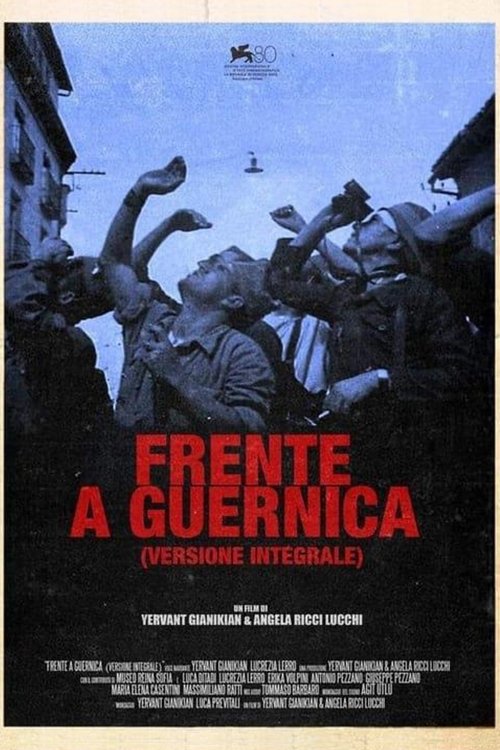
Painted by Picasso in 1937, Guernica is a universal icon against the war. In 2014, the artists Yervant Gianikian and Angela Ricci Lucchi conceived a new film that tells the history of 20th century upon the painting. In 2023, years after Angela’s passing, Yervant accomplishes this task.
Frente a Guernica

Russia, its culture and conflicts, the 1920s and 1930s, the avant-garde movements persecuted by the authorities. Gianikian and Ricci Lucchi open the precious workshop of their creation to us: old films, photographs from the Tsarist era, the Russian Revolution, and the years that followed, Angela Ricci Lucchi's watercolors, comments, texts (Chekhov, Anna Akhmatova, Nina Berberova, Tolstoy, Shklovsky, Pushkin, Mandelstam), fairy tales for children. And then the figures encountered during their travels in Russia, “living archives” to whom the two filmmakers want to restore presence and voice. In this way, we discover the materials that feed their new film, in preparation, "Journey in Russia" (2017), making this, as the suffix of the title indicates, "A propos de," "About," a sort of catalog. Gradually, however, these notes acquire an autonomous dimension that encompasses a poetic universe: the intimate sphere of the artists.
À propos de nos Voyages en Russie

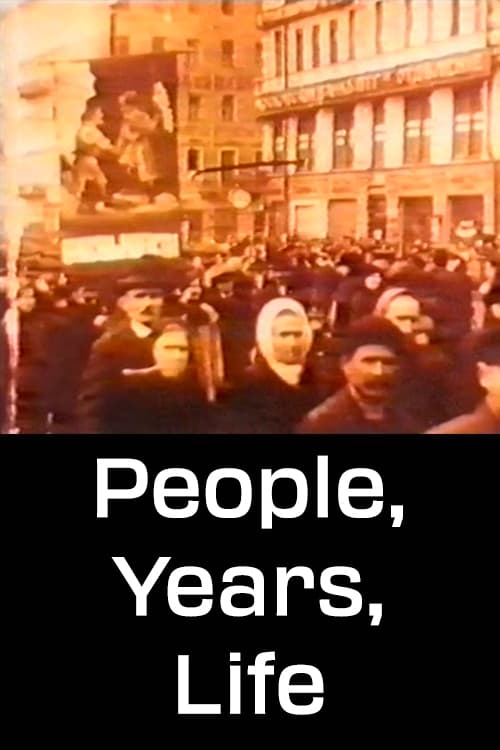
Using images shot in Russia and Armenia from World War I to the 1930s and retrieved from a Soviet film archive, Gianikian and Ricci Lucchi constructed a meditative film about the status of Armenians as a people without a state. Inspired by the diary of Gianikian’s father, People, Years, Life uses rare footage depicting the region’s major historic events: the end of Tsarist Russia, violence in the Caucasus during World War I, the 1918 Armenian exodus from Azerbaijan. Gianikian and Ricci Lucchi’s treatment of the material manipulates the speed of the images, adds color and music, and magnifies various parts of the image, so that the movement of bodies across the frame begins to carry the weight of exile, mourning, dispossession.
People, Years, Life

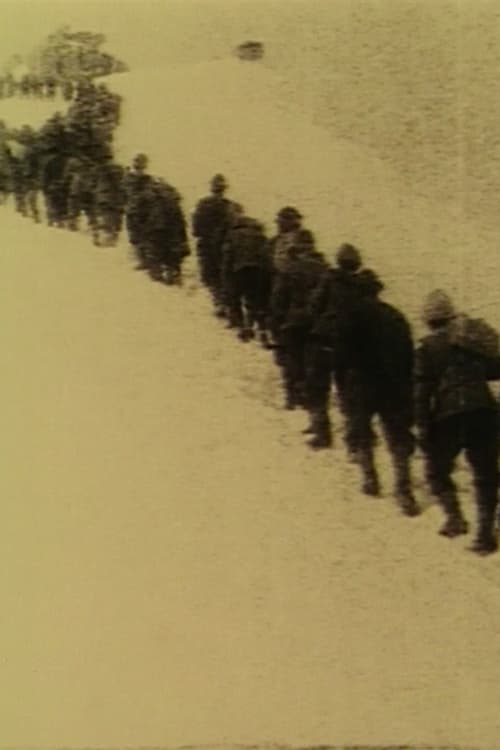
This haunting film comprises of footage shot during WWI from opposite sides of the conflict: Czarist Russia and the Austro-Hungarian empire. The filmmakers tinted the material with sensual colors from sepia to red, blue, and purple and slowed the footage to analyze the material. The total absence of commentary renders the material eloquent and disturbing. - MoMA
Prisoners of War

African Diary uses footage from a filmed personal diary shot in Algeria by an anonymous Frenchman between 1927-1936. Here, they reprise his cinematic jottings as he followed in the footsteps of the 19th century Orientalists like Flaubert.
African Diary
The couple of filmmakers traveled to Armenia in 1988 to film the upheaval of the USSR in the country. During their trip, an earthquake struck, a fatal echo of the political earthquake.
Terremoto
A silent, elegiac poem describing the pain and violence of war, made from footage shot at Sarajevo in 1995, Belgrade in 1996, and Zagreb in the 1980s, and incorporating archival footage from WWI. - MoMA
Nocturne
Inspired by their beloved Dolomite area in Northeast Italy, a battle theater in World Wars I and II, Gianikian and Ricci Lucchi continue to explore issues of war and peace in their most recent production. The film uses shots of ordinary toys found in the area, many missing limbs and other pieces, to represent, in both direct and oblique ways, the historical period between Fascism, Nazism, and the postwar era.
Ghiro ghiro tondo
No description available.
La lotta eterna
1978, Afghanistan before the wars. Kuchis (Roma people) move toward Bamian. The caravan is a living creature.
Electric Fragments No. 7 - Gypsies Toward Bamyan
No description available.
Viaggio di la rose

Comprised of images shot by amateur photographers and German soldiers in the Balkans from the twenties through the forties, BALKAN INVENTORY was begun by Gianikian and Ricci Lucchi in response to the tragedy unfolding in the former Yugoslavia.