Theodor Luts
Camera
Biography
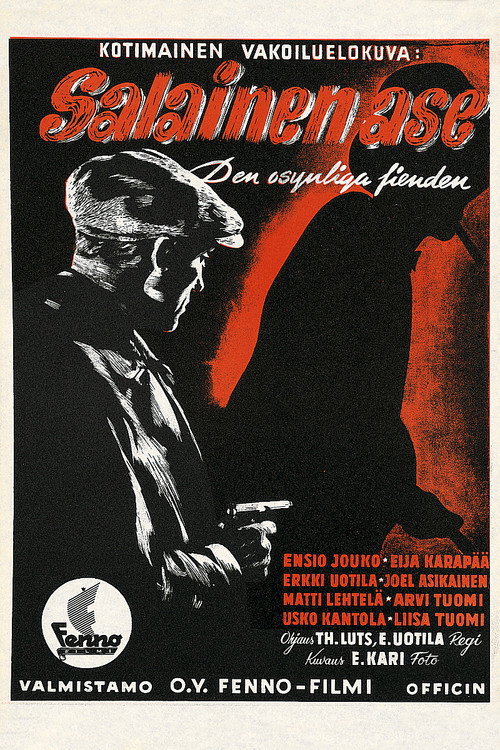
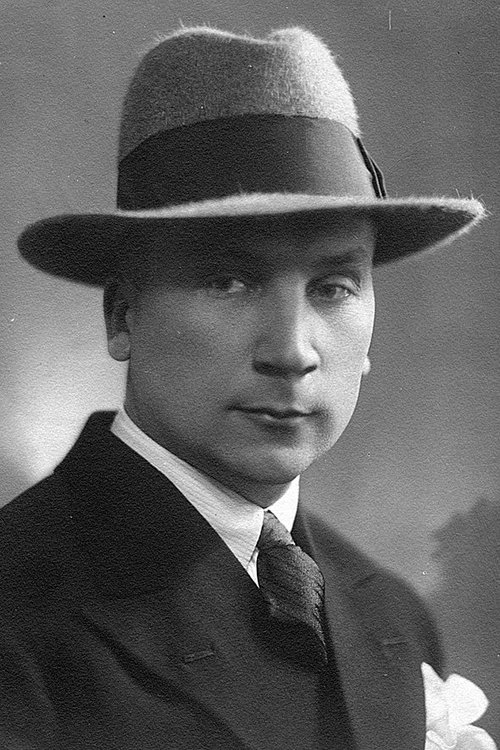
Theodor Luts (14 August [O.S. 2 August] 1896 in Palamuse – 24 September 1980 in São Paulo) was an Estonian film director and cinematographer, brother of classic writer Oskar Luts. Theodor Luts was the first major figure of Estonian cinematography. His Noored kotkad (Young Eagles) (1927) is generally regarded as the cornerstone of Estonian cinema. Päikese lapsed (Children of the Sun) (1932), directed by Luts, was the first Estonian full length sound film. After the Great Depression hit Estonia in the 1930s Theodor Luts produced mostly documentaries for a state subsidized film studio Eesti Kultuurfilm and also had a successful career in Finland. Twenty-four films by Theodor Luts made in Estonia have survived and are held at the Estonian Film Archives. Feature films directed by Luts in Finland include Salainen ase (1943) and Varjoja Kannaksella (1943). After World War II and the Soviet occupation of Estonia, Luts emigrated to Brazil with is wife, actress and filmmaker Aksella Luts, where he directed Caraça, Porta do Céu in 1950
Known For

Old Virtanen is a respected night watchman at a textile factory and a single father to his daughter Aino, who is about to graduate from high school. The heartless factory owner Kuusela fires Virtanen, who is forced to look for a new job. When Aino, who is in love with the manager's son Veikko, disappears after her graduation party, her father, who has fallen ill with worry, is overcome with despair.
Yövartija vain…

A new steward, agronomist Paul, arrives at the Siltala estate. The self-assured steward causes tension among the gentry, especially among the estate's owner, Captain Lilli's widow. The flamboyant Lieutenant Hugo courts the owner of Siltala, but Lilli and Paul find common ground.
Siltalan pehtoori

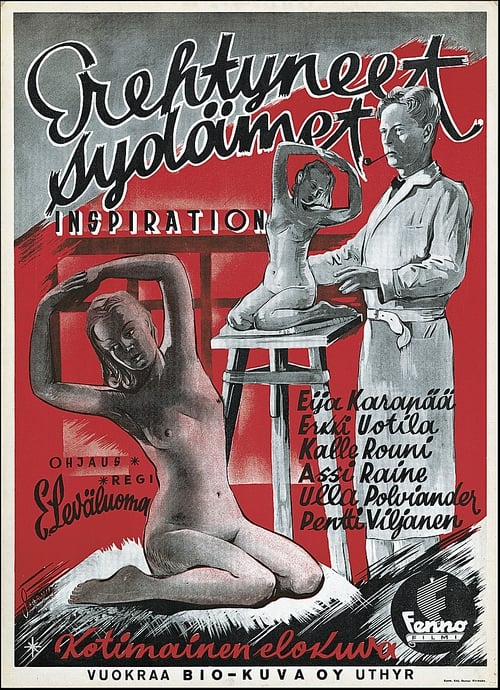
After being harassed at the office by her boss, Eila gets sacked and tries to find a new job. After difficulties, she eventually begins to work as a model to a sculptor.
Erehtyneet sydämet

Young married couple, Martti and Ulla, are spending a carefree weekend at their Rauhanlehto villa. Their peace is disrupted when the in-laws and Ulla's sister Alli, come to visit.
Voi meitä! Anoppi tulee

Set in North Karelia, whne Antti Ihalainen's house runs out of matches, he goes to borrow some from a neighbor. On the road, he meets a rich widower, Jussi Vatanen, who asks Ihalai to be his speaker and friend on an engagement trip to the city of Jo. The hosts from Lieper are snorting drunkenly from behind their shoulders.
Tulitikkuja lainaamassa

Esko makes a bet that he will marry the first young woman he encounters. This turns out to be Kirsti, who promptly turns down the proposals. But when she finds about the bet, she agrees to marry him in order to get her revenge.
Vaimoke

In this comedy set in an urban environment, a bachelor household unaccustomed to housework seeks a maid. Unbeknownst to each other, engineer Arvi hires Helvi, a music student, and Martti, a master's degree holder, hires Aili, also a master's degree holder. When journalist Salomon hires Manta as a maid, chaos ensues.
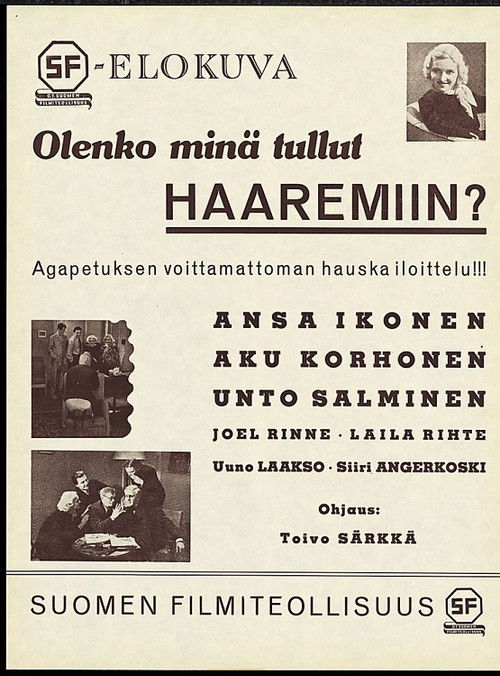
Olenko minä tullut haaremiin

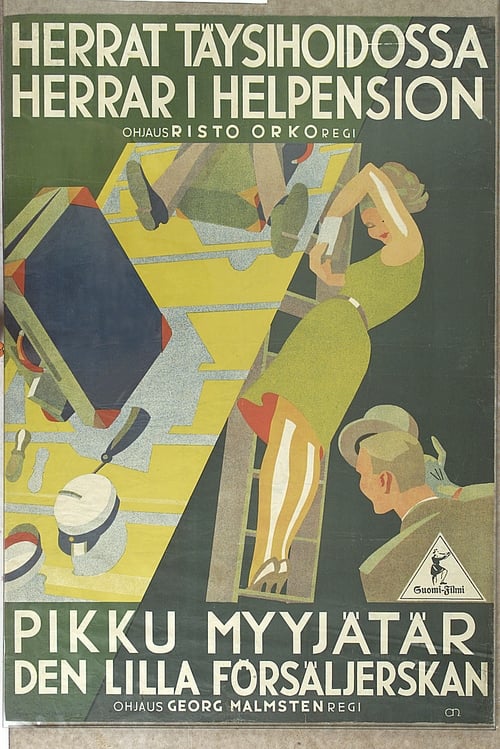
Poor high school students Toivo Päiviö and Unto Uramo solve their housing problems by enrolling in Sofia Andersson's boarding school. Toivo falls in love with Mrs. Andersson's deceased husband's niece, Aune, and begins to compete for her attention with opera singer Reino "Toreadoor" Kiljunen.
Herrat täysihoidossa

February Manifesto was Yrjö Norta's and Toivo Särkkä's Finnish movie from 1939. It is a Finnish historical drama about developing independency based on book of the writer Mika Waltari. Movie Starring Tauno Palo and Regina Linnanheimo. For it's anti-soviet thematics it was banned in Finland from 1944 to 1987.
Helmikuun manifesti

Senator Fredrik, who advocates a policy of appeasement, expels his nephew Robert, an activist and lover of Justiina, from his home. Decades later, the lovers meet again when Robert returns to claim his inheritance.
Eteenpäin – elämään

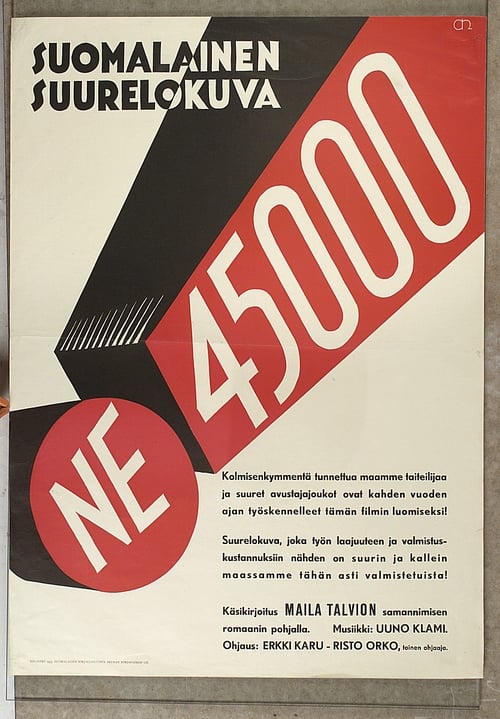
Medical student Antti Ahonen, who is fighting tuberculosis, finds himself in the middle of a love triangle with his friend Heikki Huhtamäki and his crush Helmi Hirvinen.
Ne 45000

The romantic musical comedy Kaikki rakastavat is a key work in Finnish film history since it was the first feature film of Valentin Vaala as the house director of Suomi-Filmi and the film which launched the most beloved screen couple of Finland, Tauno Palo and Ansa Ikonen.
Kaikki rakastavat

In 1930s Ostrobothnia, the Ylitalo siblings enjoy a summer filled with love. Eliina, who is disabled but full of joie de vivre, falls for university student Yrjö, while the divine Johanna's heart beats for her childhood friend Akseli.
As Dream and Shadow…

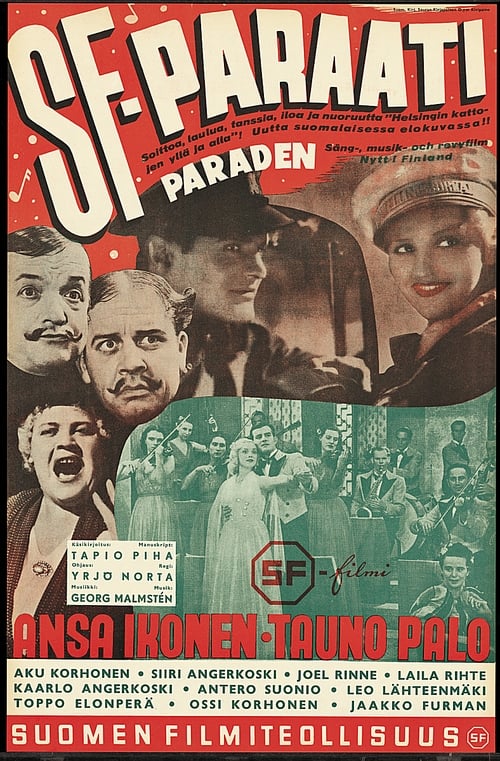
A love story between a taxi driver and a travel guide in the form of a musical.
SF-paraati

Arno is a painter having an idyllic summer romance with dancer Helja on the picturesque coast of North Estonia when an unexpected visitor appears – a well-off young woman Margot. She tempts Arno to join her to have a good time at a resort town. Helja stays where she is and starts missing Arno. Northern summer is short – but long enough in order to realize one's feelings.
The Children of the Sun

Waste paper collector Mikko dreams of being a wealthy mining engineer who succeeds in all his business ventures. He is also lucky in love when Clas, a factory owner, charming daughter Aune takes a liking to the charming mining engineer.
Jos oisi valtaa…

Tornionjokilaakso at the end of the 19th century, Paloniemi's landlord Heikki tries to get out of his financial difficulties with the help of his son Juhan and Nuottaniemi's only daughter Hanna. The happiness of Hanna, who has fallen in love with Antti of Rehti Koskenalusta, is threatened by the evil and dangerous Korpikoski.
Koskenlaskijan morsian

Irmeli wants a certain job as a secretary but finds out that she would have to be married in order to get the vacancy. She lies that she has recently married and then gets a stranger from a nearby restaurant to pose as her husband. Complications arise when they have to continue their charade.
Mieheke

Aarne, the son of Laamanni Horn, who is studying law, falls in love with his father's office assistant Helena, but due to his parents' prejudices, he wants to keep his cross-class relationship a secret. Aarne finds himself presiding over his first court case in conflicting circumstances, as he is assigned to judge Helena.
Jumalan tuomio

Tanja Bulkova arrives in Finland under the name Toini Salonen and, with the help of spy chief Rosenberg, becomes the secretary of engineer Rautavuori and discovers the drawings of a secret invention.